

SEPTEMBER 2011
Click title to jump to review
BARRIE: BACK TO BACK by J.M. Barrie | Pacific Resident Theatre
THE ELABORATE ENTRANCE OF CHAD DIETY by Kristoffer Diaz | Geffen Playhouse
END DAYS by Debra Zoe Laufer | Odyssey Theatre Ensemble
MILK LIKE SUGAR by Kirsten Greenidge | La Jolla Playhouse
THE TEMPEST by William Shakespeare | The Old Globe
WALTER CRONKITE IS DEAD by Joe Calarco | San Diego Repertory
Barrie's world
J.M. Barrie turned a fondness for children into a celebration of childhood, which he treated as a state of mind that remains not only useful but invaluable in later life. While his landmark Peter Pan celebrated being young, many of his novels and plays were for adults, with central characters who survive – even help others – by maintaining a childlike openness, imagination and sense of wonder. Two of these rarely produced one-acts are receiving wonderfully entertaining stagings at the Pacific Resident Theatre.
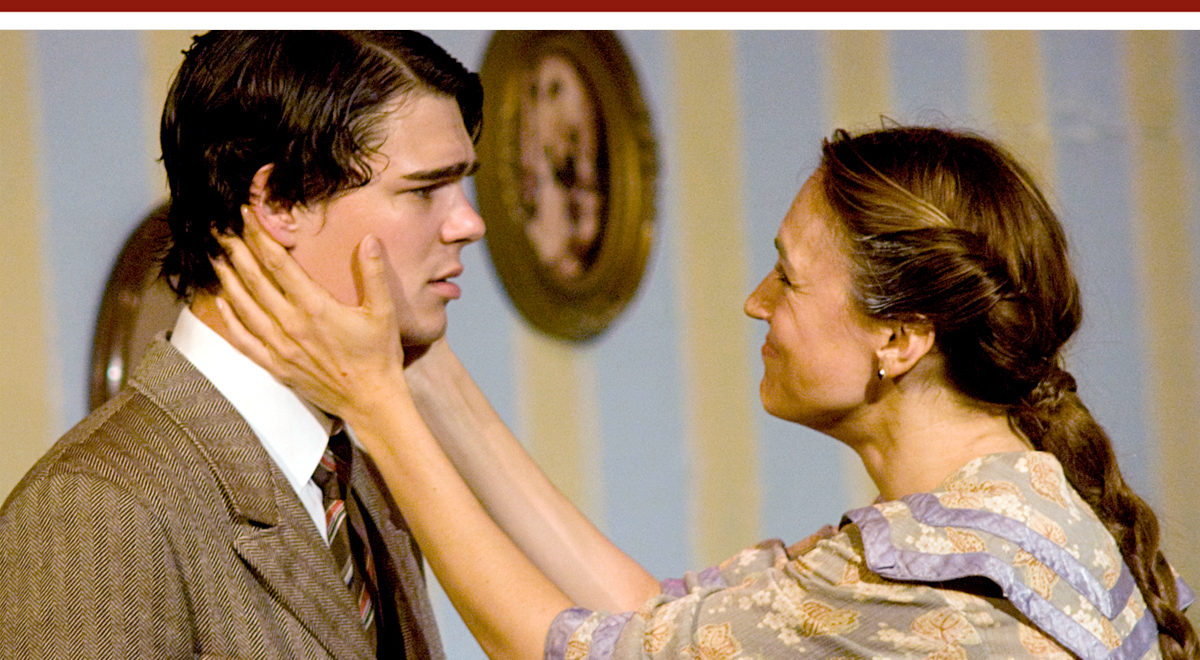
In Rosalind (1914), directed by Dana Dewes, Mrs. Page (a revelatory Lesley Fera) is in her room, chatting with her landlady as a storm rages. Mrs. Quickly (Ann Bronston) notes how young and beautiful Page's famous daughter Beatrice, a stage actress, looks in a framed photograph. Page quickly waves off any suggestion of envy: "I am middle-aged, so why should I complain of it?" A young stranger, Charles (Kevin Railsback), arrives seeking temporary refuge from the storm and once inside is overcome by the sight of Beatrice. He then presents his own wallet-sized photo of her, and explains that after idolizing her from afar they became acquainted and he is now truly in love. He is delighted to meet her mother, though Rosalind had never mentioned her.
As we noted in our review of A Noise Within’s Dear Brutus, "Barrie seems to have had little interest in justifying his set up." So interested is he in getting to the fascinating world of illusion that he assembles the shortest chain of events, even if the links stretch incredulity, to bring people together and allow the discoveries to begin.
Mrs. Page playfully mocks Charles' feelings for her daughter. In doing so, Barrie questions infatuation in general. The two discuss true love and make-believe before Mrs. Page takes the measure of Charles' heart by means of a secret she does not reveal until later, and which we will not reveal at all. However, we discover along with Charles that Page’s healthy attitude to aging depends on a healthy embrace of theatrical escape. That the ultimate vehicle of this rejuvenating escape is theater is so delightfully rendered, that it commends the seldom-seen Rosalind to annual mountings, when its promise of eternal youth could prove invaluable to subscription drives.
Dewes co-directs the second one-act, The Old Woman Shows Her Medals (1918), with PRT Artistic Director Marilyn Fox. Though there are six characters, this is really another older woman-younger man two-hander. Here, however, the connection is maternal, as Mrs. Dowey (Penny Safranek) and an unrelated Kevin Dowey (Joe McGovern) create a family where none existed. It is a credit to that willingness to pretend, to be open to the new and even odd, that allows the Doweys to forge a bond that will help them weather loneliness during the brutality of World War I.
Fera must appear "40 and a good wee bit more" and then be infused with the energy of someone half that age. It is done effortlessly, and her magic elixir is a sense of playfulness always twinkling in the corner of her eye. It's a trait Barrie surely would have prescribed. Railsback provides solid support as the lovestruck, then bewildered, then lovestruck again Charles. Bronston, who shares her role with Sarah Zinsser, gives Quickly a good turn.
Safranek and McGovern turn the tiny PRT space into a classic stage. These are performances full of warmth, humor, empathy and insight. Safranek rises to the top of L.A.'s finest elder actresses. Her frail frame holds a large heart which can ask so little and offer so much because of a mysterious nobility. It is another quality Barrie would have applauded. McGovern, who can be teasing and admiring of the dotty old Dowey, makes this a warm-hearted comedy with great rewards, in equal parts laughter and heartbreak.
The production has extended several times, and this weekend may be the last chance to see it. However, if people continue to visit Mrs. Page and the Doweys, their world may be the ultimate tribute to Mr. Barrie, and never succumb to age.
top of page
BARRIE:
BACK TO BACK
by J.M. BARRIE
directed by MARILYN FOX
and DANA DEWES
PACIFIC RESIDENT THEATRE
June 25-August 7, 2011
Extended to 10/3 (Reviewed 9/24)
CAST Lesley Fera, William Lithgow, Jennifer Lonsway, Joe McGovern, Roses Prichard, Kevin Railsback, Penny Safranek, Sarah Zinsser
PRODUCTION Nick Santiago, set; Audrey Eisner, costumes; William Wilday, lights; Keith Stevenson, sound; Miguel Flores, stage management
HISTORY Rosalind was first published in 1914 with three other plays in Half Hours. The Old Lady Shows Her Medals came four years later in a collection entitled Echoes of the War
Kevin Railsback and Lesley Fera
Vitor Martins

Smack down economics
There is a big, wounded heart at the center of Kristoffer Diaz’ The Elaborate Entrance of Chad Diety. It belongs to the central character who narrates this 2010 Pulitzer Prize for Drama finalist, now making its West Coast premiere at the Geffen Playhouse (through October 9). He masks it behind lightning-fast language and hip-hop attitude. But the pain of disillusion is unmistakable, providing depth and purpose to a play that could be dismissed as shrill and gimmicky.
Macedonia Guerra (Desmin Borges), a New Yorker of Puerto Rican heritage, first felt the sting of betrayal when he learned his childhood wrestling heroes were frauds. Nevertheless, he pursued a career as wrestling fall guy, taking choreographed dives to make the sport’s headliners look good. Soon, he saw wrestling as the epitome of American trickle-down economics, or, better, "shit-upon" economics. What’s more, the characters in the ring reflect comic-book stereotypes of his fellow first- and second-generation Americans as dangerous bad guys in America’s battle between good and evil.
How Mace remains such a willing participant in the stereotyping lies within the story that he tells to form the arc of The Elaborate Entrance of Chad Deity.
Diaz' trick is to honor the lore and lure of professional wrestling while using the ring, with its reliance on both spectacle and comic-book depictions of good and evil, to reveal an America run not by idealists but by opportunists.
Edward Torres directs, as he did both the 2010 world premiere at the Victory Gardens Theater in Chicago and the New York premiere later that year at Second Stage Theatre. Veterans of those stagings – Usman Ally, Terence Archie and Borges – are here in the lead roles.
It's a sprawling work by one of the most exciting writers to emerge lately. Diaz' skills have been displayed locally in public play readings and properly in last year's triumphant Old Globe premiere of Welcome to Arroyo’s, his more accessible follow-up to Diety. [Reviewed here.]) Here, as there, he provides great entertainment while stabbing beneath the cover of his story at big, unwieldy subjects with sharp writing and keen observation. And, once again, the experience is thrilling and the results theatrically invigorating, if somewhat less clear.
Beneath four large video screens and enough flashing lights from Jesse Klug's plot to open a Spielberg film, set designer Brian Sidney Bembridge's wrestling ring nearly fills the Geffen stage. To its left is the desk of Everett K. Olson (Steve Valentine), president of THE Wrestling, a league of professional wrestlers that follows the "sport's" tradition of mixing athleticism with predetermined outcomes and spectacle theatricality. Mace, our "Hero," tells of his impoverished childhood with his brothers, playing with wrestling action figures. Growing to love wrestling as a source of modern myth, he joins EKO’s THE Wrestling as one of the shills. He and the others are scripted to lose to the company’s star, Chad Diety (Archie), a sculpted slab of African-American beefcake that upholds wrestling’s great traditions as he is held up as its greatest practitioner. Of course, it’s all fakery. And, Mace accepts it in a weird love-hate resolve.
When another brown-skinned immigrant’s son, Vigneshwar "VP" Paduar (Ally) is recruited from the Brooklyn streets as a comrade in arms to Mace, they tag team Diety. A string of white hopes – wrestlers with the names of "The Bad Guy," "Billy Hearlland," and "Old Glory" (played by Justin Leeper and Timothy Talbott) are beaten by Deity in the choreographed fights.
MACE: It is teamwork, even if I‘m the only one on the team doing the work. And that, ladies and gentlemen, not the storylines, not the competition, not the dazzling physiques or the pretty colors or the elaborate entrance of Chad Deity is the reason that professional wrestling is the most uniquely profound artistic expression of the ideals of the United States:
CHAD DEITY: In wrestling, you can‘t kick a guy‘s ass without the help of the guy whose ass you‘re kicking.
Brian Sidney Bembridge's set sits beneath four large video screens and enough flashing lights from Jesse Klug's plot to open a Spielberg film)
top of page
THE ELABORATE ENTRANCE OF CHAD DIETY
by KRISTOFFER DIAZ
directed by EDWARD TORRES
GEFFEN PLAYHOUSE
August 30-October 9, 2011
(Opened 9/7, Rev’d 9/8)
CAST Usman Ally, Terence Archie, Desmin Borges, Justin Leeper, Timothy Talbott, Steve Valentine • u/s Jay Ali, John Rushing, Tony Sancho, Rylan Williams
PRODUCTION Brian Sidney Bembridge, set; Christina Haatainen Jones, costumes; Jesse Klug, lights; Mikhail Fiksel, sound; Peter Nigrini, projections/video; David Wooley, fights; Young Ji/Gary J. Breitbach, stage management
HISTORY Developed by Victory Gardens Theater, Chicago, as part of its "Ignition: Emerging Playwrights of Color – 2008" (Funded by The Ford Foundation) and premiered there in association with Teatro Vista (2009). A Pulitzer Prize for Drama Finalist. West Coast premiere
Desmin Borges and Terence Archie
Michael Lamont
Terror divine
Deborah Zoe Laufer’s End Days, now at the Odyssey Theatre through October 23, is an irreverent, not-too-black comedy about doomsday believers, social outcasts, and how the September 2001 terrorist attacks immobilized some and imbued others with purpose. Here, both responses divide a single marriage.
Lisa James directs the production to generally solid results. Her cast of five wraps broad, wacky comedy around a salient point of eternal relevance – would we love God more, or less, without His terror threats of damnation, purgatory, the end of days and so on? They find the humor, the heart, and the resonnce, though there is occasional descent in mugging and the regular escalation of shouting to screaming to shrieking.
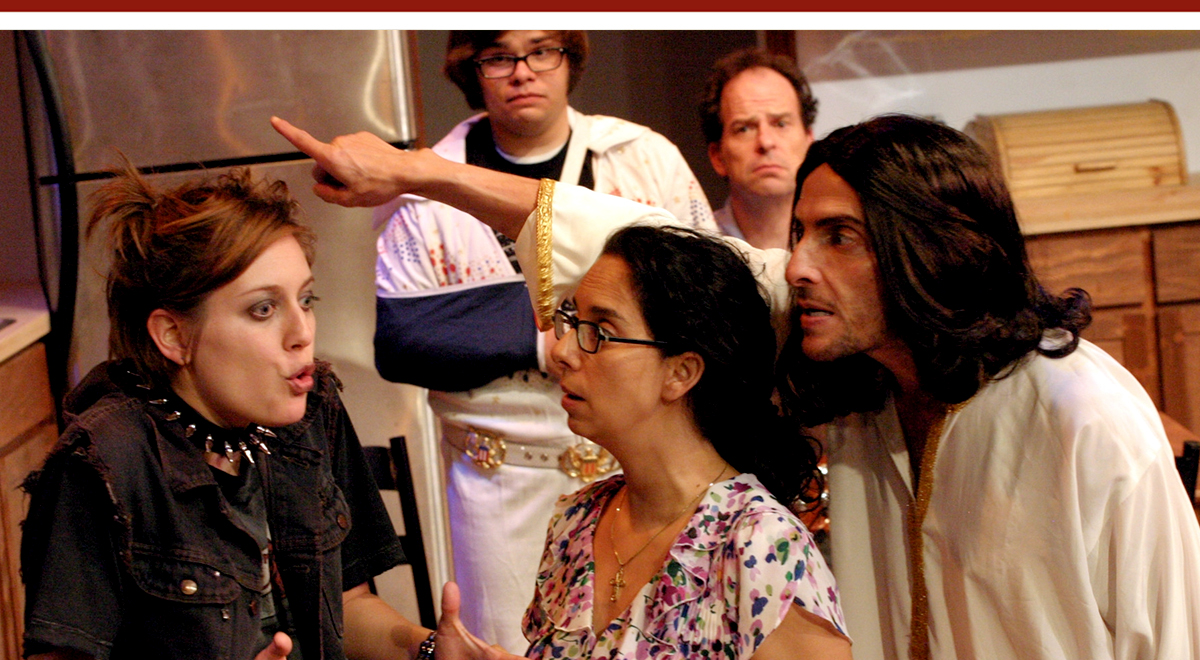
Nelson Steinberg (Charlie Saxton, ultimately winning despite the early face acting) is a high school outcast who carries a blazing torch for his neighbor Rachel Stein (Kira Sternbach, finishing the run for Zoe Perry). Despite her unequivocal rejection of him, Nelson visits her home and befriends her zombie father Arthur (Loren Lester), zealous mother Sylvia (Abigail Revasch), and re-risen Son-of-a-God Jesus (Andrew Ableson).
Arthur's malaise traces back to the September 11 murder of all 65 people he managed in a World Trade Center accounting firm. Now he spends his days in his pajamas, napping at the kitchen table. In response, Jewish Sylvia has embraced the Christian God's promise of salvation, spending her days warning "The End is Near." Everyone but Rachel welcomes Nelson. Arthur, in fact, is reborn by the opportunity to revisit the Torah in order to coach Nelson for his upcoming Bar Mitzvah recitation.
While all characters are Jewish-born, Nelson is the only one who keeps the faith. Arthur has lapsed, Rachel never embraced it, and Sylvia has gone over Christ, who . . . well, that's another story. In addition to the Bible and Torah, another book is important in End Days. Stephen Hawking's ground-breaking book counters to the religous doctrine by offering a universe without guilt, threats, or liturgy. Trying to connect, Nelson loans his copy to Rachel. With the help of an appearance by the power-wheelchair-bound Hawking (Ableson), Nelson gets Rachel to see beyond the Elvis Presley outfit that is his security blanket.
Manwhile, to reward devoted Sylvia, Jesus tips His hand about when the end may come. Panic ensues and Steinberg and the Steins huddle together to await the atrocities. United in fear, they begin to reconcile with one another and Laufer neatly ties together the many resonant strings of her play.
Aside from some of the excessive reaching for comic effect, the cast is on target and the play works. Ableson makes for good Jesus and Hawking, and Sternbach seems not to have missed a beat fitting in. There may be a darker, fuller play inside, but it's a balance that James has justifiably tipped towards the laughs.
As it happened, we attended End Days on the afternoon of September 11, 2011, after much of the morning’s anniversary ceremonies were broadcast. It gave the play immediacy, and showed it as one of theater’s worthy responses to the tragedy. Laufer's effort to take fanaticim beyond Muslim extremists – and annihilation beyond mortals – is thought-provoking, and laughter-inducing. Not a bad way to spend an afternoon. Especially that one.
top of page
END DAYS
by DEBORAH ZOE LAUFER
directed by LISA JAMES
ODYSSEY THEATRE ENSEMBLE
August 20-October 16, 2011
Extended to 10/23 (Reviewed 9/11m)
CAST Andrew Ableson, Loren Lester, Abigail Revasch, Charlie Saxton, Kira Sternbach (finishing the run for Zoe Perry)
PRODUCTION Jeff McLaughlin, set; Kathryn Poppen, costumes; Jeremy Pivnick, lights; Mathew Beville, sound; Julie Simpson, stage management
HISTORY A National New Play Network world premiere at Florida Stage in 2007 following a reading there as a part of the 1st Stage New Works Festival. It won the American Theatre Critics Association’s Steinberg Award in 2008 and had its New York premiere the following March at Ensemble Studio Theatre. West Coast Premiere
Zoe Perry, Abigail Revasch, Andrew Ableson, foreground, with Charlie Saxton and Loren Lester
Enci
Between periods
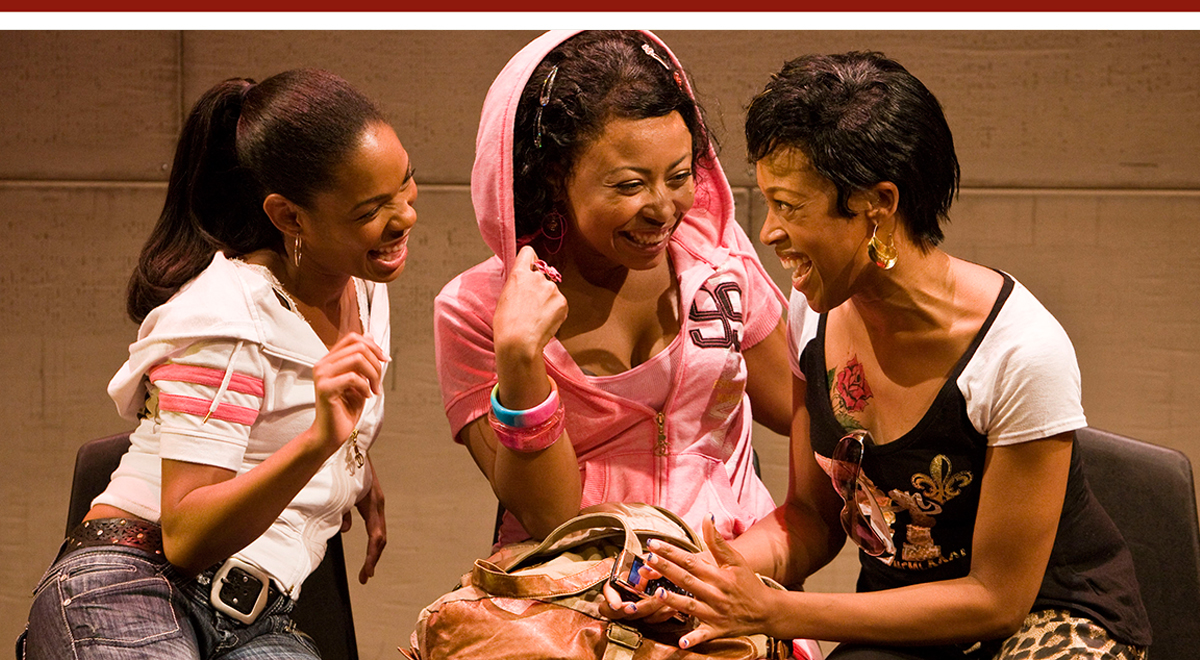
Despite constant Smartphone access to testimony about the harsh realities of teenage motherhood, and their own experience with parents struggling to nurture children, the three high school girls in Kirsten Greenidge’s Milk Like Sugar, inspired in part by a 2008 pregnancy pact between 17 Glouchester, Massachusetts students, choose parenthood as a shortcut to adulthood.
In its premiere at the La Jolla Playhouse (through September 25 in a co-production with Playwrights Horizons and the Women's Project Productions), Milk Like Sugar is as honest as it is entertaining, laced with sharply observed humor and buoyed with poetic allusion. Greenidge has a knack for turning between-period high school taunts into hilarious one-liners. The two-act, two-hour play moves briskly under Rebecca Taichman's direction. Ultimately, however, we're left wanting more clarity, as the frustration and indecision that bedeviled central character Annie seems to blur the play's conclusion.
Margie (Nikiya Mathis) is so excited about the "mad cool" accessories and unconditional love her unplanned pregnancy is sure to generate that best friends Annie (Angela Lewis) and Talisha (Cherise Boothe) decide to join her. Pledging the ultimate act of shared sisterhood they begin checking the local talent for anonymous donors. Talisha already has a mysterious "older guy" who can be tapped without being tipped off.
It’s not so easy for Alice. She can't get excited about serious, college-bound Malik (J. Mallory-McCree), who wants slow-growth romance with picnics and star-gazing. Antwoine (LeRoy McClain), an older tattoo artist, plants the seeds of infatuation by helping her resist the other girls' pressure to copy their rose tattoos, and suggesting a flame design suits her better. Whether Alice is drawn to his artistic nature, his probable future disinterest in her, or the sense they are kindred spirits, she will move closer to Antwoine as she returns to his wagon to grow her abdonimal flame tattoo until it fills her torso.
And now the fuzzines begins to set in. Alice is predisposed to rise above her surroundings. She compulsively corrects others' English and is drawn to being a positive force – trying to cheer her bitter, hard-working mother Myrna (Tonya Pinkins) and exploring religion with Keera (Adrienne C. Moore), who seems grounded despite sufferng humilition for both being both overweight and new at school. So, why not take the Malik ticket out of town? She can be conflicted; the play should not be. Ambiguity is not the same as confusing. After all the reality play, when she jumps into the fire with Antwoin, it seems more a completion of the metaphor than an act rooted in character.
Taichman and her superb cast keep Milk Like Sugar engaging. Lewis provides a beautiful heart at the production’s center. Boothe is a fierce friend, and a fiercer antagonist for Keera, who turns her small role into a rich one. As Margie, Mathis is sympathetic as a girl slipping further out of her depth. Pinkins not only brings marquee value, but a frightening strength to a woman committed to her dream of writing stories, even when energy and ideas are lacking.
The men answer the requirements of Greenidge's script, but despite superficial distinctions of ambition, age, and their interests in art versus science, are very similar in character – equally sincere, empathetic gentlemen. The play might benefit if Antwoine was played with edge, if only for contrast.
Mimi Lien's simple set features a back wall that moves up and down stage to accommodate furniture wheeled on and off by the actors. Toni-Leslie James' costumes do well to help define the personalities. And Justin Townsend's lighting is noticeably precise in isolating characters while maintaining visibility across the stage. Andre Pluess adds the right girl-power track to set the scenes.
It is astronomy student Malik who cites his family's cheap powdered milk as a symbol of the poverty he is determined to escape. Milk like sugar has a hard-scrabble meaning. Just as it might evoke a dreamy, subconscious fantasy state by a girl who will begin nursing a baby at sweet 16.
top of page
MILK LIKE SUGAR
by KIRSTEN GREENIDGE
directed by REBECCA TAICHMAN
LA JOLLA PLAYHOUSE
August 30-September 25, 2011
(Opened 9/8, Rev’d 9/10m)
CAST Cherise Boothe, Angela Lewis, Nikiya Mathis, LeRoy McClain, J. Mallory-McCree, Adrienne C. Moore, Tonya Pinkins
PRODUCTION Mimi Lien, set; Toni-Leslie James, costumes; Justin Townsend, lights; Andre Pluess, music/sound; Dana DePaul/Erin Gioia Albrecht, stage management
HISTORY Recipient of Aspen Theater Masters' Visionary Playwright Award. Co-commissioned by Theater Masters and La Jolla Playhouse. Produced in association with Playwrights Horizons and Women's Project Productions World Premiere
Angela Lewis, Nikiya Mathis and Cherise Boothe
Craig Schwartz
Shoring up
There is a wholeness to Adrian Noble’s staging of The Tempest at The Old Globe (through September 25). It is something novice audiences can intuit, and veteran viewers quickly embrace like a favorite, seldom-seen relation.
Such a welcome confection, which nightly crackles with fresh energy, is a sign that director, designers, and company have been inspired to bring the best of their individual talents to their collective purpose. As much as the actual talents, that sense of unity, bound in great part by pride in the imagination present, lifts the production off the stage just as great writing lifts a story off the page.
What we respond to in Noble’s response to Shakespeare’s last and in many ways summating work, is a profusion of these fresh ideas – or proven ideas reinvigorated by an enthusiastic band of performers and crew. We feel it from the barely restrained urgency of the roiling, pre-show sea sounds to the boisterously sung curtain call.
As the lights dim, the sound of the sea is lost under the cacaphony of Sound Designer Dan Moses Schreier's thunderous storm. Alan Burrett's lighting flashes lightening over Ralph Funicello's simple, single-platform set. A massive blue sheet as large as the stage floo, is pulled down the rough-wood deck by its corners. Bllowing like a wave, it crests and "breaks," curling under itself. We realize we're in for something special: resourceful stagecraft triumphing over expensive scenic resources. The same sheet will return as sky and sail. It will wash Miles Anderson's Prospero and Winslow Corbett's Miranda onstage, and suck the threatening soldiers out to sea.
Prospero is the unseated Duke of Milan, who has retreated with his daughter Miranda to an island. For years he has lived in exile, gaining perspective as he renewed his strength, enjoyed the affections of his child and learned to command an army of invisible creatures. Prospero's leveraging of the unseen to his purpose is a metaphor for an author's relation with the characters he or she creates.
The opening storm shipwrecked a party that includes the principles from Prospero's homeland. These include Alonso, the King of Naples (Donald Carrier), his brother Sebastian (Michael Stewart Allen), and Prospero's old councilor Gonzalo (Charles Januscz) and usurping brother Antonio (Anthony Cochrane). Also deposited on the island is Alonso's son Ferdinand (Kevin Alan Daniels), who becomes separated from the party and connected with Miranda, the butler Stephano (Adrian Sparks) and a "jester" named Trinculo (John Cariani).
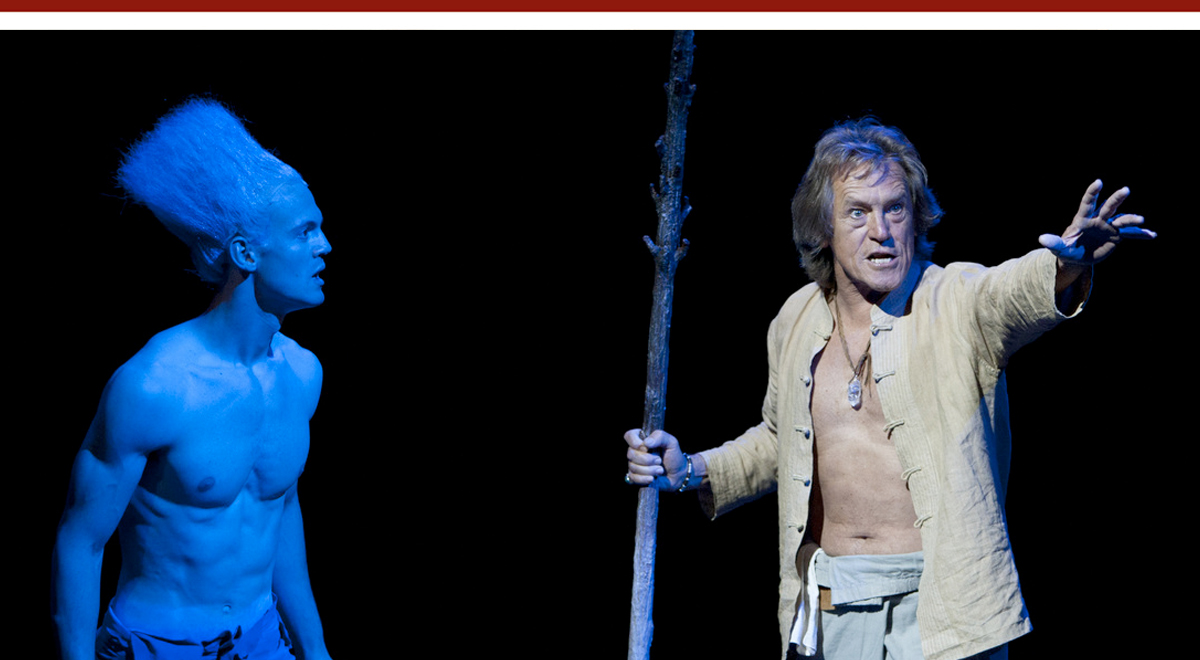
The story follows Prospero's reconnection with civilization. This includes letting go of his beloved daughter, and freeing his indentured servants, the trusted spirit Ariel (Ben Diskant) and the chained and dangerous Caliban (Jonno Roberts). It also includes his use of his invisible spirit minions to correct the injustices he suffered. Along the way, comic relief will be provided by Stephano and Trinculo, who share with Caliban a vast supply of alcohol that has washed ashore.
The show is full of beautiful songs (all composed by Shaun Davey and most delivered superbly by Diskant) and imaginative stage tricks. In addition to the many uses of the sheet, the windblown seamen, supporting each other with one hand, flap another neighbor's coattails with the other hand to show the strength of the gale.
With its sum-greater-than-the-parts magic, it must be noted that this Tempest's overall acting company, while good, is only on occasion great. Anderson is so good, that we wish Shakespeare and written more for Prospero. His delivery of the great final speech is commanding. After his first appearances are those of an actor rather than his character, Diskant redeems himself, and provides great moments of song, on stilts, and in support of his master. As Caliban, Roberts is both frightening and pitiful, and yet in his scenes with Stephano and Trinculo, wonderfully comic. (He owes much to the support of costumer Deirdre Clancy, her assistants Charlotte Devaux and Sonia Lerner, and the dresser who helps with his body hair.) Janucsz adds strong support as Gonzalo, while Cochrane’s British inflections and perfect delivery makes us wish Antonio had more to do, too.
The general troupe, mostly conservatory students and graduates, are focused and earnest. Special acknowledgements to the six MFA students who operate the three puppets, and under Joe Fitzpatrick's supervision take what could be something tired and insufferable, and make it englightened and unforgettable. They are Shirine Babb, Adam Daveline, Grayson DeJesus, Christian Durso, Deborah Radloff and Allison Spratt Pearce. That feeling that we are sharing in a rare collaboration extends all the way through the musical curtain call, as if the production itself did not want to end. It is a feeling that abides well in Shakespeare work of reluctant closure, and certainly bodes well for Noble’s summers in Balboa Park.
top of page
THE TEMPEST
by WILLIAM SHAKESPEARE
directed by ADRIAN NOBLE
THE OLD GLOBE
June 5-September 25, 2011
(Opened 6/19, Rev’d 9/10e)
CAST Michael Stewart Allen, Miles Anderson, Shirine Bab, John Cariani, Daniel Carrier, Anthony Cochrane, Winslow Corbett, Kevin Alan Daniels, Adam Daveline, Grayson DeJesus, Ben Diskant, Christian Durson, Andrew Hutcheson, Charles Janasz, Jesse Jensen, Jason Maddy, Allison Spratt Pearce, Deborah Radloff, Jonno Roberts, Ryman Sneed, Adrian Sparks, Jonathan Spivey
PRODUCTION Ralph Funicello, set; Deirdre Clancy, costumes; Alan Burrett, lights; Dan Moses Schreier, sound; Shaun Davey, music; Charlie Reuter, music director; Joe Fitzpatrick, puppet advisor; Steve Rankin, fights; Jan Gist, voice; Bret Torbeck/Deirdre Rose Holland/Jess Slocum/Annette Yé, stage management
HISTORY The play is believed by many to have been the last play by Shakespeare, written in 1610–11. First published in the First Folio of 1623.
Ben Diskant and Miles Anderson
Henry DiRocco
Where's Walter?
If Walter Cronkite, anchor and managing editor of the CBS Evening News from 1962 to 1981, had "teased" an upcoming segment with a headline as misleading as the title of Joe Calarco’s new play, Walter Cronkite is Dead, receiving its West Coast premiere through October 16 at San Diego Rep, his reputation as "the most trusted man in America" would have passed away.
As it is, Calarco’s title is meant to mourn a bygone era. It’s a stretch. Cronkite, who died in 2009, had retired nearly 30 years earlier, and even his replacement, Dan Rather (who turns 80 on Halloween), and Rather's replacement, Katie Couric, have retired. The phrase pops up in conversation between two widowed mothers of thankless adult children who, despite those similarities, are completely incompatible. Still, they both regret that social values like civility and etiquette have now gone the way of the old newsman.
The play and its title do fit together, however, since neither is likely to resonate for long. That said, Shana Wride's staging of Dead did provide 90 minutes of pseudo-significant escapism for much of the Rep's loyal opening-night audience, who were justifiably proud of their commitment to such new work. Given the warm welcome, and the minimum cast and production requirements, it should have a good run in America's community theaters.
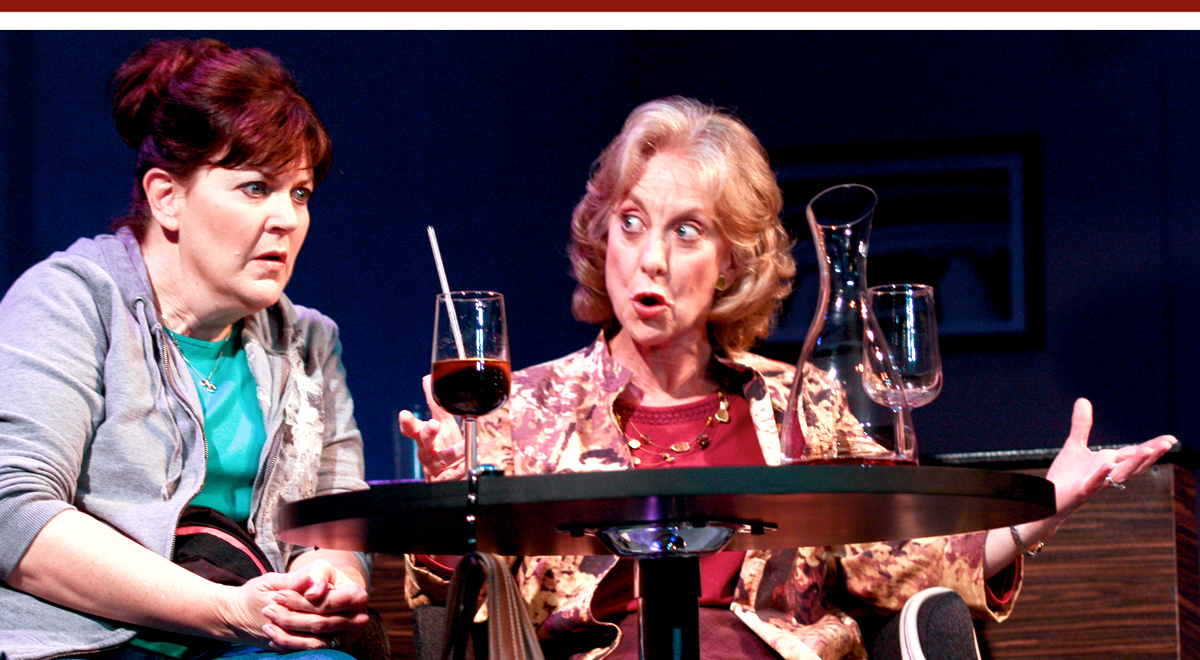
At rise, Margaret (Ellen Crawford) sits alone at a table in Reagan National airport, reading, reciting, and re-reading from a sheet of paper. (We'll later learn that this is a technical explanation of jet mechanics Margaret incants to ease her fear of flying.) Though it seems to be a peaceful corner of the airport, the terminal is in fact crowded with irritable travelers, stranded by a major storm that has grounded planes up and down the East Coast. Margaret’s concentration is broken by Patty (Melinda Gilb), an obnoxious fellow traveler oblivious to the volume of the vapid monologue she is delivering to her cell phone earpiece. (And, yes, she's one who complains of lost etiquette.) Her Southern accent is as over-sweetened as are her string of syrupy endearments. We instantly recognize her as one you want to avoid being stuck with in public. (At this point some may wonder why they paid to be with her!) Margaret understandably tries to prevent her from sharing her table. She does not succeed.
For the first two-thirds of the play, we watch the two prattle on about nothing. Through Patty's irrepressible chatter, she tells much of her story. In self-defense, Margaret responds with question for Patty and some incidents from her own life story. When they appear close to becoming friendly, one manages to alienate the other and we're back to zero. Then, inspired by their decision to share a couple carafes of wine, the tongues loosen, the resistences are down, and Calarco is writing like a playwright. It's a dramaturgical transformation as radical as if a genius student had offered his mentor an alternate ending and Calarco slipped it in uncredited. The stories are now deeply rooted, the style of their writing is gripping, and the actresses get a chance to do show off – including a gutsy, gritty "Wish I Could Shimmy . . . " from Crawford, which wins the audience over permanently.
Gilb, who has impressive credits in the musical theater world, plays Patty fiercely. Calarco feeds her lines like, "I know I’m irritating," and she makes them painfully authentic. Crawford, seen only once by Theatertimes.org in a misguided adaptation of Charles Dickens' Great Expectations [review], is never grating and makes the most of her device. As said, however, these women do bring out the best in Calarco’s script by its end. In fact, the "third act" of the intermissionless 80-minute comedy is so good, it's almost enough to redeem the earlier sections. But it's hard to forget all the high corn we've had to plow through to get to this clearing.
Sean Fanning’s set design of the airport terminal is large and realistic and a credit to San diego Rep’s support of new work. Valerie Henderson's costumes, Ross Glanc's lighting, and Omar Ramos' sound design are all solid.
top of page
WALTER CRONKITE IS DEAD
by JOE CALARCO
directed by SHANA WRIDE
SAN DIEGO REP
September 17-October 16, 2011
Opened, rev'd 9/23
CAST Ellen Crawford, Melinda Gilb u/s Jeri Holst, D'Ann Paton
PRODUCTION Sean Fanning, set; Valerie Henderson, costumes; Ross Glanc, lights; Omar Ramos, sound; Mark Stevens, stage management
HISTORY Originally produced at Signature Theatre, Arlington, Virginia West Coast Premiere