

The cruelist mouth
A strange job interview begins Tracy Letts’ August: Osage County (at the Ahmanson Theatre through October 18). Beverly Weston (Jon DeVries), an alcoholic former professor whose poetry writing dried up decades ago, is hiring a housekeeper to help with his wife, Violet (Estelle Parsons). Vi, a longtime prescription drug addict, has turned her diagnosis of oral cancer into a license to overdose.
As Vi sleeps off the day’s stupor, Bev sits with Johnna (DeLanna Studi), to go through the list of duties and a fifth of Jim Beam. He talks of his three estranged adult daughters before drifting into a soliloquy about the power of American poetry, ominously aligning himself with two of its tragic stars: Missouri- born T.S. Eliot, whose wife, Viv, ended her days in an asylum, and fellow Oklahoman John Berryman, who committed suicide. Native American Johnna, with a centuries-old tradition of looking for truth in airy white speeches, listens politely.
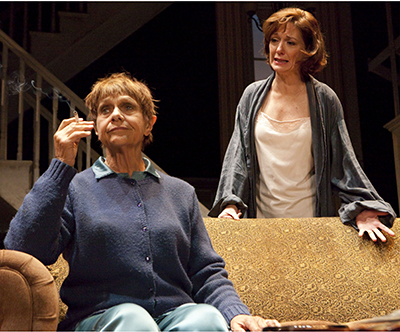
With Bev reciting a line from Eliot’s "The Hollow Men" to end the scene, Letts sets his play’s footprint. Like Scenic Designer Todd Rosenthal’s three-story Weston home, it presents a spacious framework to cage the 13 folks who will flesh out this unsentimental vision of contemporary American families. It is a world of intimates distanced by tightly held secrets, of generations passing on the worst of their elders, and surprisingly little invocation of God. It echoes O’Neill and Chekhov before clearing its own voice, filled with literary resonance and accented with enough sharp contemporary satire to engage mainstream audiences for three-and-a-half hours (two intermissions).
It is high accomplishment for a play freighted with extraordinary acclaim to still amaze. During a Broadway run that ended in June, August earned the 2008 Pulitzer Prize for Drama, five Tony Awards (including play, director and lead for Deanna Dunagan as Violet), and Best Play Awards from Theater World and the Drama Desk. Its tour, which won high praise in London and Denver, now comes to L.A.
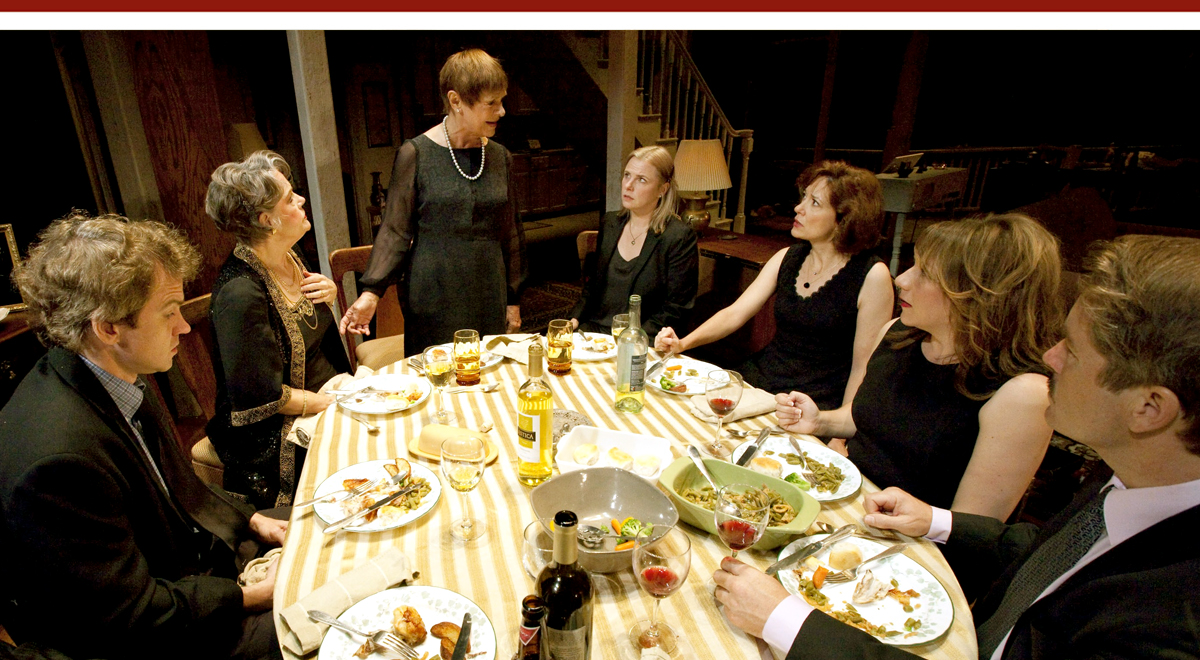
Anna D. Shapiro has staged the piece to clip along, keeping Letts’ many mini-themes spinning as her large cast lands every shot of black comedy. A week after Johnna’s interview, Bev disappears. The three sisters and their loved ones return from dysfunctional diaspora intent on suppressing their animosities long enough to support their distraught mother in a time of need. But the stifling house is quickly filled with spiteful truth telling and revelations - mostly from the acid-tongued Violet.
Middle daughter Ivy (Angelica Torn), divorced and childless at 43, has remained within shouting distance to become the begrudging, default caretaker. She arrives first, followed by the eldest, Barbara (Shannon Cochran), her literature professor husband, Bill (Jeff Still), and their precocious 14-year-old, Jean (Emily Kinney). Youngest daughter Karen (Amy Warren) flies in from Miami with a new fiancée – a suspicious piece of work named Steve (Laurence Lau). Violet’s equally damaged sister Maddie Fae (Libby George) and her husband Charlie Aiken (Paul Vincent O’Connor), live only 90 minutes away, and are already there. Their 37-year-old son "Little" Charles (Stephen Riley Key) will arrive later.
Parsons renders a frightening, pathetic Vi. Between her drug-addled zombie and her vicious matriarch, she gives plenty of clues as to how a mother’s instincts shift from protecting her children to attacking them to protect her own weaknesses. As Barbara, Cochran traces the biggest arc. She offers a gallery of adult child’s roles: accommodating, loving, beseeching and finally, overpowering. Her frustrating relationships with husband and daughter honestly portray her as victim and victimizer.
Of the rest of the cast, Torn is a particular standout as the tortured Ivy while Warren’s Karen shows how being youngest has left her with a tendency to use childishness to get her way. Studi nimbly allows her character to function in play world and metaphor. The men manage to dignify Letts’ "Hollow Men" theme without imploding. Their shared emptiness is crippling in a variety of forms, yet they function as completely recognizable. As damaged "Little Charles," Key resists the invitation to overdue, showing us the isometrics of one always working to suppress natural inclinations.
Costumer Ana Kuszmanic adds fine touches. She fits Bev with footwear that, after a speech of Vi's, provides a backhanded clue to their twisted relationship. Ann G. Wrightson's lights help define rooms in the wall-less ground floor and Richard Woodbury gives the play a realistic sonic environment. David Singer’s original music, which launches the show on boozy clarinet, always complements Letts’ themes.
Letts uses a real Native American tradition as an important metaphor upon which to hang one cautionary sign. During their entire life, the Cheyenne wear a pendant necklace to protect their spirits from getting separated, and entering the afterlife to wander alone. Johnna explains that hers contains the coiled, prenatal tether that once bound her with her mother. The Westons' lack of that fundamental connection resonates as the play ends, with a whimper. After everyone has left, Vi weeps the final lines of "The Hollow Men" into Johnna's lap. Letts quietly leaves us with volumes to talk about for years to come and the American theater with an authentic new classic.
top of page


The parent's nightmare
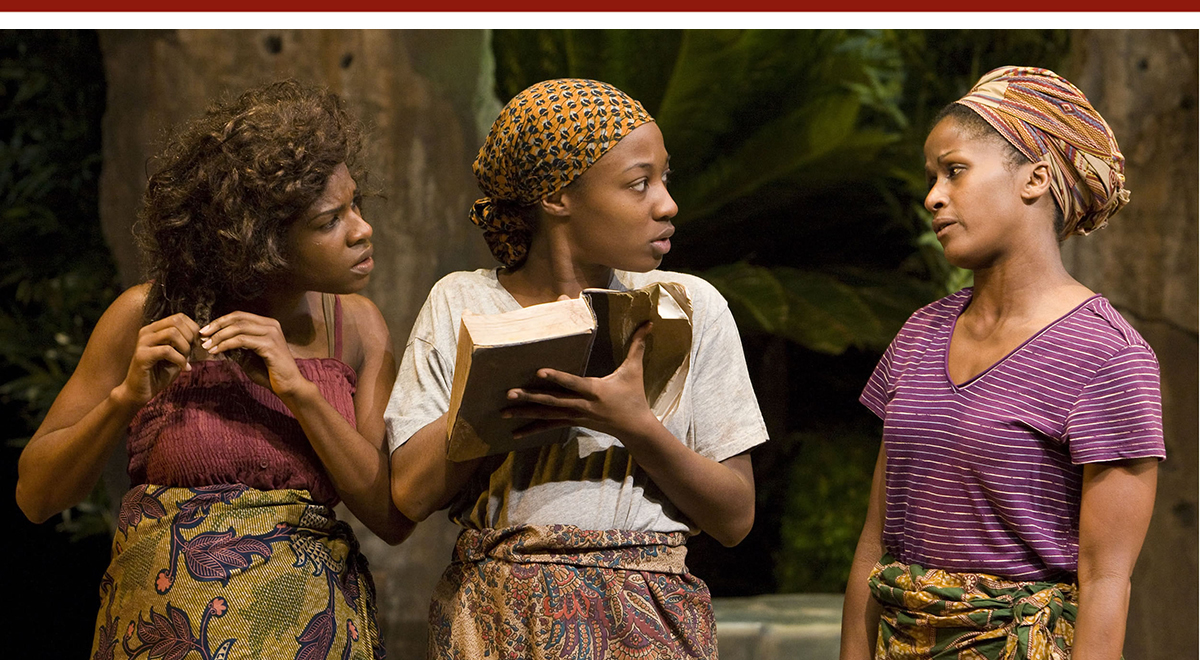
An engaging sense of mystery permeates Sheldon Epps’ staging of Charles Randolph-Wright’s ‘The Night is a Child,’ now at the Pasadena Playhouse (through October 4) after premiering at Milwaukee Rep in March 2008. From the first scene,in which a middle-aged woman is soaking up the sunny dispositions of residents on her first day in Rio, something portentous seems to lurk just out of sight.
Randolph-Wright, with impressive credits in every aspect of theater, was last in Pasadena with Cuttin’ Up, a very successful script that uses a barbershop as the setting for a celebration of the customs and characters that make these central parts of African-American communities.
Harriet (JoBeth Williams), we will learn, is both fulfilling a life-long dream of visiting Ipanema and trying to escape a nightmarish family tragedy back in Boston. The family and the tragedy will pursue her, however, and she will be forced to confront them both.
Cuttin' Up was based on a single book of interviews with Black barbers and their customers. That helped set boundaries within which the playwright focused his story. Here, without that focus, Randolph-Wright mixes such huge themes and ideas that we feel none achieves its full impact. What Harriet is running from and what encounters in her escape are so enormous, they seem slighted by use only as plot points in a story about a woman accepting her need to get on with her life. Certainly the elephantine tragedy that sent her packing will be there when she gets home. Getting to a point where she can dismiss it may only worsen her standing in the community.
When we meet Harriett, she has landed in Rio, embracing the anonymity and soothing sounds that drew her here without telling her two adult children where she was going. We meet the kids, Jane (Monette Magrath) and Bryan (Tyler Pierce), as they begin the process of determining their mother is missing, then reporting her, then guessing where she has gone and following her.
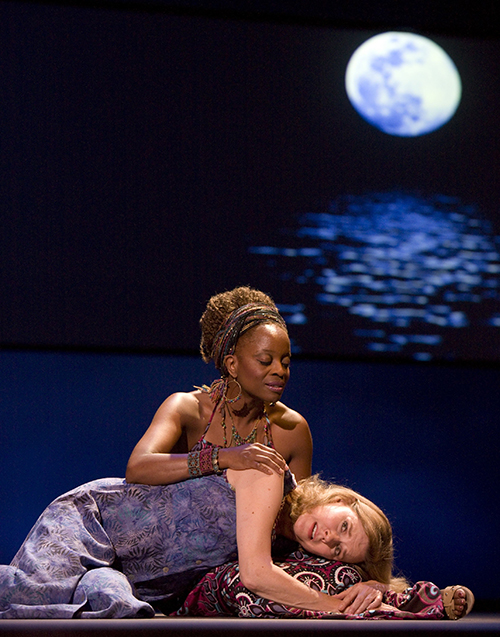
What Harriett experiences in Rio is a mixture of dream fulfillment and dream world intrusion. She quickly meets a free spirit in Bia (Sybyl Walker), a local who studied to become a physician at Harvard. She books a room in a swanky hotel run by Joel (Maceo Oliver, who also appeared in Cuttin' Up) and is soon seeing visions of another son, Michael (Bryan’s twin, also played by Pierce). That these visions could be her own mental state, or her proximity to Brazil’s Candomblé religion – a cousin of Voodoo – add to the play’s healthy sense of uncertainty and mystery.
Yael Pardess' clean, open set features twin projection screens that carry exquisite video support by Jason Thompson. Pardess employs the full stage and even breaks into the auditorium for some of the action. Admittedly, economy may have overruled design in having the Candomblé unit in front of the proscenium, where it does not need to be moved on and off stage. However, having that foreboding presence of the temple engulf Harriet, closing off the openness of the set, would have better established the sense of darkness closing in and threatening her.
The triumphant end to Harriet’s journey is audience-pleasing, but that presence of events outside the characters' control give the play a passive voice it never overcomes. The elements are certainly here, and though they do not produce the gripping experience they might, they do offer a great showcase for Williams – whose last appearance was the triumphant