


Nuclear family
A likely misconception at its beginning may actually be the intention of Julia Cho's crafty and well-crafted Durango, getting a decent West Coast premiere under Chay Yew's direction at East West Players (through October 14). The Mr. Lee being ushered from his office by a security guard is not the Mr. Lee who made international headlines when, according to The New York Timesem>, he was "dismissed from his job at the Los Alamos National Laboratory for violating security rules, but [not] charged with a crime."
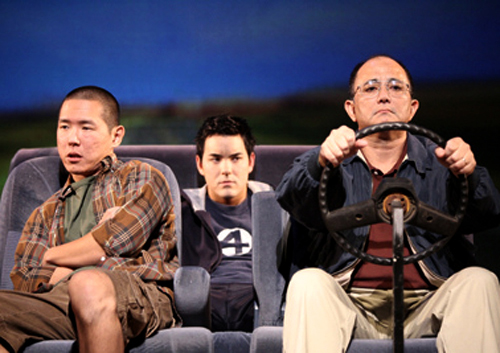
The setting, we will discover, is Arizona, where Ms. Cho was raised, not New Mexico. But it ís close enough, and the circumstances are left unclear just long enough to let the danger of divulging national secrets set the stakes for a story about the danger of keeping family secrets. Ms. Cho, whose last Southern California production, The Piano Teacher (now scheduled for an off-Broadway bow at the Vineyard), also focused on long-harbored secrets and buried shame, shifts from that play's predominantly female voice to all male characters for Durango. This womanlessness, and the general sense that men are more closed off, allows the relationship of a man and his two sons a heart-breaking emptiness that is reflected in the desert they will drive through on a futile search of renewal.
Mr. Yew, a favorite collaborator of the playwright's, exhibits great understanding of Ms. Cho's purposes and strengths and provides a good staging, though there is likely a more definitive one waiting down the road. Nelson Mashita as Boo-Seng Lee must show and not show what's going on inside him and he does it well. As Isaac, the older, post-college first son now expected to enter Medical School, Jen Suh has depth and understanding of his character's quiet rejection of everything save his music (which Suh performs beautifully to start the show).
Ryan Cusino, however, doesn't provide enough real topography in the pivotal role of high-school-age son, Jimmy, whose academic and athletic achievements are all that validate Boo-Seng's sense of parenting skills. Cusino has the most emotional territory to cover as the family healer who also hides his own secret. He's a young actor who still needs to develop more variety and ease. An overused scrunching of the face to show concern, fear, confusion and more, restricts him.
Because his scenes with Suh flatten and fail to provide better balance, the hamster-wheel exchanges between Isaac and his father take on more prominence and leave the production with a harsher tone. As a kind of artist in making, Jimmy is a young Tennessee Williams trapped in a world of intolerance and anger. Without more light from Jimmy, we're left with only the intolerance and anger in the play.
That weakness may contribute to a sense that Ms. Cho's dialogue doesn't feel a perfect fit for the men's mouths. For instance, when Jimmy's behavior sparks epithets at him from a hardened Isaac, the use of the phrase "bright shiny new" in the middle of his outrage seems forced. But these are minor quibbles in another work from a thoughtful young writer who always merits viewing. Three brief scenes in which each male channels Mrs. Lee's personality in recollections showcase the naturalness of Ms. Cho's voice and, in the excellent Suh's scene, becomes a transcendent moment for the production.
In Durango, Boo-Seng Lee has been laid off after 20 years. To justify Lee's security guard escort (John Apicella) and invoke the aura of Los Alamos (though, the real Mr. Lee was not removed so gingerly), Ms. Cho has Boo-Seng mildly, yet uncharacteristically, assault the man who fires him (Alex Klein is good as Lee's boss and some fantasy characters in Jimmy's imagination.)
Mr. Lee is then unemployed, unmarried and unhinged. Without telling them that he was fired, he manages to get his sons to join him for an ill-conceived vacation to Durango, a Colorado tourist town that promises, according to its website, "beautiful scenery, historic charm, friendly faces." Mr. Lee has a long-held brochure. (There's a little cloudiness here as to whether he had been there, or wanted to go; and whether or not it was the scene of a tryst.) Despite his best efforts to maintain his image as a stern but fair father, he will slowly unravel under the weight of his loss, the growing distance between himself and his sons, and a deep secret he refuses to share even with himself. It's a lot of stuff to be churning inside this guy, more than is needed to make the point. But Ms. Cho likes big issues and continues to show she can juggle them handily, although subplots specifically about homosexual secrecy may challenge the theme of family honesty for the play's focus.
Much of the play is their road trip, nicely represented on Donna Marquet's set, with great use of video by Jason H. Thompson and a detailed sound design by John Zalewski (though, these days, using ringing phones to represent an office ambience may distract cellphone-packing audience members).
What the men find or fail to find is interesting and informative and in the hands of Ms. Cho and Mr. Yew it makes for a fascinating journey. Hopefully, we'll get to take the trip again someday.
top of page
Hazing
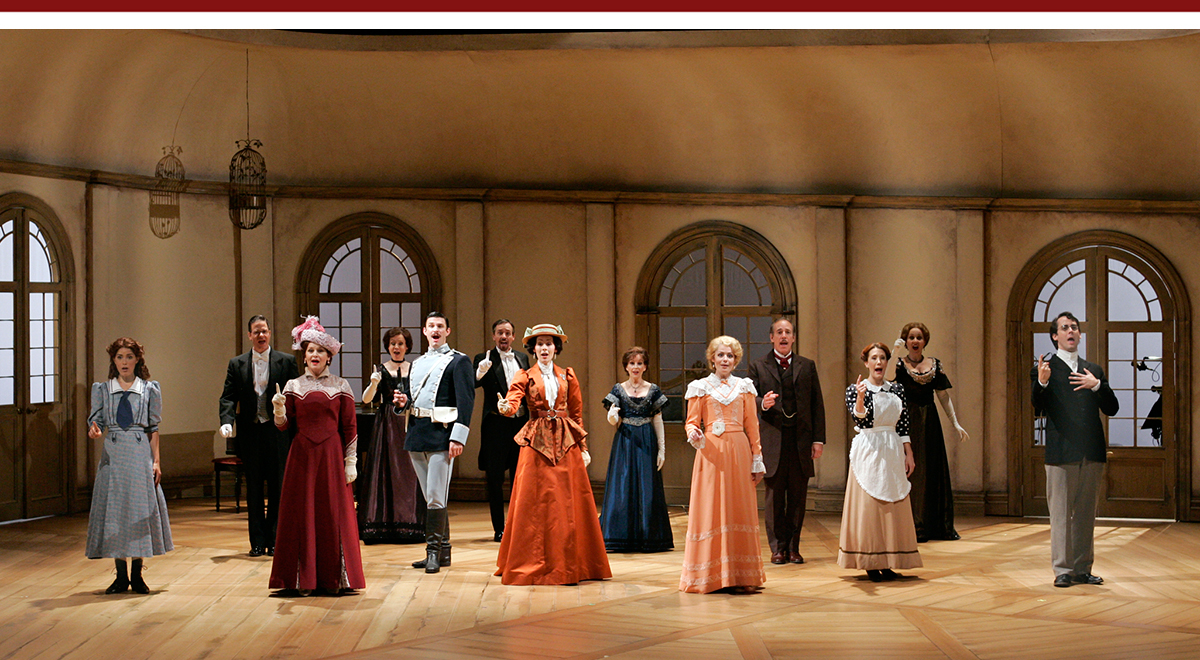
On August 31 the story of Johnson Chestnut Whittaker's years at the United States Military Academy arrived by stage in the Pasadena Playhouse premiere of Michael J. Chepiga's Matter of Honor. Directed by Scott Schwartz and continuing through September 30 it dramatizes events leading up to West Point's discharge of Whittaker, the sixth African American appointed there. This infuriating and instructive episode from the late 1870s was previously the focus of a 1972 book by John Marszalek and a 1994 docudrama from Showtime, both entitled Assault at West Point: The Court Martial of Johnson Whittaker.
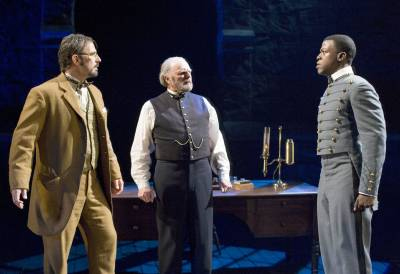
According to a program ad, Chepiga's version is "a mystery inspired by the true story." Whether fictionalizing has enhanced or undermined the true story's impact is its own mystery. After researching the real-life Whittaker, however, facts that the playwright has chosen not to incorporate lead one to wonder if he has mined as much drama as he might have. Still, credit him with retraining a light on a form of stoic American heroism too long swept under the bunk; and credit the Pasadena Playhouse with handing him a high-voltage production for a torch.
Born a South Carolina slave in 1858, Whittaker attended West Point from his 18th birthday until his discharge in 1882. Politicians appoint cadets to the academy, and S.L. Hoge had promoted a man already proven at the University of South Carolina. At the university, according to Marszalek, he "had benefited from tutoring at the hands of Professor Richard T. Greener," the first African American to graduate from Harvard. The university's website refers to Greener as a professor of "moral and mental philosophy" who also taught international and U.S. Constitutional law.
Of the five black cadets who preceded Whittaker, all but Henry C. Flipper had been discharged. Except for a few months living with Flipper before he graduated in 1877, Whittaker was an island amid the white corps. He lived alone in a room meant for two men and was on the receiving end of "silencing," the practice by whites of not speaking to blacks other than at drill and ostracizing them to sit alone at meals and church services.
Early one morning in April 1880, Whittaker was found unconscious and bleeding on the floor of his room. His hands and feet were bound, and his ears had been sliced. A mirror had been broken over his head and a note of warning pinned to his shirt. Pages from the Bible his mother had given him were torn out and burned. Once revived, Whittaker reported to the school's officials that he had been blindfolded while sleeping and tortured by what sounded like three students.
To tell how the institution pursued the "mystery" of what happened and how it was decided to discharge Whittaker is the focus of Matter of Honor. Our guide is a fictitious investigator named Chase (Eric Lutes), who as the play begins is a broken alcoholic, wallowing in guilt over his participation two years earlier in concocting the rationale that Whittaker had staged his own beating to avoid an exam. Ironically, given his exposure to Greener, it was philosophy he was supposedly dodging.
Though Whittaker (Cedric Sanders) maintains a central place in the story, the focus is split between them and the dramatic arc and timeline follow Chase. The frequent back and forth in time, complicated by Chase's shifts in sobriety, make the role more muddled than it need be. Yet, Lutes gamely tries to center it along the moving target of time and temperance. He may also be holding fire in the performance to leave headroom for Sander's Whittaker to remain the star. Establishing a POV around a self-absorbed white accessory is an appropriate tact in America, though a surprising one at a theater that after 10 years of Sheldon Epps' Artistic Directorship has arrived as a prominent presenter – and now generator – of African American theater. The choice to give us a touchstone of one who like most whites in his position would probably just go along with the majority, hints at a play about the greater society's honor and integrity. But, again, the focus is not crisp enough for that to succeed.
Among the nuggets left out is the role of Greener, who would unsuccessfully represent Whittaker as legal counsel. That may be because the Showtime film already centered on Greener, played by Samuel L. Jackson, and his partner David Chamberlain played by Sam Waterston. There, Whittaker is even less central to the story.
The cast is good, with Brian Watkins, Steve Holm, John O'Brien and Ryan J. Hill, as the young white cadets, having the cleanest shot at nailing clearly drawn characters. As the more complicated General Schofield, another historical figure, Richard Doyle provides humanity for a man whose priority is the institution, even though that means divided loyalties for the young men who constitute it. As Whittaker, Sanders is boxed in with no other character to speak with honestly – the way Chase does with Stern (Adam J. Smith), the West Point representative who seeks him out and gets him re-engaged. Ironically, by not providing him such a sounding board, Chepiga manages to silence Whittaker once more. Still, Sanders does his best to let us see much of what is going on inside.
What should, first and foremost, be a riveting drama powered by language rich in texture and insight, is not inherently gripping and may appear to be leaning on the superb production values. Re-enactments of the beating, on a hydraulic platform enveloped in stage smoke, Hellish red light and piercing sound cues, can't compensate for a script that is not uplifting. Still, a creative team – led by Robert Brill (set) and Donald Holder (lights) – are, as the Board Chairman writes, "one of the finest ever assembled at the Playhouse." And, if you've brought a box of the finest fireworks to the picnic, it's crazy not to light 'em up.
Finally, a writer relying on such extensive text projections to fill in historical links and button up loose ends – in a play "inspired" by facts – may have a script tugging for another look. Though Chepiga is past the point of such radical restructuring, future writers looking for a guide into Whittaker's story may want to look to Whittaker himself as an older man. Research indicates that, far from being defeated by the mistreatment, as Chase was by his complicity, Whittaker went on to a career of service outside the military as an educator and administrator. Even though recollection structure is admittedly creaky, a proud and productive Whittaker, who died in 1931, could easily tell his story to a young man or woman who, we can imagine, would incorporate the story into his or her work. For instance, Ralph Ellison, who some researchers say was once a student of Whittaker's.
top of page
That sinking feeling
Morrison was dead: to begin with. There was no doubt whatever about that. Playwright Gary Flaxman, director Judy Rose and lead actor Damon Shalit, had done their best to roust him from his Paris tomb for Swimming to the Moon, a world premiere now through November 11 at Theatre Row's art/works Theatre. But The Doors' lyricist, lead singer and shamanistic pied piper, had apparently used his brooding, enigmatic and self-destructive persona to lead them to mount a drama with just those qualities.

A couple factors undermine their best intentions of blending rock star analysis, Freudian analysis, social analysis, and analysis of politics, sexuality, music, fame, poetry, eternity and the lure of the Shaman: The dialogue is limited to snarling, taunting, teasing and pontificating. Self-satisfied characters ponder ponderously. Heavy ego sits heavily to suppress dramatic lift.
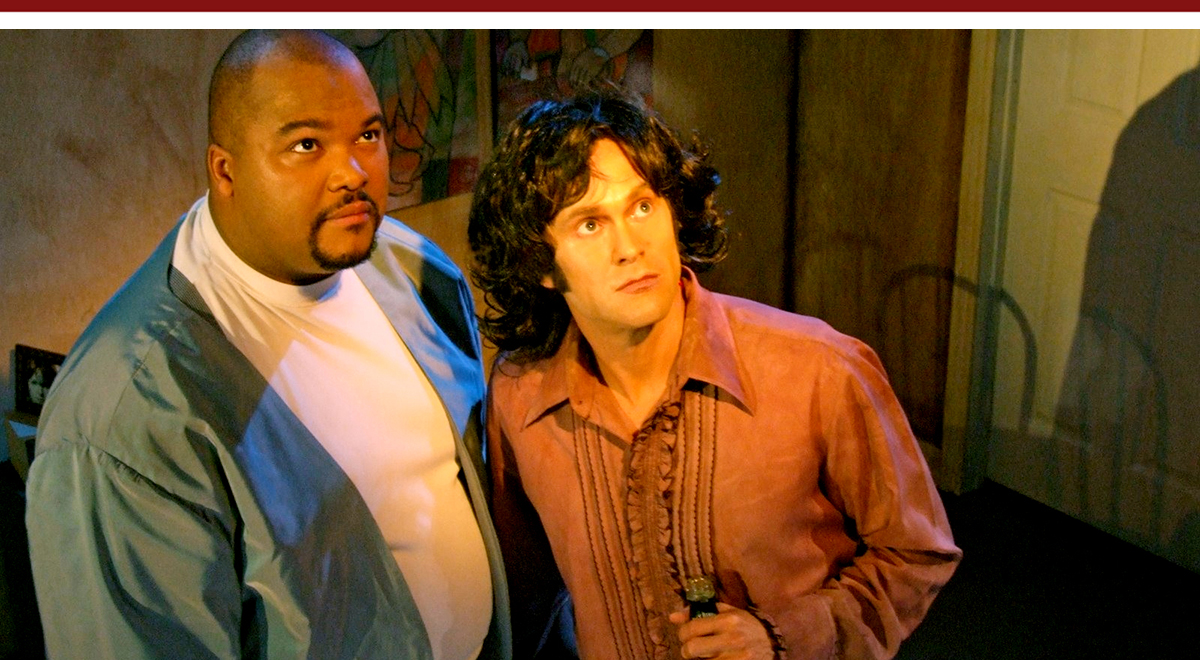
Swimming to the Moon is set in Morrison's hotel room in Paris on the night he slipped into unconsciousness. Morrison (Shalit) takes to his living room bathtub after a few final slugs of whiskey and awakes in the next world. However, it's still his hotel room. But now seated in it is a large man in a silver suit. Al (Abner Genece) is a "transporter" sent to rub the dark poet's nose in his just-ended life. It will feel like an eternity for Morrison, who is challenged to examine his deeds, mistakes and contributions before choosing between two doors that lead to one eternity or another.
The dead star and the smug interrogator then engage in a cat and mouse game of fortune cookie one-liners dressed up as infinite wisdom. The opening scene takes awhile to get to the meat, as Morrison's know-it-all persona and Al's infinitely wise persona jockey for supremacy. Despite some level of omniscience, Al is an infuriatingly smug Buddha-type who bounces back questions rather than considering them. There's enough cuteness to slice and serve a la mode. At one point Morrison sidles up and rubs a cheeky come-on into Al's shoulder, telegraphing a mysterious ambi-sexuality that gets a kitten-paw rebuke: "You are a light in the darkness, aren't you?"
It's a gabfest with murky stakes. It may be Flaxman's goal to create a kind of '60s Don Juan in Hell, where a self-obsessed protagonist is made to defend his life. But the writing isn't exciting or deep enough to keep us interested. He can't seem to find enough points of interest for his tour of Morrison's mind, so Flaxman takes the story for a tour of some Big Issue '60s side shows: racism and civil unrest, politics and war, and to a lesser extent domestic violence. To guide us, he creates five after-lifers led by Jimi Hendrix and including character symbols named "The Fan," "Detroit Woman," "Senator" and "Soldier."
Though Shalit surely researched the Bejesus out of his role, it still smacks of album cover art. There's a head tilt, a slouch, a lazy speech that feel like stage affectations asked to stand in for a full personality. More effort seems to have been made in creating a physical and sonic Morrison than was went to giving him dramatic action and decent dialogue. However, give him credit for going for it. In his interactive Miami scene, and in those times where he has to pull Morrison's wail from the deepest recesses, Shalit doesn't hold back. God bless the working actor.
Hendrix (Russell Richardson), who is likely the most interesting character from that period, suffers the same fate. Richardson, without words worthy of that mystery man, is reduced to rerunning clips of the guitarist's swagger, arm gestures, etc. The scenes between Morrison and Hendrix leave the impression that these two, far from giants, were petty bickerers. Out of context of the times, the two goliaths that shook at least the pop-culture earth are reduced to plastic dinosaurs wiggled before a monster movie blue screen.
Perhaps because they aren't strapped into historical personae, or freighted with the import of "Senator" or "Soldier," the most engaging characters are the two women. The first time the play begins to breath is when Corryn Cummins' Fan appears. In her too-brief scene we finally get someone with the shell removed. Same for Sarah Scott Davis, who, in her short time on stage successfully covers a lot of ground, and helps Hendrix revisit some of what the '60s were about for black Americans.
It's impossible to recreate one era's zeitgeist for another. Historians do the best they can by assembling as many details and anecdotes to rebuild the world as it was. The dramatist on the other hand, honors the facts with interpretations that, in his or her opinion, get to the heart of what was happening. Sadly, Gary Flaxman's Swimming to the Moon, isn't very useful history or compelling drama. A show that would seem to call out for an amazing sound design gets only a couple cues, including Darren Glover's respectable bit of "Foxy Lady's" chomping intro.
The '60s are dead, to end with. There seems to be no doubt whatever about that.
top of page