

Hamlet
by Williams Shakespeare, adapted and directed by Michael Michetti

A Noise Within •  September 20-December 7, 2008  (Opened, rev’d 9/27)

WITH  Freddy Douglas, Tony Abatemarco, Deborah Strang, Dorothea Harahan, Jacob Sidney, Steve
Cooms, Matthew Jaeger, Francois Giroday, Mark Bramhall  
PRODUCTION   Sara Clement, Set/Costumes;
Peter Gottlieb, lights; Kari Seekins, music/sound; Monica Sabedra, hair/make-up; Ken Merckx, fights; John
Pennington, choreography; Susan Coulter, stage management

By eliminating the character whose pre-show exit set the story in motion, and the one
whose arrival at curtain brought it to an end, Director Michael Michetti’s adaptation of
‘Hamlet’ baffles the aperture to blinder us to the supernatural realm and focus on the
mind  of Shakespeare’s great tragic hero.  For his purposes A Noise Within has stocked
its season-opening production (through December 7) with a superior cast.  His take
asks added dimension of his lead.  Freddy Douglas proves he’s up to the challenge.  
Michetti’s concept, however, may not be.

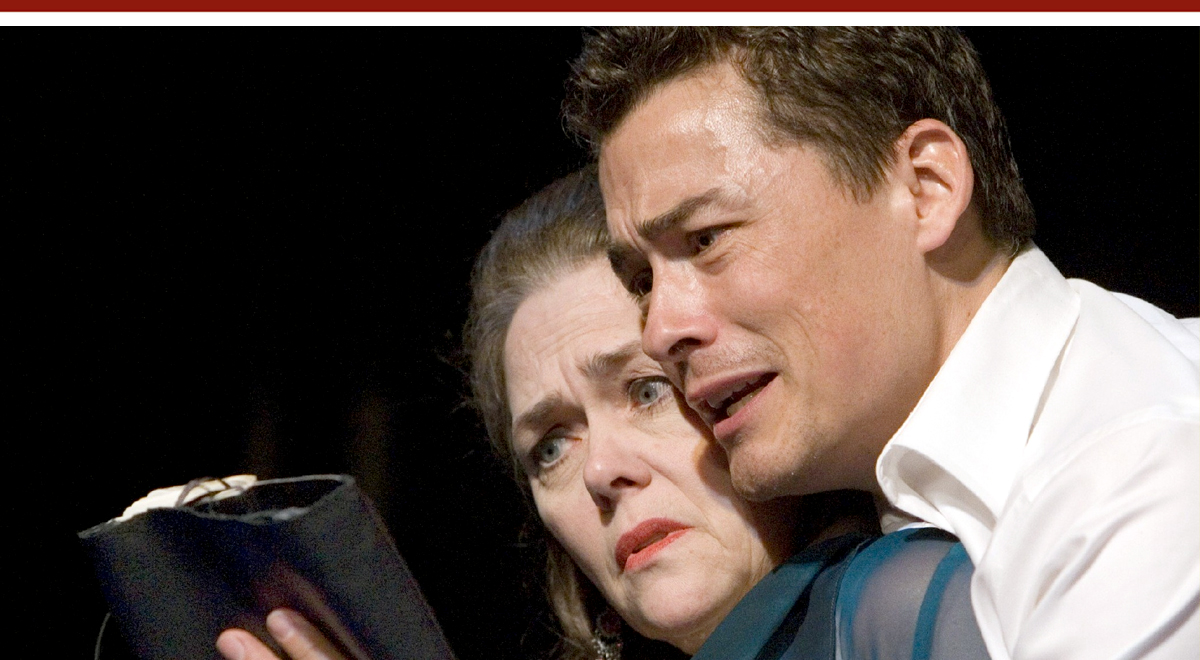
Michetti has given the role of The Ghost of Hamlet’s father to Hamlet.  Horatio (a fine Steve Coombs) has
seen him and advises his friend to join him on the ramparts to confirm the phenomenon.  The Ghost enters
through his son and his speeches along with Hamlet’s are delivered by Douglas as a man whose two
personalities are in a highly agitated conversation with each other.

Were it not for a reference in the program that Douglas indeed plays Hamlet and Ghost, we might believe
that the Ghost is no more than a psychological boil on the Prince’s mental state, and not the intrusion of a
dead spirit.  Compounding the confusion is that Hamlet actually sees his father in himself, reflected in an
upstage panel on uncertain origin.  It is all an interesting and refreshing premise, though it begs the
question, where does the factual information about the King’s murder and usurpation come from?

The schizo-dialogue is handled well by Douglas, though finding some staging technique to let him do less to
distinguish the two would be welcome.  

And so we concentrate our story more than usual on Hamlet himself.  Douglas, whose appearance her in
last season’s “Henry IV, Part 1” made the current production an eagerly anticipated highlight of the current
season, does not disappoint.  He is aided by a sympathetic Deborah Strang as Gertrude, wonderfully comic
Tony Abatemarco as Polonius, and Francois Giroday as Claudius, creating rich character equally capable of
tempestuous, table-upturning fury and almost giddy party-going fun.  

Dorothea Hanrahan makes Ophelia veer in appreciable wide arcs, too, from her distraught entrance after
reading Hamlet’s letters, to hope, conspiracy and ultimately the loneliness and pain of madness.  Coombs’
Horatio and Abatemarco’s Polonius, one as solid as the other is demented, also give this production great
breadth.

The one area where the production fails to impress is in its design.  Sara Ryung Clement creates a costume
rack pulled from a variety of periods and a set tied to none of them.  Unfortunately none of the more fanciful
costumes are very impressive in design or construction.  Material seems discounted and lines are generally
stiff rather than supple.

The set of drape, plexi and scrim is all crowded up above the proscenium and hard to make out as anything.  
It’s a sad contribution on a stage that so often has had such brilliance and resourcefulness from the likes of
Michael C. Smith.  Fortunately Peter Gottlieb’s lights help a great deal, as does the original music and sound
design of Kari Rae Seekins.

The play will soon be joined by ‘The Rainmaker’ and then a Neil Bartlett adaptation of ‘Oliver Twist.’  The
repertory season runs through the first week of December.
GHOST OF A TRANCE
THEATER TIMES REVIEWS OCTOBER 2008
FEEDBACK  HOME
Top
A Noise  Within


Open Fist Theatre


Pasadena Playhouse


Ahmanson Theatre


Kirk Douglas Theatre
Deborah Strang
Freddy Douglas

PHOTO CRAIG SCHWARTZ
Hamlet
Spring Awakening
The Rainmaker
by N. Richard Nash, directed by Andrew J. Traister

A Noise Within   • October 4-December 6, 2008 (Opened 10/12, rev’d 10/23)

WITH  Mitchell Edmonds, Steve Weingartner, Bridget Flanery, Ross Hellwig, Bo Foxworth, Scott Roberts,
Leonard Kelly-Young   
PRODUCTION  James P. Taylor, set/lights; Julie Keen, costumes; Rachel Myles,
sound; David O, music; Kate Barrett, stage management

With a title that seems perfect for a region regularly facing drought (on a globe getting
warmer), N. Richard Nash’s ‘The Rainmaker’ is in fact a multi-strand allegory about
love and loneliness, having hope and losing it, and the mix of hard-bitten realism and
wild-eyed wonder a person needs to make sense of it all.  The 1954 Broadway hit has
been revived at Glendale’s A Noise Within (through December 6).  Despite some acting
limitations (or poor choices), Andrew J. Traister’s staging has enough going for it to
allow the play to speak its piece.

For extra measure, Nash has also layered in Biblical and literary references to extend ‘Rainmaker’s’ reach
beyond its grasp of the human condition.  Though Starbuck (Bo Foxworth) is ultimately revealed as a con
man, his message is of salvation through faith: “Making rain takes confidence,” he instructs his doubting
clients.  We learn that Starbuck is one of many aliases, and imagine he chose it to calm the better-read
farmers he will target during these parched days in 1954.  Starbuck, Ahab’s first mate in ‘Moby Dick,’ is,
according to Herman Melville, “a long, earnest man, and though born on an icy coast . . . [he] must have
been born in some time of general drought and famine.”

Nash’s story takes place in a single day in the life of a motherless family struggling more with a lack of love
than with the lack of water.  The Currys include HC (Mitchell Edmonds) and his three children: Noah (Steve
Weingartner), Lizzie (Bridget Flanery), and Jimmy (Ross Hellwig).  Resigned to accept the lack of rain, the
Curry men are scheming to seed the clouds of romance by forcing Lizzie to break the ice with handsome
Deputy File (Scott Roberts). While that process gets underway, Starbuck arrives out of nowhere promising
to conjure up a downpour for $100.  

HC hires him, as much to raise his family’s spirits as reduce the heat.

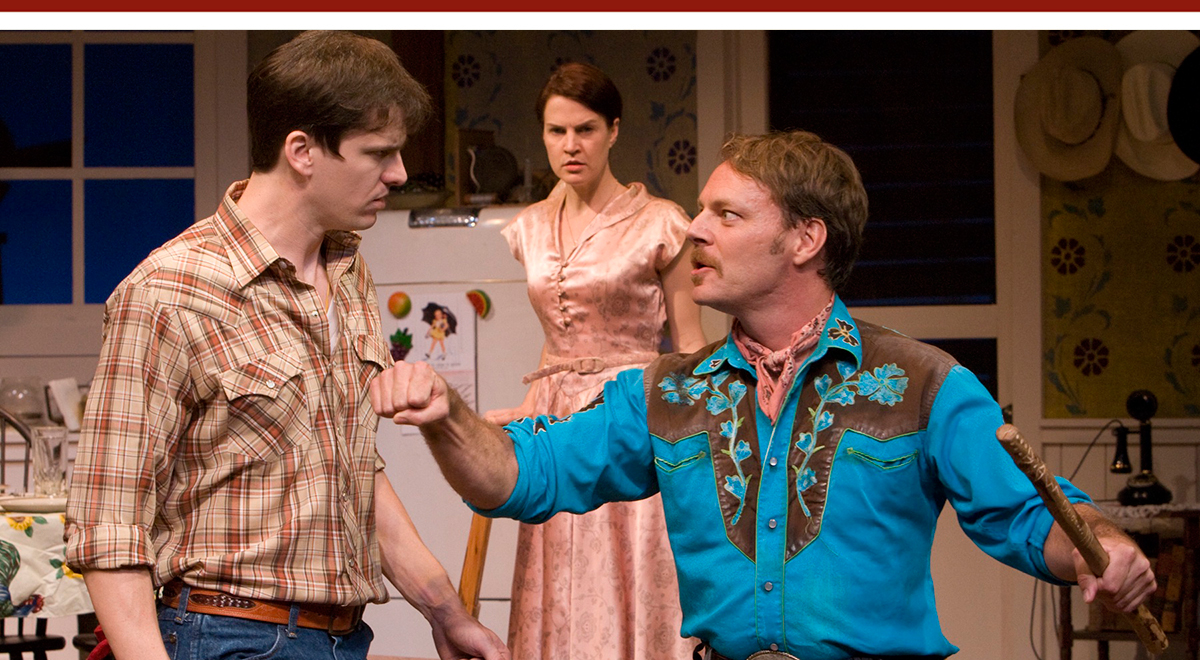
The trick to the character of Starbuck is to divine where the con becomes concern.  Like Harold Hill in ‘The
Music Man,’ who sells his marks a dream and then gets suckered right in after them, Starbuck may need the
rain he promises more than the farmers.  We occasionally need to sense that inner conflict – the cut and run
versus stay and help -- as well as the kind of shaman/showman quality that is outside the control of the
man.  A touch more of the magician as instrument of something unseen would add to the story.  

Representing his polar opposite is Noah.  Nash has named the most emotionally arid character after the
Bible’s Great Flood rider.  Noah runs the farm, dispenses advice to his lovelorn siblings with a voice of
experience he’s never earned, and retreats into the security of his account ledgers when human nature is
too much. If he ever had an emotional relationship, it is not mentioned.  Weingartner, one of Noise’s solid
company members, gives us a properly landlocked Noah.  

Foxworth, who has the responsibility of giving the production its transcendence, doesn’t tap enough of that
magic and that ultimately keeping the play from achieving the resonance it seeks.  He is a grounded
Starbuck, and in the scenes that require that, he delivers. One such scene ends Act II, as he must get real
with Flanery’s Lizzie in order to give her the self-confidence he desperately wants her to have.  In an honest
exchange of glances, they see each other - and themselves - for who they are, as revealed in their eyes.

Lizzie is the fulcrum of the story and Flanery has the wiring for the role, but too often leans on facial
expressions to insure her character’s feelings are getting across. The tendency is most pronounced in
emphasizing displeasure or anger.  And more unfortunately, that is Lizzie’s state of mind for much of the
play.  Flanery doesn’t trust her talent to convey these emotions through the eyes and speech alone.
Ironically, it is the scene in which she focuses on Lizzie’s and Starbuck’s eyes that shows what she’s got.

Edmonds, one of the company’s anchors, here anchors the play.  After the loss of his wife he has
committed himself to letting his children be happy.  The one most within reach of that goal is Jimmy, and
Hellwig delivers a beautiful version of the dreamer-in-waiting.  There is just the right embrace of simplicity in
the portrayal.  He has discovered a key part of Nash’s prescription to emotional health: don’t over
intellectualize.  He may be hitchhiking down the road to disillusion, but he has the fun-loving embrace of life
that ensures it will be in a fast car and a faster woman.

A couple of other elements do much for the show.  As Sheriff Thomas, Leonard Kelly-Young makes his
Noise debut with a nicely understated performance of this most minor character.  And David O provides
original music that is both plaintiff and evocative, adding a dimension that helps make a good production that
much better.
OF DROUGHT AND DOUBT
Bo Foxworth

PHOTO CRAIG SCHWARTZ
Joe's Garage
The Lady With All the Answers
by David Rambo, directed by Brendon Fox

Pasadena Playhouse   •   October 17 – November 23 (Opened, rev’d 10/24)

WITH  Mimi Kennedy  PRODUCTION  Gary Wissmann, set; Holly Poe Durbin, costumes; Trevor Norton,
lights; Lindsay Jones, sound; Carol F. Doran, wig; Joel Goldes, dialect; Lea Chazin/Hethyr Verhoef, stage
management

The time in 1975 when an issue stumped ‘The Lady With All the Answers,’ the
sobriquet Esther Pauline Friedman Lederer gave her alter ego, Ann Landers, is the
occasion for David Rambo’s 2006 one-woman show, now at the Pasadena Playhouse
(through November 23).  Rambo, with the cooperation of Lederer’s daughter, Margo
Howard, has created a surprisingly captivating evening that tells the Landers story as
it reveals how her correspondence with “60 million readers” became a unique
conversation with America.

Director Brendon Fox is fortunate to have Mimi Kennedy filling the stage with Lederer’s life and Landers’
letters.  Kennedy gives us a sense of both the public and private personae of the ground-breaking writer,
shifting almost imperceptibly between them as she mixes flashback storytelling, audience interaction
(including some “show-of-hands” surveys), and her side of several phone calls.  The calls come from her
daughter, her sister Pauline Esther (the identical twin who became Landers’ rival columnist, Abigail “Dear
Abby” Van Buren) and her husband of 35 years, Julius.  It is Julius' actions that have caused Lederer to
change format for her July 1 column, and discuss her own troubles rather than answer reader mail.  The
evening in which she struggles to complete the "hardest column I ever wrote" forms the time span of the
play.

In the first act, Rambo lets “Eppie” tell how she became Ann Landers, how she became Mrs. Julius
Lederer, and how twin sister “Popo,” born 17 minutes later, became “Dear Abby” less than a year after
Lederer took over the Landers column from its originator, Ruth Crowley.  In the second act we hear more of
the letters, especially those dealing with sex, relationships and personal growth.  Kennedy’s portrayal
balances an intuitive blend of humor, authority, self-effacement and sincere interest that allowed her to
coax more confessionals out of readers than a congress of Catholic clergy.  

The performance also gives the auditorium its own kind of balance.  The atmosphere is both inclusive and
intimate.  As if the fourth wall of Gary Wissmann’s beautifully tailored apartment opens onto a lecture hall
for hundreds of theatergoers, we are at once alone with her in her study and a member of a cross-section
of her readers.

Though 'The Lady With All The Answers' gives the 60 million figure for 1975, according to author Mark
Rhodes in the “Illinois Review,” by the early 1990s the column “appeared in 1,200 newspapers around the
world with 90 million readers daily.”  As Rambo illustrates here, Landers frequently directed that audience,
built  through her efforts to make individual lives better, to make the world better.  When cancer research
legislation had stalled on President Nixon’s desk in 1971, the advice columnist became advocate and urged
her readers to support the bill by mailing a clipping of the story to the White House.  It's estimated that a
million signed letters were sent as a result, and Nixon signed the Act.

Rambo, Fox and Kennedy have provided an engaging, entertaining and educational evening about the
influential woman behind one of the most famous pen names in newspaper history.

Postscript.  Landers' column would continue nearly 30 more years after the night dramatized in
‘Answers.’  In June 2002, Lederer would take the copyrighted column with her to the grave. Daughter
Margo, who had written her own column in the 1960s under the name “Dear Prudence,” now became “Dear
Margo,” still in syndication today.   

"Popo" had brought her daughter, Jeanne Phillips, on as co-writer for “Dear Abby” before her sister's
death.  But two months after Eppie died, her twin was diagnosed with Alzheimer’s Disease and Jeanne
went solo.  She continues to write “Dear Abby,” now estimated to be the most widely read column in the
world.
WELL ADVISED
Mimi Kennedy

PHOTO CRAIG SCHWARTZ
Spring Awakening
Book & Lyrics by Steven Sater, music by Duncan Sheik, directed by Michael Mayer   
West Coast Premiere

Ahmanson Theatre
  •   October 29-December 7, 2008 (Opened, rev’d 10/30))

WITH  Krystina Alabado, Christy Altomare, Blake Bashoff, Julie Benko, Todd Cerveris, Steffi D, Chase
Davidson, Kate Fuglei, Gabrielle Garza, Kimiko Glenn, Sarah Hunt, Anthony Lee Medina Andy Mientus,
Ben Moss, Angela Reed, Kyle Riabko, Perry Sherman, Matt Shingledecker, Claire Sparks, Henry Stram,
Lucas A. Wells
MUSICIANS  Jared Stein, conductor/keyboards; Freddy hall, guitar; Julie Danielson, bass;
Kristen Lee Rosenfeld; Marques Walls, drums; Alon Bisk, cello; Ben Lively, violin; Karen Waltuch, viola  
PRODUCTION Christine Jones, set; Susan Hilferty, costumes; Kevin Adams, lighting; Brian Ronan, lights;
Duncan Sheik, orchestrations; Simon Hale, string arrangements; AnnMarie Milazzo, vocal arrangements;
Kimberly Grigsby, music supervision; Jared Stein, music direction; Bill T Jones, choreography

The absurd gap between what adolescents must learn about life and what formal
education – and much ‘home’ schooling – lays on them is exposed by a single scene
shift in ‘Spring Awakening,’ Steven Sater and Duncan Sheik’s 2006 musicalization of
Franz Wedekind’s play, now at the Ahmanson (through December 7).  Fourteen-year-old
Wendla (Christy Altomare) opens the show with “Mama Who Bore Me,” reaching out
for maternal guidance as she roams the reaches of her newly charged body electric.  
Mama, however, refuses to lend a hand in understanding Wendla’s current situation,
and that still-too-common act of denial will lead to horrible consequences.  

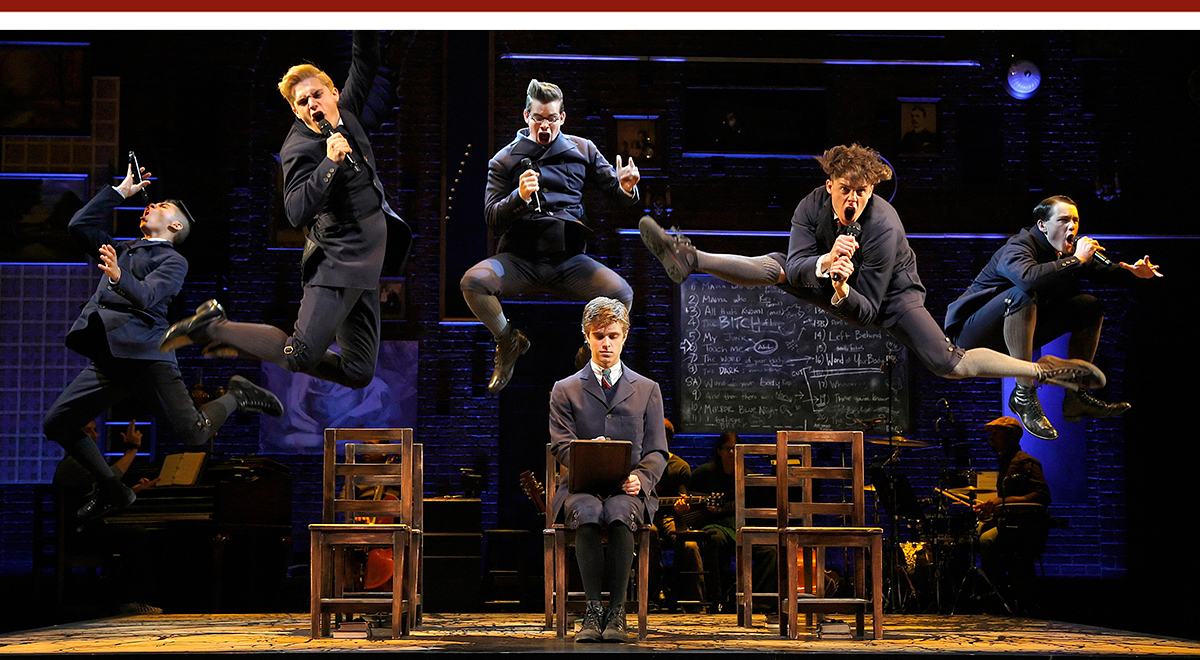
Segue to a boys school, all the more incarcerating within Designer Christine Jones’s giant brick-walled
set.  The students – segregated from Wendla and her gender – are obsessed with their own stirrings.  
However, while their heads are stuck in a pubescent dreamworld as frightening as it is fantastic, the
headmaster insists on shoving those heads into books about ancient civilizations and dead languages.

Sater (book and lyrics) and Sheik (music) have pulled the covers off Wedekind’s play in a way that makes it
dynamic and urgent for today’s audiences, even as it portrays an era that was vastly more repressive.  
This is done by keeping it visually Victorian, but infusing it with the defiant sound and stance of rock.  (Bill T.
Jones did the choreography.)

Sheik’s score is feisty enough to give the actors room for swagger, but not too tough for Broadway.  
Thanks to Director Michael Mayer’s impressive grasp of the play’s style and subject, and an excellent
ensemble’s spirited delivery, this musical could be theater’s counterpoint to the rockers who best embodied
adolescent anger in past decades – from Pete Townshend, to Elvis Costello and Joe Strummer, to Kurt
Cobain.  

To articulate this world between childhood and independence, Sater has given the text both toughness and
poetry.  Though Wedekind wrote it in 1890, several years before Sigmund Freud’s ‘Interpretation of
Dreams’ would give scientific support to much of the playwright’s dramatic motif, it was not staged in his
native Germany for a decade and a half.  It took another 11 years for it to reach England.  Its production
history has been marred by charges of pornography.

To be sure, there isn’t a lot of hiding behind metaphor here.  Sater, Sheik and Mayer are simply dealing in
what are – or should be – universal experiences of maturation: isolated fantasy and masturbation, to
exploration and intercourse with lovers.  To be honest, the creators include an act of coupling to straddle
the interval.  And yet, all who have been through it – or hope to not be shocked.  It’s message is meant to
awakened elders to the responsibility of communicating honestly.

The story follows three of the teens ­ Wendla, Melchior (Kyle Riabko), and Moritz (Blake Bashoff).  
Wedekind subtitled it “A Children¹s Tragedy.”  And, all three tragically will find their awakenings perilous.  All
the adults (played by two actors ­ Angela Reed and Henry Stram ­to reinforce the solidarity of the
parentocracy) are unhelpful and pig-headed at best, brutal and dangerous at worst.  Wendla¹s story gives
the play symmetry.  After the non-conversation with her mother, she fends for herself, riding her urges to a
hayloft where the irresistible Melchior sits swatting at his own demons.  They meld in the straw, giving Act I
its button, and the show its fulcrum.

After the break the world has changed.  The genie is out of the box, and the kids have knowledge and
independence.  But for many of them, it does not translate to fulfillment.  Moritz is especially lost, while
Melchior and Wendla¹s exploration has borne fruit.  Her complicit mother demands to
know: “What have you done?”  When Wendla pleads innocent, her mother snaps back “Oh, I think you
know!”  She is so in denial of her role that she has convinced herself that her daughter magically learned
what she refused her.  Now, she shames Wendla for asking about.

And, here¹s where the third rail of the play¹s themes comes in: the pious abuse of religion.  The adults in
‘Awakening’ uphold The Bible, but only to bring it down with a vengeance on the heads of their hormonally
jostled juveniles.  They hope to beat lust from the teens the way one beats dust from blankets on a line.

The ensemble is so seamless, and the assignments so well divided that everyone, from the three leads to
the violinists and ensemble members who spend the show in shadow exude ownership in the piece.  More
kudos to Mayer for creating such an environment.  

One of the many joys is the band.  Small and cohesive, they are as energized as the cast and as animated
as a rock band.  Cues from Music Director Jared Stein, who plays keyboards, blend traditional measure-
counting with an animated piano-bench bounce and dancing hands that jab the backbeat with pistol fingers.

Despite Wedekind’s tortured message, the performances leave us with a sense of optimism.  Sater
supports this with a song near the end.  Like the natural order to which the show¹s title alludes, people are
capable of breaking through whatever sod is shoveled over them.  With the eternal innocence of rock
posturing, it¹s hard not to believe it.  The yank of spring is still a time to shake ourselves free of the clods.  
And that is the first step to the fruit that lies ahead.  The ensemble sings Sater’s lines: “All shall know the
wonder of purple summer.”  

Here’s to parents who wake up and make getting there less bruising.
NO STAGE FOR OLD MEN
Christy Altomare
Kyle Riabko

PHOTO PAUL KOLNIK
This Beautiful City
by Steve Cosson and Jim Lewis, music and lyrics by Michael Friedman, directed by Steve
Cosson   
West Coast Premiere

Kirk Douglas Theatre
  •   September 21-October 26, 2008 (Opened, rev’d 9/28)

WITH  Emily Ackerman, Marsha Stephanie Blake, Brad Heberlee, Brandon Miller, Stephen Plunkett, Alison
Weller  
MUSICIANS  Tom Corbett, Erik James, Mike Schadel, Brian Duke Song  PRODUCTION  Neil Patel,
set; Alix Hester, costumes; David Weiner, lights; Ken Travis, sound; Jason H. Thompson, projections; Erik
James, musical direction; John Carrafa, choreography; Hannah Cohen/Jennifer Brienen, stage
management.  A co-production with Vineyard Theatre.

Like hikers scaling Pike’s Peak, the Rocky Mountain that dominates the skyline west of
Colorado Springs, The Civilians provide thrilling spectacle as they challenge the
heaven-scraping grandeur of ‘This Beautiful City,’ an interview-based “dram-umentary”
now at the Kirk Douglas Theatre through October 26.  But just as they make the
loftiest point, and crest to begin winding back down, it gets cloudy and they wander
slightly off the trail.

Still, that first-half ascent alone is wondrous enough to justify the drive to Culver City.  

This West Coast premiere is the latest of The Civilians’ half-dozen “investigative theater” projects. Artistic
Director Steve Cosson and Jim Lewis created the script from interviews, news stories and a minimum of
original dialogue.  Cosson, Lewis and five of the six cast members interviewed hundreds of Colorado
Springs residents while living among them in the weeks surrounding the 2006 mid-term elections.

Colorado Springs was already home to the U.S. Air Force Academy and the North American Aerospace
Defense Command (NORAD) when in 1984 it attracted the mega-ambitions of evangelist Ted Haggard.  
Haggard in turn attracted thousands of fellow fundamentalists as he grew the biggest fish in an over-
stocked pond of large, small, white, black, conservative and liberal churches.  Haggard’s mission for New
Life church was widely know to be the conversion of Colorado Springs into a Christian community.

And that is what attracted The Civilians.

Onstage ensemble members Emily Ackerman, Marsha Stephanie Blake, Brad Heberlee, Brandon Miller,
Stephen Plunkett and Alison Weller (except Miller) joined the writers in tape recording conversations with
church leaders, local journalists, parishioners, atheists, business people, cadets at the Academy, and
apparently anyone else who would sit still.  We can hear in the responses used in the script that the
residents overcame any suspicions of the The Civilians’ motives.  Those instincts were justified, for The
Civilians have treated all their subjects with rare respect.

Then, while fishing for reactions to Haggard's the mega-church from average folks inside and outside New
Life, they netted a story of Shakespearean scale.  That discovery, judiciously planted as the act break cliff-
hanger, marks the show’s dramatic peak.  It lands with the storytelling wallop of divine intervention -- a gift
from a fed-up God.   

The act break is a dramaturgical gift, too, as it comes after the first stall in what had been consistently
mounting dramatic tension.  The tension alone is a major achievement, because it develops sublimely
through the unadorned presentation of conversation.  Suddenly we are experiencing the rare power of
people presented objectively.  Most artists (and reporters) would be tempted to editorialize by adding subtle
shadings of attitude and cynicism.  The Civilians, true to their non-affiliated name, resist applying a single
brush-stroke of irony.  Because of that – and superb, honest acting – we’re allowed to hang on every word,
and watch how some of the speakers are eventually hanged by them.

The actors, whenever possible, “perform” the people they interviewed. They are clearly operating with that
extra measure of consciousness that comes with a commitment to something bigger than craft.  Over-
familiar journalists can lose objectivity with too close a relationship to their subjects.  These investigative
thespians only get closer to the truth.  The way they bring their subjects back alive not only protects their
sources, but  safeguards their play’s relevance.  

While they should all be singled out, we’ll mention Brad Heberlee because one of his characters is so
illustrative of the phenomenon.  His impassioned minister is the charismatic fisher of men who gets us to
willingly sign over title.  Without the slightest indication that he’s working at it, Heberlee expertly delivers this
character, wearing his enormous charisma loose enough so the unctuous charm never soaks through.  The
entire cast, however, performs similar miracles creating great characterizations of a transsexual, a black
minister, and a local weekly editor who is dumbfounded by Haggard's success.  

The stall occurs during the late act one scene with the RHOP, when one member launches into an
explanation of what inspires their faith.  There’s a palpable drag as for the first time it feels like we've heard
this before with equal sincerity and passion.  It's as if our climb has plateaued.  The same group will produce
an even more egregious diversion when we follow the group's leader as he rambles along a cross-country
video blog.  It may bring closure to that sub-story, but it's at a cost of diluting the play's energy.

Much of that energy comes from Michael Friedman’s original music, performed by Tom Corbett, Erik James,
Mike Schadel and Brian Duke Song.  It beautifully captures how the narcotic pop of contemporary Christian
music can mask what, lyrically, is only one story.  Ken Travis’ sound design, so subtle it could be missed, is
another example of the power of understatement.

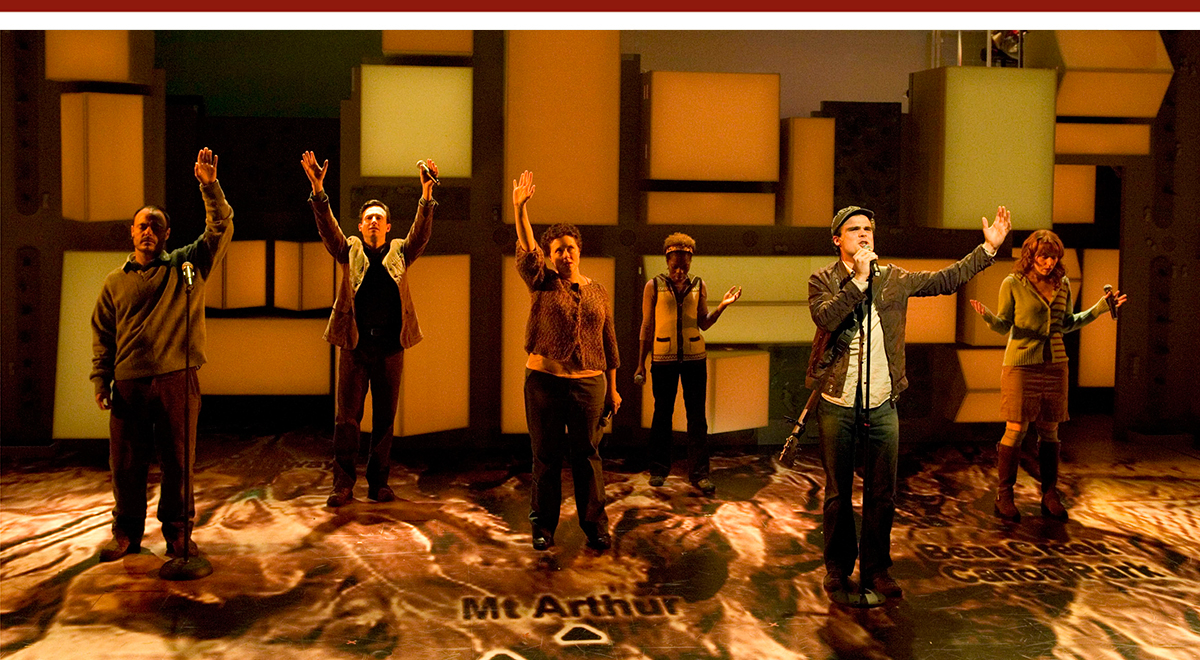
The physical production is dominated by Neil Patel’s God’s-eye view of Suburbia.  Patel, Cosson and
company come up with more entertaining things to do on its rooftops than Jerome Robbins did in ‘America.’  
The housestops become projection screens, light boxes, backdrops and ultimately a kind of city planner’s
Google map of Eden.  Costumes by Alix Hester are a perfect fit, from the camouflaged editor to the wolves
in sheep's clothing.

Structural quibbles aside, there is so much to love here.  The gentle juxtaposition of God the Father and
Mother Nature, in the guise of several National Park guides, is elegant. The last ranger to appear reminds
us, “Even with a map you can get lost.”  A good reminder for trailblazing preachers, backpackers, and
playwrights.  (‘This Beautiful City’ will be Off-Broadway at the co-producing Vineyard Theater in 2009.)
ROCKY MOUNT
Stephen Plunkett

PHOTO CRAIG SCHWARTZ
This Beautiful City
Joe's Garage
written by Frank Zappa, adapted by Pat Towne and Michael Franco, choreography by Jennifer
Lettelleir, musical direction by Ross Wright, directed by Pat Towne

Open Fist   • October - November 24, 2008 (Opened 10/, rev’d 10/17 extended to 12/20)

WITH Jason Paige, Ben Thomas, Michael Dunn, Becky Wahlstrom, David Castellani, Maia Madison, Mario
Mosley, Tom Burruss, Matt Crabtree, Nicole Disson, Crystal Keith, Jennifer Lettelleir, Pip Lilly, Lindsay
Loesel, Jonny Marlow, Franci Montgomery, Herbert Russell, Laura Sperrazza, Glen Anthony Vaughan
MUSICIANS  Ross Wright, bass; Ian Dahlberg, sax/keyboards; Daniel Kaminski, malacat/percussion; Scott
Nagatini, keyboards; Ken Rosser, Kevin Tiernan and Chris Wabich, guitars
PRODUCTION Michael Franco,
Jeff G. Rack, Shawn MacAulay, production/set/puppet design; Martine Granby, cosumes; Cricket Sloat,
lights; Tim Labor, sound; Sam Saldivar, video; Marjorie Knight/Monica Martin, stage management

Frank Zappa personified the highest ambitions of rock music.  He considered himself a
composer first, a musician second, a singer not at all, and a lyricist by necessity only.  
His three-decade career – fronting his ‘Mothers of Invention’ and on his own – drew
inspiration from obscure avant garde composers, R&B hit makers and lots in-
between.   In 1979, around the midpoint of a recording output that began with ‘Freak
Out’ in 1966 and ended with his death at 52 in 1993, he released ‘Joe’s Garage, Act I, II
and III.’  Nearly 30 years later Open Fist Theatre in Hollywood has staged its premiere
(through November 22) under the watchful eye of Zappa’s widow, Gail.     

The original double-album, now 2-CD set, of “Joe’s Garage” included lyrics in script form, stage directions
and character descriptions: everything a garage of thespians needed to stage a lip-synch version. Now, co-
adaptors Pat Towne (who directs) and Michael Franco have put the 90-minute recording on its feet with
word-for-word, note-for-note faithfulness.  No little feat.  To do so they assembled the key element, a Joe
who makes this work as rock and as theater, and a band that can handle Zappa’s mercurial music, from
crushing hard rock to unison runs of high-velocity jazz – all in a music-stand-demanding sampler of shifting
key and time signatures.  While the Fist’s brick-box acoustics might have bothered the meticulous Zappa,
they do further the “garage-band” sensibility.  The entire physical production, in fact, has a kind of found-art
brilliance to it: Franco, Jeff G. Rack and Shawn MacAulay did the set, puppets and props; Martine Granby
designed costumes; Cricket Sloat contributed lights; and Sam Saldivar filled the two projection screens.)

Jason Paige’s Joe, however, is a performance that fearlessly goes where no one has gone before.  Singing
his heart out as was the requirement of Zappa vocalists, he soars on the authentic playing of the band
under the musical direction of bassist Ross Wright.   Ben Thomas, in a role that sadly falls off Zappa’s
narrative too early, is also terrific.  

Zappa's story, such as it is, is a paranoid fantasia for the success-bound rock musician.  From garage band
roots to local success and record company support, Joe's story hits high and low notes of rock star
mythology -- from yelling neighbors to yielding groupies to mindless journalists and soulless record execs.  
His zigzag tale seems built more to hang a line from which his songs can be sung. While Zappa was a great
defender of freedom of speech, and a crusader against censorship right into to the halls of Congress, here
his sense of the dramatic leans more towards the shocking than the structured.  

The compelling Orwellian tone and sanctimonious call for absolutely free speech seems to be clearing the
way for nothing more purposeful than our right to have sex in public and swear up a storm.  As appealing as
that is, we need more.  As if, after  the garage owner gives total independence and freedom of expression
to the teen band members he houses, then returns to see all they used it for was spray painting "pussy" and
"fuck" on the walls.  Okay, fine:  That's a start.  Today, the underlying themes of abusive power never
needed to be so vague and sophomoric.  Sexual freedom may be the obsession of high schoolers, but the
imperials we need to blow down are the constitutional rapists like Cheney and Rumsfeld.  Their ilk is always
roaming around like Twain's Duke and King.   

Nevertheless, the actors and band, as well as the designers and backstage crowd who built this impressive
physical production, have invested it with a kind of zealous fervor.  The devotion to recreating Zappa’s
world is unquestioning, understandable, and only once ill-served - when we get an entire Zappa piece
played in the dark.  (A few minutes would serve the purpose.)   However, when the band launches into
'Peaches en Regalia,' one of Zappa's great instrumental pieces off the 'Hot Rats' lp, we are believers again.

'Joe's Garage' is garage band mythology, paranoid fantasy, civil rights righteousness stitched into a storyline
that never rises too far above the interests of a couple High School juniors indulging their fantasies after
draining a keg.  But the sheer force of the music is connecting with younger audiences, many of whom, if
even born when the record came out, certainly weren't buying it.  That they're buying Zappa's music now is  
is the latest marvel from the wonderful folks with the Open Fist.
BLOWJOBS AGAINST THE EMPIRE
Click the button to request a
printable version of this review.  
Top of page
Top of page
Top of page
Top of page
Jason Paige

PHOTO MAIA MADISON
The Lady with All the Answers
Read a report in New
York's 'Time Out' about
Ted Haggart attending a
performance
(3/12).