

For All Time
by KJ Sanchez, Laurie Woolery World Premiere
Cornerstone Theater Company • October 30-November 23, 2008 (Opened, rev’d 11/6)
WITH Richard Azurdia, Gustavo Cayro, Kate Coyne, M.C. Earl, Jose A. Garcia, Kozetta Garnett, Ramona
Gonzales, Jenny Vaughn Hall, Yolanda Hester, Nathan Hunter, Jonathan Jerald, Joshua Lamont, Diana
Mera, Sherrie Miller, Xavi Moreno, Pat Payne, Sabrina Sikes, Geri Silva, Jimmie Thompson, Bahni Turpin,
Carolyn Van Brunt PRODUCTION Amy C. Maier, set; Elizabeth A. Cox, costumes; Geoff Korf, lights;
Michael Hooker, sound; Lindsay Byrne, stage management
Like justice, dramatic engagement hangs in the balance. The see-sawing of conflict
and resolution is the pulse that gives music and drama its grip. KJ Sanchez’s ‘For All
Time’ is the third in Cornerstone Theater Company’s five-play look at various aspects
of justice (through November 23 at Shakespeare Festival/LA). Through interviews with
those on all sides of crime and punishment, Sanchez provides gripping moments in an
even-handed look at the inevitable shortcomings of our systematic pursuit of fairness.
On a symmetrical set, a fine ensemble under Laurie Woolery’s evocative direction gives pro and con equal
voice. Individual moments have shape borne of conflict, creating vivid, in some cases unforgettable,
snapshots from these tortured lives. An overarching dramatic arc, however, has been left hanging in, or
perhaps flattened by, the balance.
Those snapshots are from real life, and like the work of The Civilians (with whom Sanchez is an associate
artist) there is excitement in knowing that layers of conventional theater artifice have been stripped away.
As with The Civilians' ‘This Beautiful City’ (reviewed here), which played the Douglas in October. ‘For All
Time’ acknowledges its devise by quoting a couple interviewees as they ask whether their comments will
really be useful as material for the stage.
To their credit, Sanchez and Cornerstone may have consciously chosen not to employ the structural
apparatus that helped give the last installment, Julie Marie Myatt’s ‘Someday’ (reviewed here), an
audience guide wire through the scores of real-life vignettes. It’s good to avoid allowing these cycle plays
to become formulaic. However, where ‘Someday’ hung its character sketches and social commentary on
two strong stories with beginnings, middles and ends, ‘For All Time’ becomes a blur of short, fairly
anonymous episodes, only loosely threaded on a string of selections from Aeschylus’ ‘Oresteia,’ and two
inmates’ experiences in (Jonathan Jerald) and steeling for (Bahni Turpin) their probation hearings.
Woolery has given the production dramatic relief, drawing fine performances from all these actors, and in
some cases rather extraordinary stage moments. Among the highlights are Richard Azurdia’s “Tai,”
Ramona Gonzales’ heartbroken woman whose violent brother she no longer relates to, M.C. Earl as the
frustrated-but-caring older brother of a convict, and Joshua Lamont as the survivor of a brutal beating.
Tucked into the play’s flow are some statistics to remind us that inherent racial and economic injustice
undermines any confidence we might have on our system of law and order. There is such tell-tale
imbalance in the prison population (the highest per capita in the world). While African-Americans make up
less than seven percent of the general population, they are nearly 30 percent of prison populations.
Meanwhile, whites, with half the general population, make up only a quarter of those behind bars. At
various times, five male prisoners talk frankly about their lives at one end of the reflecting pool. At others,
they are mirrored at the other end by women wrestling with the rage they are asked to surrender.
There is much to recommend in ‘For All Time.’ The brutal disregard of so much crime, and the knowledge
that so many go unsolved or unpunished, tip the balance of our sympathies for the victims. Yet, Sanchez
and Woolery let those behind bars seem real and we can empathize and understand that we cannot assume
the simple act of sentencing means justice has been served.
If the ‘For All Time’ leaves us feeling we have been looking through snapshots arranged across a tabletop,
without enough dramatic arc to engage us as story, it never fails to engage us as urgent social portraiture.
The readings of ‘The Oresteia,’ which has been called “the only complete [Aeschylus] trilogy which has
escaped the wreck of time,” are done by Xavi Moreno as the lead chorus member. He carries the
paperback with him (except for a scene in which Jose A. Garcia carries it while Moreno is Antoine) from
pre-show through the play. It is a call to apply ancient wisdom and patience to our system of justice. And, a
reminder that in theater, honest debate will emerge from honest portrayal.
THEATER TIMES REVIEWS NOVEMBER 2008
|
A Noise Within
Cornerstone Theatre
South Coast Repertory
Laguna Playhouse
Kirk Douglas Theatre
Rude Guerrilla
Charles Dickens' Oliver Twist
adapted by Neil Bartlett, directed by Julia Rodriguez-Elliott
A Noise Within • November 6-December 14, 2008 (Opened 11/7, rev’d 11/8)
WITH Shaun Anthony, Jessica Berman, Brian Dare, Robertson Dean, Apollo Dukakis, Geoff Elliott, Tom
Fitzpatrick, Jill Hill, William Dennis Hunt, Stephen Rockwell, Aurea Tomeski, Tim Venable, Christina
Ishizaki, Anne Troupe PRODUCTION Kurt Boetcher, set; Soojin Lee, costumes; Ken Booth, lights; David
O, music; Monica Lisa Sabedra, wigs/hair/make-up; Maggie Goddard, stage management
A Noise Within has entered the Dickens Derby with ‘Oliver Twist’ (through December
14). Neil Bartlett’s new adaptation, ‘Charles Dickens’ Oliver Twist,’ plays to the
company’s strengths: a venue that welcomes the grimy confinement of designer Kurt
Boetcher’s stage-within-a-stage; director Julia Rodriguez-Elliott’s talent for giving
even non-musicals a sense of movement, and an ensemble capable of giving the show’
s anonymous group of players an air of cohesion and shared purpose.
In his introduction, Dickens stressed that the severe conditions and characters he portrayed in ‘Oliver
Twist,’ were based in reality. The implication was that his 1839 novel, his second after ‘Pickwick Papers,’
was serious social indictment. And, that while it offered a gallery of unforgettable personalities, it was all
drawn from Dickens’ experience as an “orphaned” child forced to labor after his family was sent to the
poor house. The most enduring of these is the imperious lowlife Fagin. Rodriguez-Elliott’s casting of Tom
Fitzpatrick in the role is not just a highlight of this production, but of Dickens on stage regionally.
Bartlett’s adaptation sets the play in a rather decrepit English theater. The company is both ensemble and
Greek chorus – or perhaps Gregorian chanters – who sing unison bits of establishing exposition as
recitative. They congregate on their upstage platform during pre-show like members of an orchestra tuning
up while a ghost light occupies center stage. They don costumes and wigs before an entrance, otherwise
they sit and watch. They share the narrative with Shaun Anthony’s John Dawkins, who walks us into the
story as, one presumes, an actor before entering the story as ‘The Artful Dodger.’ Sadly, Anthony’s accent
(no one claims program credit as dialogue coach) is one of the weaker spots in the show.
Rodriguez-Elliott keeps this production dark and foreboding, yet accented by comic touches that keep it
lively. She establishes this tone early (a full-stage, over-the-top eruption of indignation greets Oliver’s
request for more), but employs them sparingly. William Dennis Hunt, Jill Hill and Apollo Dukakis
(particularly effecting as Mr. Bumble) have the physical characteristics to create characters torn from the
original book’s illustrations. Robertson Dean and Geoff Elliott loosen up to given multiple roles plenty of
playfulness; Stephen Rockwell and Jessica Berman give Noah Claypole and Rose Brownlow, respectively,
give the show touches of innocence and sincerity.
Though Dickens has become the stuff of cozy fireside reads and holiday theatricals, he wrote ‘Oliver Twist’
to provide “a lesson of the purest good . . . drawn from the vilest evil.” While Oliver (a pleasant Brian Dare)
jump-starts the story by running away as a boy, he soon lands in Fagin’s clutches, and quickly hands the
reins of dramatic action to him and his cronies. Fagin’s circle represents a microcosm of society's lost
souls, where good and evil fight it out between the good (Oliver), the redeemable (Hill’s Nancy), and the
irredeemable (Elliot’s Bill Sikes).
Because Oliver essentially becomes a passive victim of adults, the story spills out beyond his personal
narrative. Here Bartlett has let it flow onto the flood plane of Act II. The battle of wills between Nancy,
Fagin and Sikes needs more clarity and balance. All three drift closer to the center. In the case of Nancy,
Hill's resistance to making her sweet is right. What emerges -- be it maternal instinct, final disdain for her
way of life, or retaliation against the men – should work subtly in her. Her goodness becomes highlighted
in opposition to the others.
In the middle, Fagin is able to shift his footing from comic to terrifying when it serves his purpose. Here is
where Fitzpatrick, a mainstay of the Actor’s Gang making only his second ANW appearance, does
wonders. As Sikes, whom Dickens described as “utterly and irredeemably bad,” Elliott goes for the
brutality and finds it. He is somewhat hampered by vocal embellishment that cushions us from a man of
pure evil Dickens said “would not give, by one look or action of a moment, the faintest indication of a better
nature.”
Rodriguez-Elliott might help focus the second act’s storytelling by bringing Fagin’s prison scene center
stage. Obviously there are logistical reasons that she has opted to keep it on an upstage wagon. But a
couple more holes in the floor for prison bars and a few seconds added to the running time – currently less
than two hours -- would give this central moment for a central character, its proper penultimate place.
Still, the production is a welcome addition to Southern California's staging of Dickens. If it sells as well as it
plays, one guesses it may return, as the (admittedly cheaper) productions of 'Godot' and 'The Price' have.
Certainly the production has the earmarks of long-term investment. Soojin Lee’s detailed and distressed
costumes play richly under the candle-warmth of Ken Booth’s lights. David O composed the plaintive
score, played in another strolling performance by violinist Endre Balogh. It may not be one of Boz'
Christmas stories, but the holidays are a fine time to remember that the mistreatment of children did not
end with the reign of Queen Victoria.
Tom Fitzpatrick
PHOTO CRAIG SCHWARTZ
The Little Dog Laughed
by Douglas Carter Beane, directed by Scott Ellis
Kirk Douglas Theatre • November 16 – December 21, 2008 (Opened, rev’d 11/23)
WITH Johnny Galecki, Brian Henderson, Zoe Lister-Jones, Julie White PRODUCTION Allen Moyer, set;
Jeff Mahshie, costumes; Donald Holder, lights; Lewis Flinn, music/sound; Cricket S. Myers, sound; Gregory
T. Livoti, stage management
In the world of Douglas Carter Beane’s ‘The Little Dog Laughed,’ the three roads to
happiness are love, sex and the career, and all require constant negotiating. Making
his case is the agent provocateur Diane. Think meaner, butcher, just as sexy
namesake of ‘Network’s’ Diana Christenson. Negotiations to cast Julie White in the
role brought happiness all around as she followed the 2005 Off-Broadway bow and
2007 Broadway run by winning theater’s top award (as Faye Dunaway did the Oscar
for Chayefsky’s Christenson). Haggling with Box Officers at the Kirk Douglas Theatre,
where ‘Dog’ plays through December 21, would be ill advised, however, as this is a
must-see.
White is one part of the production’s winning trifecta. Beane is as sure-handed a writer as [insert top
NASCAR draw here] is a race car driver. Audiences can relax for the two-hour, two-act ride through
wildly revved scenes over dangerous curves for every gender. This would all be a disaster, however,
without a masterful director to meet Beane’s demands. Scott Ellis – who recently helped bring out the best
in ‘9 to 5: The Musical’ at the Ahmanson – again lets his actors and designers work their magic with tonal
unity without leaving his fingerprints on anything. Those who want their playwrights to stay on the
“straightaway” are cautioned: there is brief male brieflessness, and participles do dangle.
White’s Diane is guide through style and substance. In her opening monologue about beautiful beginnings
and how ‘Breakfast at Tiffany’s’ ruined a promising one, she sets the anything-is-possible tone with
interactive stand-up. The story is very much an inside look at the world of the hard-bitten theatrical agent,
the reality of theater’s place in a world of hundred-million-dollar film projects, and a sour bottom line that
suggests “the closet” may still have appeal if it’s stocked with enough lucre. Still, tucked within all the
cynicism is a fairly sweet reminder that love knows no borders. And that those borders that do exist have
been imposed like gerrymandered political divisions by people out to control others.
Movie star Steve (Brian Henderson), who doesn’t identify as gay, nevertheless has a Jones for Joes that
began back in Boy Scouts. (The merit badge that dare not speak its name, to paraphrase the kind of one-
liners that fill the script.) Left to his own devices, hotel room and Internet connections after New York
business meetings under his agent Diane’s wing, he will order up a prostitute. Alex (Johnny Galecki)
answers the call. He is also a sexual fence-sitter. A male prostitute who is in it “only for the money,” his
loosely strung relationship with “girlfriend” Ellen (Zoe Lister-Jones) is lukewarm and mainly maintained for
its playful mix of sex and cynicism. An opportunity for Steve to star in the film adaptation of a play comes
about just as he decides to come out and see if his prostitute might be a becoming partner. Diane,
envisioning her seven years invested in Steve’s career going down a Larry Craig toilet, intervenes.
The production is, as usual here, super slick and imaginative. With the most steeply raked seating in town,
the Douglas presents a unique challenge in give audiences a sense of direct sight. Yet, set designers like
Allen Moyer here, continue to neutralize the problem. Tall banks of translucent panes in accept back-lit
pastels from Donald Holder’s light palette and the occasional gobo projected to establish location, and
divide neatly into horizontal thirds that facilitate automated scene changes. Two stacks of gold-cane
banquet chairs flank the playing area, a wonderful elaboration on a single line in the script.
Jeff Mahshie’s costumes are also just right and the sound and music by Carter Beane’s partner and co-
parent, Lewis Flinn (cued with an exactitude that merits noting by production stage manager Gregory T.
Livoti) is evocative.
It is, however, White’s show. The curbs have been pushed way back to let her take Diane to the limit and
she navigates it all magnificently. In a little echo of the 1970s’ Diana, who admonished Robert Duvall’s
Frank Hackett with, “Now, Frank, it’s being handed to us on a plate; let’s not blow it!,” Beane’s Diane
delivers a similar line to Steve. But here, “Don’t blow it!” is double-entendre that White hits like a 7-10 split.
Then, with the kind of wall-breaking awareness that fills ‘The Office,’ she grimaces and shakes at her own
pun.
It is a black comedy tour of contemporary people who are driven by lust to pursue their happiness through
love, sex and career, all the while operating with a license that never requires them to remove their blinders.
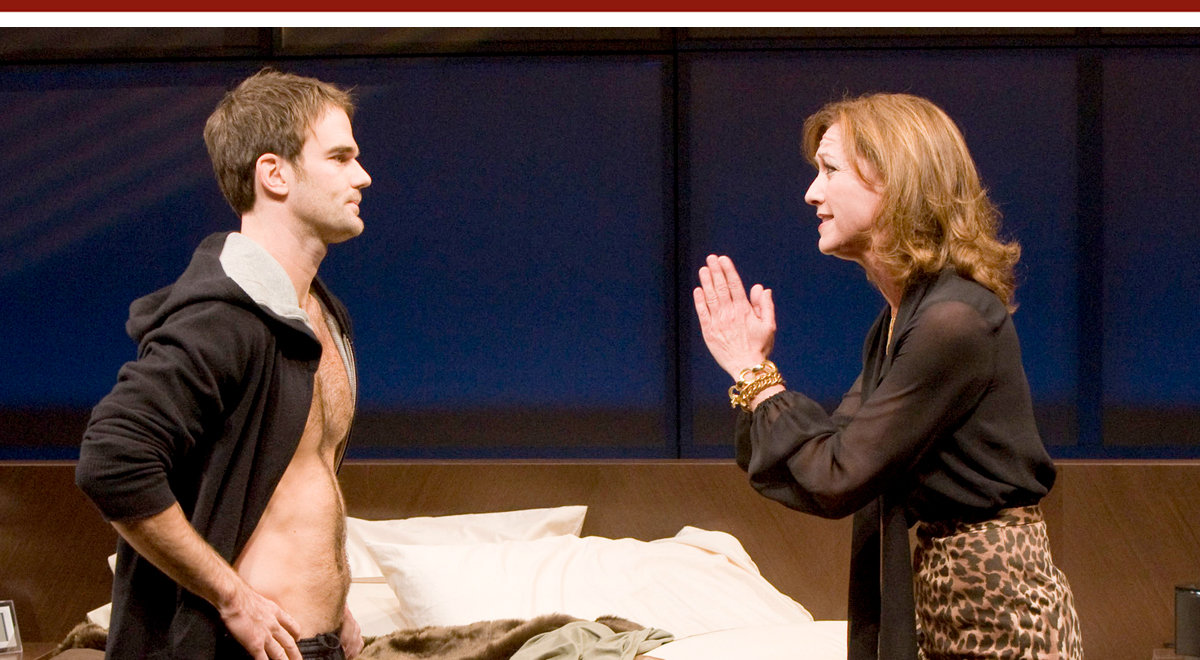
Zoe Lister-Jones
Julie White
PHOTO CRAIG SCHWARTZ
Click the button to request a
printable version of this review.
The Heiress
by Ruth Goetz and August Goetz, directed by Martin Benson
South Coast Repertory • October 17- November 24, 2008 (Opened 10/24, rev’d 11/8m)
WITH Tony Amendola, Karen Hensel, Branden McDonald, Lynn Milgrim, Rebecca Mozo, Michael A.
Newcomer, Kirsten Potter, Jennifer Parsons, Amelia White PRODUCTION Thomas Buderwitz, set; Maggie
Morgan, costumes; Tom Ruzika, lights; Vincent Olivieri, music/sound; Chrissy Church/Jamie A. Tucker,
stage management
The wealth a lonely daughter inherits from her lonely father is the least of the baggage
bequeathed to ‘The Heiress,’ a cautionary melodrama about children raised by parents
conditioned to diminish them. South Coast Repertory’s current production (through
November 16) skirts the pit larmoyant on the back of another winning performance by
Kirsten Potter, a strong turn by Tony Amendola, and the restrained direction of SCR
Artistic Director Martin Benson.
Potter plays Catharine, a 20-year-old on the fast track to spinsterhood thanks to the over-bearing rearing
she has received from her father, Dr. Sloper, played with beguiling charm by Amendola. Catherine, an only
child after her mother died in childbirth, has been made to feel guilty about a loss her father seems to
believe was his alone, and not hers. Sloper, who by all accounts has a welcome bedside manner for his
many patients, has no patience for Catherine’s shyness, clearly the result of the father’s constant reminders
that her mother was a far superior creature.
The broad-stroke character study is descended from an original story by Henry James titled ‘Washington
Square.’ The drama hinges on the fact that the doctor is incapable of examining his own actions. It is his
depression, from 20 years of getting up on the wrong side of a lonely bed with no right ones, that he will
pass on to Catherine long before his last will and testament. He has blindly crippled the girl by expecting her
to measure up to the yardstick of the idealized wife he holds impossibly high and out of reach.
To say she is starving for affection is the understatement of American letters. When Morris Townsend
(Michael A. Newcomer), the brother of her cousin’s fiancée, tags along on a visit by the couple, he makes it
clear he is interested in Catherine. He will return on his own that week and within a few visits propose
marriage. The curative powers of affection overwhelm Catherine’s suspicions and she accepts Morris’
proposal.
For all of Act I, Benson and Newcomer keep us guessing whether Morris’ intentions are inspired by
Catherine’s beauty or booty – as in treasure chest – as in future inheritance. Meanwhile, Benson and
Amendola keep Sloper’s motivations equally balanced between the selfishness of a graceless father and the
intuitions of a caring elder who is sure he smells a rat.
Of course, Dr. Sloper will be vindicated in Act II and the mystery will shift to how Catherine will deal with
Morris’ exposure. Naturally, and sadly, she will mourn the death of her love as her late father did after the
death of his: she will inflict suffering on the one who snatched it away. That is her inheritance.
Potter, a favorite of these pages, is quite good in this role. She never lets Catherine fall into self-pity.
Despite the devastation of a desperately needed romance proving itself fraudulent, she holds herself nobly.
Potter has the range to let us watch a young woman of social ineptitude become girlish with sudden love,
and then grow brittle as the loss of hope bleeds her of a willingness to love that she had safeguarded.
Amendola has the old world bearing of European genes. We see that Sloper has charm, but also how it is
balanced by practicality. He's asked to do more blocking in his first scene with his sister, moving around the
room unnecessarily and appearing skittish or nervous when he's not. But more importantly, he avoids
creating "a bad guy." He is deeply flawed, but he operates on a justifiable and grounded belief system. For
his part, Newcomer never cheats in creating a character who is all surface, yet seems to offer much more.
The fourth lead, Lynn Milgrim, as Catherine’s aunt and Morris’ unwitting inside accomplice, renders another
of her forgivable, wide-eyed-and-dotty romantics. SCR company members Karen Hensel and Jennifer
Parsons are also spot-on in small roles. Branden McDonald, Rebecca Mozo and Amelia White round out the
cast.
Tom Buderwitz’s excellent set is just right. It strikes the right balance of scale, color and perspective to give
the stage energy but never overpower the players. Maggie Morgan also dresses the production beautifully.
Tom Ruzika has all the right light cues, but they frequently shift so severely that their intent to focus our
attention and enhance drama do more harm by calling attention to themselves.
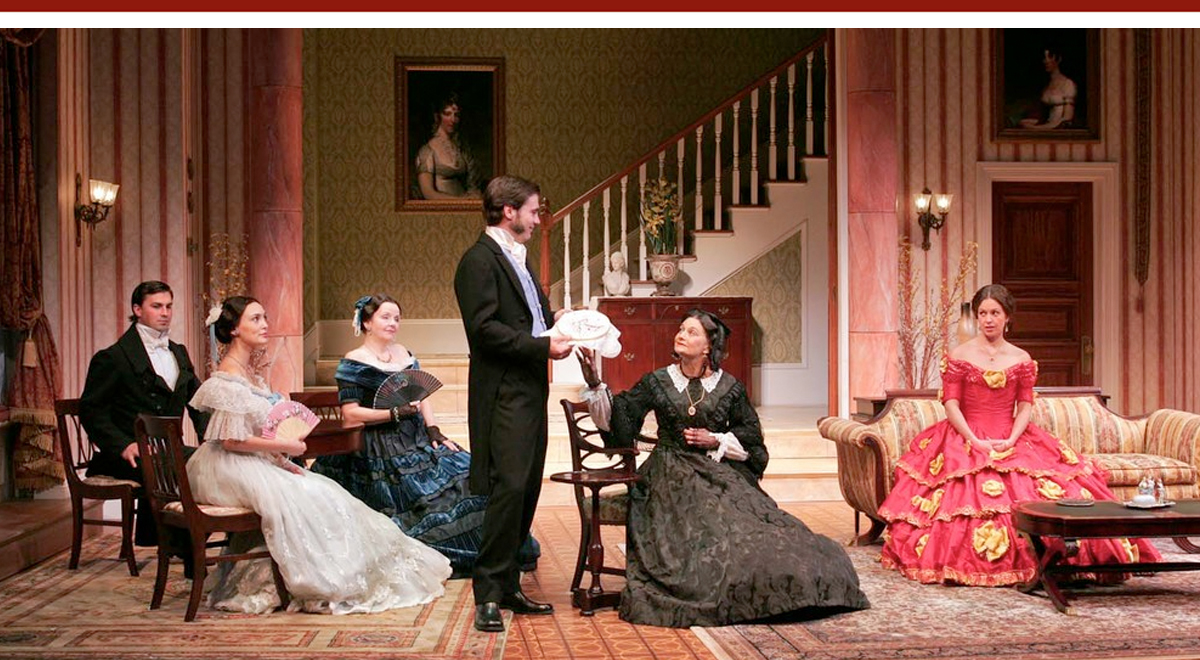
Kirsten Potter
Tony Amendola
PHOTO HENRY DiROCCO
Click the button to request a
printable version of this review.
Joshua Lamont
Yolanda Hester
PHOTO JOHN C. LUKER II
Click the button to request a
printable version of this review.
Our Town
by Thornton Wilder, directed by Sharyn Case
Rude Guerrilla • November 6-December 13 (Opened 11/7, rev’d 11/8)
WITH Lloyd Botway, Gregory Cohen, Steve Hill, George Pelham, Sally Leonard, Karen Harris, Scott
Barber, Sarah de Leon, Lacey Pierce, Sean Engard, Frank Javier Aranda, Jeanne Nelson, Michael J.
Trudeau, Brennan Cipilo, Zedrick Restauro, Esther Sarah de Leon PRODUCTION Chris Boyd, lights;
Peggy Nielsen, asst. direction; Connor Keene, board operator
Mapquest and Google Maps can show us a recent photo of virtually any place in the
world, from the neighbor’s barbeque island to the mountains of Afghanistan. When we
need a snapshot of where we’ve been as a nation, though, it’s time to turn to theater.
Rude Guerrilla in Santa Ana has brought Grover’s Corners, New Hampshire, the
fictional setting for Thornton Wilder’s 1938 Pulitzer Prize-winning ‘Our Town,’ back to
life in Southern California (through December 14). Sharyn Case’s unexpectedly
unpimped production for the Rudists is a clear-eyed look at America two century-turns
back. Simply designed and simply delivered, the production let’s Wilder make his
point -- a kid-gloved but unmistakable finger-wag at generations of audiences who
inevitably squander their lives.
Three acts, two intermissions and approximately two hours and 20 minutes move easily through the story
of neighborhing families. Dr. and Mrs. Gibb will raise their two children alongside the two of Mr. Webb,
editor of the town’s paper, and his wife. In Act II they will become in-laws as George and Emily court and
marry. Act III will bring the premature death of Emily in childbirth. That event is the clasp that rounds out
Wilder’s circle of life structure and sends Emily to join the spirit world hovering amidst the mountaintop
cemetery overlooking the town. There, with the passed-on, including her mother-in-law, Emily will opt for a
single-day return visit as way to say farewell. She will cut it short, however, when she sees how little the
living understand of their gift.
Case’s non-Equity cast is good overall, with one very impressive performance and only a few who remain
more townspeople of Orange County than Grover’s Corners. The most appealing are all in leading roles:
Lloyd Botway as the Stage Manager, Karen Harris as Mrs. Webb, Lacey Pierce as Emily and Scott Barber
as George.
Botway plays Wilder’s omniscient stage manager narrator with a professorial clarity. His speech about
eternity is especially effecting, landing every line and message. If there’s a seen-it-all complacency to the
performance, it’s a justifiable choice and remains genial enough to draw us in. Those moments where
Botway lets his stage manager enjoy what he’s doing, however, are welcome accents.
Though her movie-star good looks seem a little out of place in Grover’s Corners, Harris renders a solid
Mrs. Webb. And, the glamour adds some irony to her conversation-closing comment to Emily: “You’re
pretty enough for all ‘normal’ purposes.” Pierce’s Emily is sympathetic, girlish and, in her work with Barber,
at the bedroom windows, meeting after school, and in the ice cream parlor, are extremely touching.
Barber has six years of credits as an actor and director with Guerrilla, but ‘Our Town’ is our introduction to
him. Indications from his George Gibbs are that Barber is gifted. The line between richness and
overplaying was carefully monitored and virtually never overstepped. One can see that Barber is working
to keep what is likely a full bag of tricks in check. Every scene is interesting yet honest and he never pulls
focus from a scene partner. He appears to have both the talent and the wisdom to apply it within the "less
is more" philosophy.
Wilder’s goal was to plant a theatrical marker back at the dawn of the 20th Century. He created a town that
was an anomaly: “90 percent of ‘em graduating from high school settle down right here to live – even after
they’ve been to college,” the stage manager explains. It was a kind of kinship that was already passing as
Wilder looked back from 1938. Opportunities brought on by increasing industrialization – he makes several
references to the arrival of automobiles – would soon be pulling families apart like string cheese.
His achievement was to move from the commonplace to the exquisite and divine. The Stage Manager is
quick to point out Grover’s many churches, an indication of a multi-denominational culture. Ironically, the
Stage Manager does not mention God, but talks instead of nature, and mankind. It’s left to little Rebecca,
George’s sister, to reference a deity when she describes how another kid used "The Mind of God" in
addressing an envelope. It’s one more way Wilder hopes to get his viewers to take personal responsibility.
Case and her team have brought a story about home to our home. If it employs actors who sometimes
remind us that they are more our neighbors than those of the Gibbs and Webbs, maybe that’s just as well.
Lacey Pierce
Scott Barber
PHOTO JAY MICHAEL FRALEY
Click the button to request a
printable version of this review.
Leaving Iowa
by Tim Clue and Spike Manton, directed by Tim Clue
Laguna Playhouse • November 11 – December 14, 2008 (Opened, rev’d 11/6m)
WITH Roy Abramsohn, Erin Bennett, Jill Brennan, Gregory North, JJ Rodgers, Kevin Symons
PRODUCTION John Berger, set; Dwight Richard Odle, costumes; Paulie Jenkins, lights; David Edwards,
sound; Rebecca Michelle Green/John Lowe, stage management
There once were 19 covered bridges in Iowa. You’ll see all six of the survivors during
the pre-show slideshow for ‘Leaving Iowa,’ now receiving its West Coast premiere at
the Laguna Playhouse (through December 14). The images, in addition to being a
welcome distraction while awaiting lights out, recall the wholesome roadside
attractions that filled many a forced family road trips. Those long-days journeys are
the vehicle for this slight comedy out to discover what ‘there’ might have been in one
more father-son relationship that writer Gertrude Stein might have dismissed as
having ‘no there there.’
Co-authors Tim Clue and Spike Manton, with roots in theater and stand-up comedy, are plowing the
territory of fellow-Midwesterner Jean Shepard, whose stories examined family dynamics from the
perspective of the grown-up looking back on childhood. Shepherd, credited by no less than Jerry Seinfeld
for forming his “entire comedic sensibility,” knew exactly how much pressure the reflective funny bone can
stand before it causes pain. As a rearview look at the American family, ‘Leaving Iowa’ seems short-
sighted, and falls between the comedy stool and the analyst's couch.
Clue and Manton do land a few one-liners, but not enough to make up for the unfunny stretches of go-
nowhere squabbling. The show is rife with the clichés of parenting: “I said no,” “Ask Your Father,” “He Hit
Me,” “Do what your mother says.” Instead of digging between the car cushions for deeper meanings of
why the generations missed connecting, we stay on the surface and listen to bickering and belligerence.
Despite the few laughs along the way, an audience member may feel like a cross-country hitch-hiker ready
to sacrifice the free ride to escape the dead-end harranging.
Our narrator is Don (Kevin Symons), seen as a man seeking a suitable spot to scatter his father’s ashes,
and the backseat boy on a series of summer drives behind the man behind the wheel of the family car. As
a child, Don battles Sister (Erin Bennett) for territorial control, then teams with her against Mom (Jill
Brennan) and Dad (Gregory North) to get their way. Adult Don is spurred by guilt at missing his dad’s
funeral and the other ways in which he contributed to the gulf between his father and himself. That
complicates a mission already complicated by the fact that the obvious choice for dad's final resting place,
his parents’ home, has been replaced by a market. Don’s search for an alternative, dotted with flashbacks
of those early trips and calls in to his mother and sister, is the spine of the show. The aimlessness of his
trek, rather than adding humor, seems to underscore the absence of meaning.
A number of odd Iowans populate the routes of Don’s recollected youth and current search for a scattering
place. These are played with gusto by Roy Abramsohn and JJ Rodgers. But the writing doesn’t have the
character of Shepard – or even The Wonder Years – to engage us. So these characters feel like a
perfunctory parade of attention seekers. Rodgers manages to hit the mark for most of her appearances,
forcing just enough to maintain the style, but keep her sideshow folks real. Her biggest go – a waitress –
works for most of the speeches, but eventually runs out of gas as it becomes just so much more yelling
without content.
John Berger’s set and Dwight Richard Odle’s costumes are effective as is Paulie Jenkins’ light plot.
(Though Mom’s two phone entrances were late enough to leave the stage dark for a few moments. Twice
in a show indicates a director gapping his cues.) And, David Edwards, one of Laguna’s best assets,
creates an interesting sound scape with a couple fine moments of symphonic silliness.
The authors -- Clue also directs -- have the big picture in their sights. A father who is a history teacher
constantly instructs his family on the world outside the car without ever stopping to try and understand
himself. His obsession with facts fills the void left by an absence of emotional outreach. But everything's a
joke, until we need to bring it home for a bittersweet final tableau.
Ultimately, the journeys some children must take back into dark of their post-partum separation with dad,
may be satisfied simply by finding some place where you can find your father laughing freely. That is as
good a place as any to mark the center of one's emotional country. The fact that the play earned
someone's nomination for Best New Play (the program isn't specific) for its Purple Rose premiere indicates
that, for some, it lands that kind of impact. Not for this traveler, however.
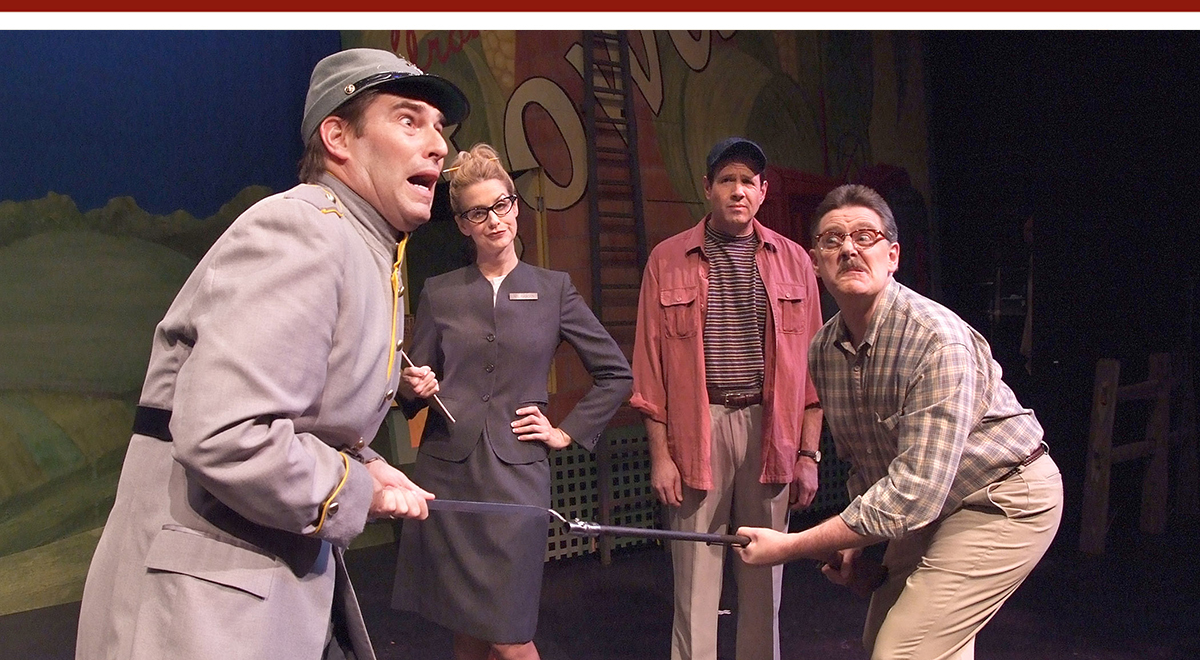
Kevin Symons (top)
Gregory North
PHOTO ED KREIGER