

THEATER TIMES REVIEWS MARCH 2008
|
The Old Globe
Laguna Playhouse
Elephant Theatre
South Coast Repertory
A Noise Within
Pasadena Playhouse
Kirk Douglas Theatre
Ahmanson Theatre
No Child
by Nilaja Sun, directed by Hal Brooks
Kirk Douglas Theatre • March 6-April 13, 2008 (Opened, rev'd, 3/7)
WITH Nilaja Sun PRODUCTION Sibyl Wickersheimer, set, based on Narelle Sissons original Off-Broadway
design; Jessica Gaffney, costumes; Mark Barton, lights; Ron Russell, sound (World premiere, Epic Theatre
Center, NYC, May 2006)
Emily Dickinson described hope as the feathered thing in the soul that “sings the tune .
. . and never stops at all.” Were she a student at the Bronx high school that inspired
Nilaja Sun’s 2006 solo piece, ‘No Child . . .’ she’d have likely heard her bird go silent.
As compact and kinetic as its writer-performer, the intermissionless 65-minute ‘No
Child . . . ,’ now at Culver City’s Kirk Douglas Theatre through April 13, dramatizes the
realities of inner city education following the No Child Left Behind (NCLB) Act of 2002.
Ms. Sun forges a many-faceted character wheel, spinning it at Zoetrope-speed for a
keyhole glimpse into a world where hope is often the thing left behind.
Eerily reminiscent of the plots that drove the cheery Garland-Rooney vehicles of nearly four score years
ago, ‘No Child . . .’ hangs its arc on whether or not the play’s Ms. Sun, whose name suggests a story based
on personal experience, can cajole, caress or ass-kick one of the school’s toughest classrooms into
mounting a play. But their testing of her belief in the eye-opening powers of art will be anything but
standard.
Of course, the arc that really interests us is Ms. Sun’s. She arrives an enthusiastic innocent dedicated to
sharing her considerable energy and experience. A too frequently unemployed actor, she will lead these
students in reading, rehearsing and finally staging “Our Country’s Good,” Timberlake Wertenbaker’s 1988
stage version of Thomas Kenneally’s novel about convicts in Australia mounting a play. All the while, she’ll
be encouraging them to find relevance in the subject matter. This circular, plays-within-plays synchronicity
is something made clear by Ms. Sun’s narrator, an ancient janitor who in 1958 was the first African-
American hired by the school.
Ms. Sun is confronted by a classroom full of individuals whose only coherence is in being confrontational.
But they have their reasons. As she states in an aside, paraphrasing, “79 percent of these students have
experienced emotional, physical or sexual abuse.” The class’ full-time teacher, Ms. Tam, herself a novice, is
railroaded by the students, allowing Ms. Sun some cover to make her own progress with them.
A longer, two-act play could allow us to spend more time with these kids and get to know them. As it is they
remain fairly stereotyped and comic, which makes for an enjoyable showcase of Ms. Sun’s unique talent for
blending real poignancy with rapid-fire character-changes. While the hour-plus display makes its point and
earns its enthusiastic standing ovation, and while there’s no need to turn it into another ‘Lean on Me’ or
‘Stand and Deliver,’ there are some pretty wide jump-cuts along the way. In such brief encounters with a
wide diversity of characters we're denied the messy nuts-and-bolts of how the students are engaged,
turned around and moved ahead. It’ exciting to watch the characters become flash-cards in the spokes of
Ms. Sun’s extraordinary high-speed changes, but it seems there's time for some longer, deeper visits with a
couple key students.
She eventually reaches the point of despair and is willing to leave the project behind. Later, we get a sense
of what that abandonment means to students when one boy who made a serious turnaround is unable to
take part. Sharing his despair at missing out is the play’s finest moment and might have ended another
version of the piece – although to devastating emotional effect (not to mention the death of word-of-mouth).
It’s a heart-wrenching scene that lets us feel a little of the pain of one left behind.
The merits of the Federal No Child Left Behind (NCLB) Act, passed in both Chambers of Congress in 2001
and signed into law by President Bush the following January, are in great dispute, and revised legislation,
alluded to in the play, is in the wind. It’s likely any top down attempt to “reform” America’s education system,
particularly as regards its benefits for poor, abandoned neighborhoods such as New York City’s Bronx
borough, would be doomed to failure and savaging.
In ‘No Child . . .,’ the classroom has become the stage and vice versa. The light of inspiration Ms. Sun took
into the real world becomes magnified for theater audiences by its reflection in her play and performance.
Without lecturing, we are taught that real change isn’t mandated, it’s inspired.
Nilaja Sun
PHOTO CRAIG SCHWARTZ


Henry IV, Pt 1
by William Shakespeare, directed by Geoff Elliott & Julia Rodriguez Elliott
A Noise Within • March 1-May 18, 2008 (Opened 3/8, rev’d 3/9)
WITH J. Todd Adams, Jessica Berman, Ronnie Clark, Robertson Dean, Freddy Douglas, Mitchell Edmonds,
Geoff Elliott, Dorothea Harahan, Jill Hill, William Dennis Hunt, Kenneth R. Merckx, David Nathan Schwartz,
Eric J. Stein, Matt Van Curen, Steve Weingartner, and Jillian Batherson, Jill Maglione, Larry Sonderling and
Andy Steadman PRODUCTION Michael C. Smith, set; Soojin Lee, costumes; Peter Gottlieb, lights; Laura
Karpman, music; Rachel Myles, sound; Monica Lisa Sabedra, wigs/make-up; Kenneth R. Merckx, fights;
Victoria Robinson, stage management
Of Shakespeare’s three major play categories – comedies, tragedies and histories – it’s
the chronicling that most needs borrow from the others. It’s Shakespeare’s drama and
humor that keeps his recounting of court and battlefield exploits engaging for foreign
audiences like us. ‘Henry IV, Pt. 1,’ kicking off the second half of A Noise Within’s
2007-08 Repertory Season through May 18, provides his histories with one of theater’s
greatest comic creations in Sir John Falstaff. The bloated blowhard, whose famous
soliloquies are as insightful as they are entertaining, is here rendered by playhouse co-
director Geoff Elliott, who co-directs with Julia Rodriguez Elliott.
Here, the Glendale company mounts another solid production that provides clear access into this classic. It
both benefits and suffers from the old rep company tenet of a limited number of actors taking on unlimited
roles over time. The grand premise, the bedrock of early British and American theater companies, balances
the fun of seeing familiar actors inhabiting unfamiliar roles against the demands of precision casting. We’ll
either be fascinated when our friends’ faces become barely recognizable on the fictional bodies, or lose the
fictional creations in the folds of individual actor tricks. So it is that most folks within Within’s audience will
be sufficiently enthralled by Elliott, and Robertson Dean in the title role. Others, however, may find the play ill-
served by the stretch of actors whose elasticity is getting played out.
The bright light in this serviceable production – as it is in the story of Henry’s fight to hold England together –
is Harry, the future Henry V. Making his Noise debut is Freddy Douglas. Douglas gives the play guest-artist
energy, just as Kirsten Potter’s company debut did for ‘As You Like It’ two seasons back. Meanwhile, J.
Todd Adams, as a buff, fired-up Hotspur smacking of growth hormone abuse, is the squarely structured
play’s fourth corner.
Douglas reveals the fine definition of training and apprenticeship in his native England. He has the
outstanding enunciation of an O’Toole, yet alternately yields and commands his scenes with his occasionally
less interesting scene partners. (He and Adams get the featured spot in the curtain call, but, oddly, not in the
press photos.) And, while Falstaff is by far the most interesting character in this play, he is diminished by
Elliott’s actorish delivery. Still, when Elliott wants to nail something he pulls in the oars and rests the broad
stroking and shows what he can do. This is the case with his lovely rendering of the Catechism speech.
But much of the broader scenes seem lost, which gives Douglas (and, briefly, Jill Hill’s Mistress Quickley)
less to play against.
On the other end, the real Henry IV’s reputation for careful contemplation and strategizing turns, like milk, in
Dean’s interpretation, to somber and internalizing. While Elliott’s Falstaff seldom finds real footing, Dean’s
Henry doesn’t gain traction. Adams, despite a couple of moments in which he pushes over the top, seems
to be overcompensating for these others. Still, he remains on target and, with Douglas, perform Ken Merckx’
stage choreographer like they mean it. Their hand-to-hand combat is tight, dangerous, and energized. When
the full battle arrives to end the play, the combat spills up the aisles yet keeps its intensity. (Ms. Rodriguez
Elliott, who often takes choreography chores at the theater, may be due some of the credit here.)
Of the others, Steve Weingartner shows himself, as he did with Calaban a couple years back, a great if
quiet asset to the company. In his key and minor roles, he finds his spots in the storytelling and owns them
with just the right amount of flavor and command. The women, true window-dressing in this story, are all
solid: Hill, always fun to watch, Dorothea Harahan, and young Jessica Berwin, following up her lovely ‘Dear
Brutus’ appearance, does well in her non-English-speaking speaking role.
Ultimately the Elliotts have put up a ‘Henry IV’ that offers clarity if not a combustion. Merckx has done great
work here and Soojin Lee adds to her impressive list (though the fat suit is a bit lumpy). And, while we hope
to see Douglas as a regular here, we urge casting directors at the other Southern California regionals to give
him a real test drive in one of their marque productions.
Freddy Douglas
PHOTO CRAIG SCHWARTZ


Sweeney Todd, the Demon Barber of Fleet Street
by Stephen Sondheim and Hugh Wheeler, directed and designed by John Doyle
Ahmanson Theatre • March 12-April 6, 2008 (Opened, rev’d 3/12)
WITH Edmund Bagnell, Keith Buterbaugh, Diana DiMarzio, Benjamin Eakeley, David Hess, Judy Kaye,
Benjamin Magnuson, Steve McIntyre, Lauren Molina, Katrina Yaukey, and Edwin Cahill, David Garry, Megan
Loomis, Elisa Winter PRODUCTION Richard G. Jones, lights; Dan Moses Schreier, sound; Paul Huntley,
wigs/hair; Angelina Avallone, makeup; David Loud, music direction; Sarah Travis, music supervision and
orchestrations; Adam John Hunter, associate direction; Newton Cole, stage management
Marketed as a musical thriller, the long-awaited John Doyle adaptation of Stephen
Sondheim’s and Hugh Wheeler’s ‘Sweeney Todd, the Demon Barber of Fleet Street,’ at
the Ahmanson Theatre through April 6, has now earned additional credentials as a
psychological thriller. Doyle, whose chamber version is most noted for an
arrangement of actors who play the music, has also tweaked the storytelling. Tobias,
who we learned in the first L.A. production 28 years ago, is the story’s soul survivor,
now tends to the tale as flashback from his home among the lunatics at Bedlam.
Since Angela Lansbury and Lou Cariou first put their stamps on Mrs. Lovett and Mr. Todd in Hal Prince’s
original Broadway staging, ‘Sweeneys’ have lived or died by who played the pussy-popping pastry chef
and her beloved butcher-barber. Here, David Hess services Sweeney well, if unremarkably. He has
chosen to keep the lid on Sweeney’s fury until well after the arm-completing razor-reunion scene. Once it is
unleashed, he fares better, cutting fine renditions of such signature songs as ‘Priest,’ ‘Pretty Women’ and
the cathartic ‘Epiphany.’ However, the strategy means glossing over much of Act I, including the climax of
‘Poor Thing.’ That moment, when he learns the fate of his wife and daughter, should blow open a blast-
furnace of pent-up rage. It’s structured to singe the audience’s hair yet Hess hardly ruffles it.
Ms. Kaye, on the other hand, joins the front rank of Lovetts, both recalling and surpassing Ms.
Lansbury. Despite superb comedic gifts that mine every laugh, she keeps Lovett’s own outrage at life’s
inequities threatening to bubble over her pasty shell. Whether singing or acting, her command of the stage is
the stuff of Broadway stardom.
But it is Doyle’s concept that most distinguishes this look back down Fleet Street. The opening lines of the
show’s Prologue, usually distributed among a scattered chorus of wandering Londoners, now emanates
from the solitary Tobias (Edmund Bagnell). He kicks off the story as he is freed from his asylum strait-jacket
and hood. It’s frightening to hand over an opera to a madman, but the refocus succeeds in broadening the
play’s impact. ‘Sweeney’ now not only reminds how revenge sucks us into the evil we seek to repay, but
how the process spills over onto innocent third parties. That’s an important bonus in a world where drive-
bys hit bystanders as often as targets, and parents train their children to perpetuate cycles of abuse.
Tobias may have shilled for a “street mountebank,” but that hardly merits his damnation.
A side benefit of this new level of twisting the story structure is that, by stationing a wholly unreliable
narrator at its center, the events are thrown into question. Certainly, the bones of the story are secure. But
there is a new dimension of gamesmanship: Tobias, who spends the play in his blue asylum jammies – the
only costume outside the black and white color palate – is recreating the characters with projected images
of people from his own broken psyche. The men in the story derive from some authority figure wearing a
white dress shirt and tie – a teacher, father or hospital director. This may have been intended – or may be
misinterpreted – as the costumes of the Music Hall. But, and here is where it gets fun, in one of those “Back
to the Future,” chicken-and-egg time-travel inversions, the sources of Tobias’ characterizations are a
combination of people from his own life with the “real” Lovett, Barker, Anthony, et al. Most of the characters
have been repressed as too grotesque to recall. And this is why see the safer, happier Music Hall images
replacing the too-gruesome recollections of pie and barber slicing. This also explains Mrs. Lovett’s
incongruous appearance of the torn hose of a harlot, the hairdo and apron of a housewife and the minstrel’s
tuba. Bagnell continues to exercise his central role, watching his story from the perimeter. Sadly, however,
his expressions of madness, accompanied by crazy fiddling, sometimes go overboard with facial twinges.
Beyond all that, the most noticeable change in characterizations is the swapping of temperaments between
Beadle Bamford (Benjamin Eakeley) and Judge Turpin (Keith Buterbaugh). We now have more of an Othello-
Iago dynamic, with the hapless Judge more a victim of his immature cravings for Joanna (Lauren Molina),
than a malevolent plotter. As a result, the Beadle's actions are those of the over-stepping sycophant, doing
damage to others through his superior. Though we all loved Calvin Remsburg’s bumbing Oliver Hardy of a
Beadle, it’s nice to have something different. And, it makes sense as far as it goes.
However, the counter-balancing pull-back of the Judge makes less sense. Perhaps Buterbaugh, who is the
weakest performer in the mix, simply doesn’t have it in himself. And, while it may seem tedious to have both
men equally malicious, that may ultimately be the perfect answer. After all, the Judge orchestrated Barker’s
incarceration, Lucy’s (Diana DiMarzio) deterioration, and Joanna’s isolation from the world. Tobias paints her
as virginal, and dressed in a variation of a nightshirt he sees every day. For her part, Molina contributes a
delightfully empty-headed Joanna..
As far as the music goes, here too the chamber quality not only conforms to the context of a lone tormented
narrator, it reflects Music Hall staging, and allows only the actors on stage to fill the roles. Of those
performing, some are clearly accomplished musicians (Bagnell and Molina), and two are ringers. Steve
McIntyre’s bass gives the entire score its foundation, while minimal acting is required for his one character,
asylum director Jonas Fogg. Katrina Yaukey, who knows her way around the piano and accordion keys,
moves around the stage as part of the chorus, then portraying Pirelli (whose scene, as is now custom,
includes only the hair-cutting competition while pulling the tooth-pulling contest).
And, last but not least, Benjamin Magnuson’s Anthony, which takes some getting used to as he seems pretty
light at the beginning, is ultimately winning, especially for his clarity on a number of numbers that involve
dueting through some of the show’s most difficult passages with Molina.
As will likely be said again and again in these pages, we’ll take a competent night of Sondheim over the
finest production of any other musical theater composer. There you have it: fool disclosure. In John Doyle’s
imaginative and wholly integrated vision, one not only gets the brilliance of Sondheim at the peak of his
creative genius, we get another entire level of meaning, adding a dimension of demented gamesmanship.
Who would have thought such a thing possible. For anyone who loves language for as more than a way to
order pizza and bad-mouth the neighbors, for whom the Mother Tongue means more than Oedipal Frenching,
Sondheim is the reigning godhead. A Will Shortzean fireworks display like ‘Have a Little Priest,’ where the
lyricist parks the story for a bit of fun, allows us to luxuriate in language just as Lovett and Todd feast on
their shared misanthropy. It’s proof of heaven, as you’re living.
Judy Kaye
PHOTO DAVID ALLEN STUDIOS


The American Plan
by Richard Greenberg, directed by Kim Rubenstein
Old Globe Theatre • February 23-March 30, 2008 (Cassius Carter, Opened 3/8, rev’d 3/16)
WITH Kate Arrington, Sharon Hope, Michael Kirby, Sandra Shipley, Patrick Zeller PRODUCTION Wilson
Chin, set; Emily Pepper, costumes; Chris Rynne, lights; Paul Peterson, sound, Leila Knox, stage management
With allusions to the divisive waterways of both ‘Paradise Lost’ and ‘The Great
Gatsby,’ Richard Greenberg has created his own literature about how isolated people
misuse love to escape their melancholy in ‘The American Plan,’ a 1990 drama only now
receiving its West Coast premiere. Wrapping her balanced staging around the haunting
central performance of Kate Arrington, director Kim Rubenstein lets the play’s
impressionistic portrait of characters at sea resonate.
Greenberg sets the American play beside a lake in the Catskill Mountains, across from a resort hotel offering
affordable week-stays packaged under names like ‘The American Plan.’ It’s 1960, four decades after
Adolph Hitler’s Nazi Party began setting German Jews adrift with platform points like “No Jew, therefore,
may be a member of the nation," and 12 years after the founding of the nation of Israel. A flat square of
grass covers the Cassius Carter’s stage floor, diagonally bisected by a wooden walk that points to the
distant hotel at one corner and, in the opposite direction, to the residence of Eva Adler (Sandra Shipley), her
daughter Lili (Arrington), and Olivia (Sharon Hope), the maid who has earned membership in the family.
The lake intrudes somewhat into the set, with enough depth to allow Nick Lockridge (Patrick Zeller) to rise
out of the water for his sly first entrance. Lockridge, whose name not only recalls Fitzgerald’s writer-
narrator but also evokes the terra firma that Lili will see in him, is a minimally successful writer staying at the
hotel. The set’s seating is provided by a neglected rowboat and some iron lawn furniture. (Wilson Chin
designed and Chris Rynne lighted the playing area, which adds another page to the Old Globe’s textbook
illustration of how to create environments without benefit of a single vertical surface.)
The Adler house is odd in ways Greenberg is careful not to speciy. Whether it has the appearance of a
museum, mausoleum or boathouse, Lockridge and Gil Harbison (Michael Kirby), another intruder from the
other side, are both surprised to find that people live in it.
Rubenstein, whose listed credits run towards larger productions, most recently as Associate Artistic
Director at Long Wharf Theatre, shows that she is equally comfortable in a chamber size staging. She has a
gift in Arrington, who seems to intuit moment-to-moment exactly when her character is showboating and
when she’s sinking. For the highly intelligent and damaged Lili, the hindrances to fulfillment are different than
the WASPs who partied between the World Wars in ‘Gatsby.’ The Adlers are Jewish. Eva escaped “by
boat” but has made her daughter an heiress to effects of that evil.
Lili has become an individual island within a family island within the ethnic island that represents the Jews in
post-War America. Her final listless encounter with the out-reaching Nick exhibits only vague remainders of
what might have been self and strength. The loss feels complete when we learn, in a nicely buried aside,
that she is devoid of independence from her mother’s sense of furnishings, even after Eva has died.
The role of Eva provides great dramatic opportunity as far as it goes, and Shipley does well pawing, clawing
and pouncing through the dominatrix’ cat-and-mouse games with the other characters. However, here we
need more definition than Greenberg’s impressionistic style provides. Eva’s complexities, and her murky
relationship with her late husband, need a little more bricks and mortar to help us see where she’s coming
from. Filling in the blanks with ‘The Holocaust’ is too nebulous and too easy. There is more at work here.
Greenberg’s discomfort with supplying this material is evident in a scene at the top of Act II, an
uncharacteristically clunky bit of exposed exposition about Lili’s father that does more to stop the storytelling
than illuminate it.
Greenberg has great affection and affinity for words, and character names like Nick and Lili can justifiably
recall writer Nick and troubled Daisy of that earlier masterpiece. There, of course, the concern was
achieving the American Dream (or perhaps demystifying it so it wasn’t so seductive). Here, the American
Plan is less oppressive, more diffuse. It is a state of freedom, from persecution (as Eva has sought), from
convention (as Gil proposes in his pursuit of love), and from self-destruction (as Lili vainly hopes).
Zeller, Shaw and Kirby meet the demands of their roles without going overboard. Kirby, another of the Old
Globe’s UCSD Masters students, does well in what appears a featured role debut. However, a few more
outings will strengthen a performance quality that is already very promising.
In some ways, ‘The American Plan’ is the American play: a statement for a larger canvas in which
Greenberg offers a shadow world complement to Fitzgerald’s seminal portrait of blind American ambition
torpedoed by fraud. Here, at the dawn of the 1960s when prosperity seemed within reach of anyone willing
to dive in and go for it, old wounds and generational protectionism were weights that would not be ignored.
Not dealing with demons only meant that any effort to make it to "the other side" opened one up to being
grabbed by the darkness and pulled under.
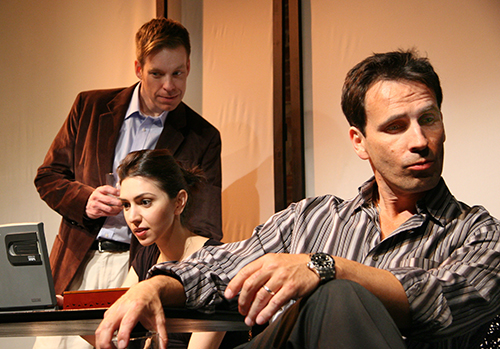
Kate Arrington
Sandra Shipley
PHOTO CRAIG SCHWARTZ


The Dying Gaul
by Craig Lucas, directed by Jon Lawrence Rivera
Elephant Theatre • March 20-April 19, 2008 (Opened, rev’d 3/20) Los Angeles Premiere
WITH Ken Arquelio, Patrick Hancock, Mary-Ellen Loukas, Nick Salamone PRODUCTION Gary Lee Reed,
set; Kathi O’Donahue, lights; Bob Blackburn, sound; Ron Salto, video; Elna Kordijan, stage management
In Craig Lucas’ most famous play, 1988’s ‘Prelude to a Kiss,’ written when AIDS was
decimating the gay and theater communities with no signs of containment, young
lovers marry and magically are faced with one’s imminent death by old age. A decade
later in ‘The Dying Gaul,’ only now receiving its Los Angeles premiere in a well-paced
staging by Jon Lawrence Rivera at Theater Row’s Elephant Theatre (through April 19),
the story begins after a promising screenwriter helps his thirty-something agent/lover
die from the disease. The depth of rage carried by that writer, which will help destroy
other characters and threaten the play he is in, is not unlike that which the playwright
himself famously grappled with the decade before.
Rivera, who energized Jessica Hagedorn’s unwieldy ‘Dogeaters’ last year, moves his uneven cast nimbly
around the challenging billboard-shaped stage. Gary Lee Reed’s simple set, well lighted by Kathi
O'Donoghue, helps. The row of upstage sliding Japanese screens, along with passages in Bob Blackburn’s
varied sound design, add serene echoes of the script’s (sometimes intrusive) theme of Buddhist surrender.
While one casting shortcoming short-changes what might have been a more powerful – and clearer –
production, the lead performance by Patrick Hancock, who pushes his character to the breaking point,
makes this a production worth supporting.
Just as an individual life usually begins as one kind of story and ends somewhere unexpected, ‘The Dying
Gaul’ starts us down a fairly conventional, though gay-themed, path of the innocent-in-Hollywood
adventure. But we are soon wandering into the darkest territories, where faith and ideals are impotent
projections of the hopeless, leaving the power of action to the callous, desperate and deeply wounded.
Ultimately, we are left with a strange and uncomfortable sense of mythic, even cosmic, helplessness.
Robert (Hancock), a talented writer who is yet to cash a decent paycheck, is still grieving when a studio
exec calls him in to discuss ‘The Dying Gaul,’ the script his late lover had submitted. Jeffrey (Ken Arquelio),
a bisexual who leverages his producership to feed his commercial and carnal drives, assures Robert that
keeping the loving gay couple at the center of the script will destroy the movie’s appeal. (Lucas’ play
opened three months before the first episode of ‘Will & Grace’ aired, years before ‘Brokeback Mountain,’ but
the same argument no doubt continues to be made today.) However, Jeffrey is personally attracted to both
the story and its storyteller and offers a $1 million contract – and his home in the hills for meetings – if he’ll
write-out the homosexuality. Robert, whose principles become another deinition of “dying gall,” is soon
introduced to Jeffrey’s beautiful wife Elaine (Mary-Ellen Loukas) and a bizarre game of public fondling that
invites her discovery.
Elaine – who, in the play’s one murky area seems at times to condone and at other times to be unaware of
Jeffrey’s pursuits – gets Robert to teach her about the gay online chat rooms he frequents. She is soon
secretly stalking him in an effort “to be part of her husband’s world.” But something drives her to cruelly
pose as Robert’s dead lover’s spirit. And, where we might argue that Robert would connect the dots back
to Elaine, he falls into her trap. Suspicious, he accuses his therapist, Foss (a sympathetic, nicely conflicted
Nick Salamone), of being behind the communication. But once convinced Foss is innocent, allows himself to
believe the source of the chatter is ethereal and abides its insights into Jeffrey’s world. The believability is
not the point. It’s a set-up to get us where we can experience – as we did in ‘Prelude’ with no effort at
logical support structure – someone engaged in the realm of the extraordinary.
To get a clean window into this phenomenon, however, we need to better see the confused morass of
manipulation, guilt, curiosity, voyeurism and revenge that is driving Elaine. But Loukas, try as she might, is
out of her depth here. This requires levels of conflicted, unconscious motivations that even older actresses
with more life experience may not be able to touch. Patricia Clarkson played the part in the Lucas-directed
film, and one should look there for more insight into what the writer is after.
But, Hancock does allow us to feel the war of hopelessness and wishfulness that meet within Robert.
Those battling emotions are as exhausting as the Roman wars that inspired the sculpture of the play’s title.
This owes much to Rivera’s steady hand, Hancock’s insightful performance, and the great interplay
between writer and producer that launches the two-and-a-quarter, two-act production. But by the end,
when the demons have been unleashed, Arquelio, and particularly Loukas (who was clearly nervous getting
started on opening night and should fare better as the run proceeds), have less success with the
challenges.
Lucas’ work – as the fine production of ‘Small Tragedy’ at the Odyssey last year more successfully showed
– is among the most exciting written in decades. He has a unique talent for giving common conversation the
feeling of spare poetry, then using what goes unsaid for even greater impact. With the right actors and
direction, his work come alive in the interstices between the lines.
‘The Dying Gaul’ is a fascinating look into an artist – both within and without the play – who allows his
seething anger to take his art places he might have been uncomfortable going one small tragedy before. The
play may not be discoverable country for the audience member who arrives in need of clarity and
understanding. Silences are always ambiguous. But those willing to let one of our masters take them where
he will, even as he allowed his emotions to take him, will feel more than theater’s potential for storytelling.
They’ll feel art’s door crack in a rare effort to let in a greater show of force: the uncontrollable rush of
randomness – and destructiveness – of life itself.
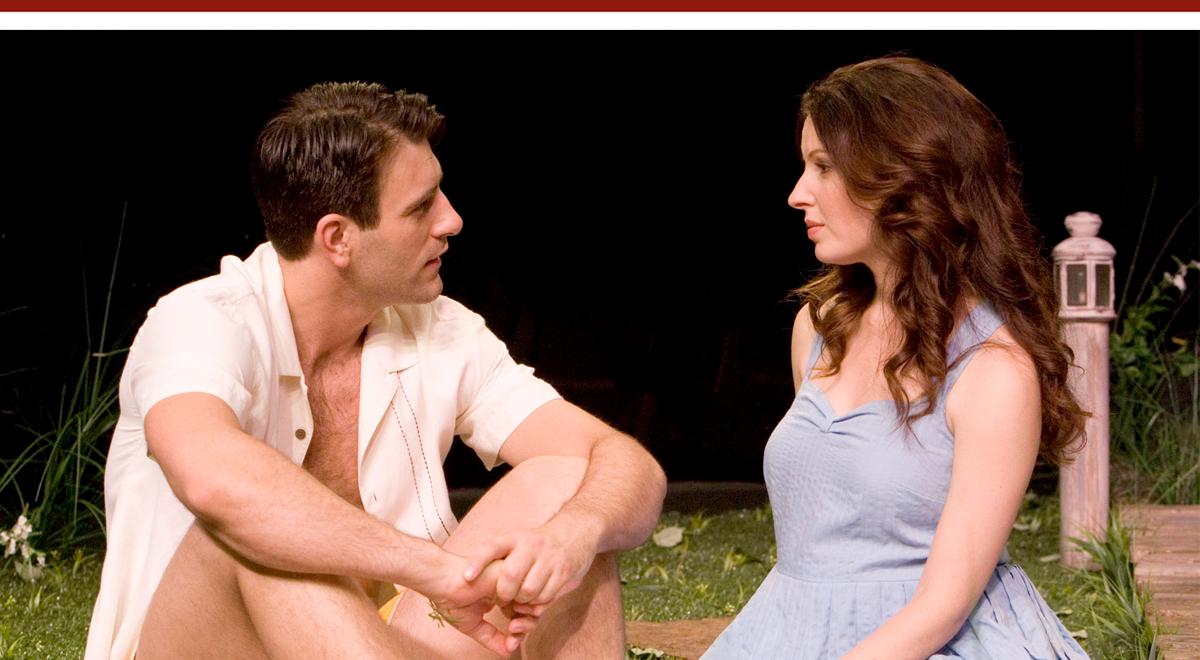
Patrick Hancock
PHOTO JOHN ALLEN PHILLIPS


Mask
book by Anna Hamilton Phelan, music by Barry Mann, lyrics by Cynthia Weil, musical staging by
Patti Columbo, musical direction by Joseph Church, directed by Richard Maltby Jr.
Pasadena Playhouse • March 12 April 20, 2008 (Opened, rev¹d 3/21) World Premiere
WITH WITH Michelle Duffy, Greg Evigan, Michael Lanning, Allen E. Read, Alec Barnes, Brad Blaisdell, Katy
Blake, Ryan Castellino, Diane Delano, Chris Fore, Sarah Glendening, Krysten Leigh Jones, Mark Luna,
Heather Marie Marsden, Shanon Mari Mills, Suzanne Petrala, Ethan Le Phong, Jolene Purdy, James Leo Ryan,
Matthew Stocke PRODUCTION Robert Brill, set; Maggie Morgan, costumes; David Weiner, lights; Peter
Fitzgerald and Carl Casella, sound; Austin Switser, projections; Michael Westmore, make-up; Carol F.
Doran, hair/wigs; Bob Kretschmer, Rocky¹s wig; Steve Margoshes, orchestrations; Jeff Marder, electronic
music; Barry Mann, arrangements; Joe Witt/Lea Chazin, stage management
On March 13, when Stephen Sondheim told a UCLA Live audience why he thinks
musicals (like his ‘West Side Story,’ and unlike his ‘Sweeney Todd’) can fail to work as
movies (“film is reportorial, theater is poetic”), one hardly expected that within the
week his articulation would explain a rocky transition in the opposite direction. ‘Mask,’
now in its world premiere at the Pasadena Playhouse (through April 20), is Anna
Hamilton Phelan’s musical theater adaptation of her own Oscar-nominated 1985
screenplay. Now, equipped with a Barry Mann-Cynthia Weil sound system and a clear
set of directions from Richard Maltby Jr., she is gearing the decades-old vehicle for a
trip to Broadway. But prosaic book and lyrics, without the essential additive of poetry,
signals that the show may run out of gas upon arrival. That is, assuming it doesn’t get
pulled over in Las Vegas.
Telling the true story of Roy L. “Rocky” Dennis, who at the age of 15 had a healthy worldview despite seeing
through the distortions of craniodiaphyseal dysplasia, served the Peter Bogdanovich film well. The condition’
s street name, lionitis, hints at its frightful effect of flattening and widening the facial sub-structure. In a
stage musical, however, dialogue and lyrics need to do more than tell the story, they need to take it to a
higher level.
The ironic thing is that the elements that would have taken the play into other dimensions are visible within
easy reach of the story. Like leftover motorcycle parts, the machine is down the road while important
pieces lie unused on the shop floor.
The plot of ‘Mask’ remains uncomplicated. Rocky (Allen E. Read) and his feisty, foul-mouthed mother, Rusty
(Michelle Duffy), arrive at his new high school in Azusa, California. His comfort with his condition
immediately eliminates the familiar arc of an outsider grappling with his fate. Soon, a one-song conversion of
his new classmates eliminates the conflict of getting respect from a prejudiced world. Rocky has quickly
moved past Quasimodo and Cyrano (not, however, before engaging in a little Cyrano-style tutoring to help
the hunk better bed the blonde). But, like both those tragic figures (and most of the rest of us), Rocky’s
Waterloo will be women, and in a deeply buried irony, the winning Wellington will be his own mother.
Rusty brushes aside doctor warnings that Rocky has “Three to Six Months” to live. This is the result of her
disgust with doctors, but more importantly an inability – despite her bravado – to face reality. The latter point
is underscored by her reliance on Methamphetamine, which, in term, the show becomes reliant on for its
strongest arc. Rocky’s story becoming a kind of “Easy Rider” Cyrano determined to bike to Sturgis with “the
tribe,” the aging motorcycle club that is their extended family. Ultimately, in an effort to shock his mother
clean by moving out, Rocky works at a camp for blind teens and has his first real romance with Diana (Sara
Glendening in a winning showcase).
But, finally, a musical is about its music. Pop songwriters of the magnitude of Mann and Weil craft songs that
are personal in the singing and universal in the hearing. These two are titans, with dozens of hits to their
credit on the order of “On Broadway,” “You’ve Lost That Lovin’ Feelin,” and “We’ve Gotta Get Outta This
Place.” Of course, pop tunes are designed to work their magic in three minutes and be done. Musical
theater songs need to drive narrative action into the next scene, carrying the poetic seed along with them.
‘Mask,’ however, feels like a series of mini-cycles. Set like pinwheels in the roll of the story arcs they spin
here about Rusty’s dependence on drugs, there about her on-again-off-again relationship with Gar (Greg
Evigan, whose “A Woman So Beautiful” suggests a Bob Seger musical presence that should be further
mined), and then about Rocky’s valiant effort to take to the highway with a hog and a honey.
To the writers’ credit, the addiction story is taken seriously and approached with impressive directness for a
Broadway show. But as long as they’re getting messy with it, they might as well go all the way. Rusty’s
addiction is the key to the metaphor. The irony that one so tough is hiding – much more than her son, born
behind a mask, who refuses to hide – is just not picked up on. That she has made such an extraordinary
person of her damaged son, yet falls apart, indicates a complex character that modern audiences need
elevated to a place in dramatic art.
Duffy, who is unquestionably appealing, does more here than she’s had to in ‘Can-Can’ (a breakthrough for
her here in Pasadena last year), or the other local musicals she has helped. But, there’s more that needs to
be found. Part of the problem is the shallowness of the script, which forces her to rely upon exasperated
takes, short-fuse anger, and her beautiful and powerful voice. However, until the story opens up to be
about more than a single tragedy in Azusa, it will be more like everything from “A to B” in the USA.
On the plus side, Read is great. He’s boxed in by a limited story, but within that unfortunate cage he’s lion-
hearted. Also, the show’s unabashed portrait of a brotherhood of the open road, and the joys of an
extended family that watches out for each other, is endearing and could stand to be even grittier. The
opening image of gone-to-seed bikers promises something that unfortunately doesn’t fully materialized: a line-
up of aged defiance, modern outlaws under long hair, much of it gray, who stand with paunches and pride.
What fun it would have been to really pursue this dramatic device with a song like ‘Over the Hill,’ that played
on the realities of the AARP generation that grew up (while refusing to grow up) on Mann-Weil music.
(“‘Climb Every Mountain” and where will you be? Over the hill, yeah, Over the hill.’)
In addition to the shot of Seger there’s a little touch of Townshend to the night. On overdue bit of power
chording, recalling the opening crunch of ‘Baba O’Riley,” helps produce the standing ovation. And, if you
squint during those closing moments, you might even catch a glimpse of a third dramatic character up there
astride Rocky’s heavenly Harley. After Quasi and Cyrano, there’s enough of a reminder of Daltry’s blind,
deaf and dumb boy to with the book writer and bike riders had given us a more thrilling ride.
Michelle Duffy
Allen E. Read
PHOTO ED KRIEGER

Brownstone
written and directed by Catherine Butterfield
Laguna Playhouse • March 25-April 27, 2008 (Opened 3/29, rev’d 3/30m) World Premiere
WITH Dorothea Harahan, Laurie Naughton, Gino Anthony Pesi, Deborah Puette, Brian Rohan, Kim Shively
PRODUCTION Lauren Helpern, set; Julie Keen, costumes; Paulie Jenkins, lighting; David Edwards, sound;
Rebecca Michelle Green/Victoria A. Gathe, stage management
A fine cast, all making Laguna Playhouse debuts, has opened Catherine Butterfield’s
‘Brownstone’ in a welcome world premiere, here through April 27. Butterfield, who
also directs, shows she knows her way around writing, casting and staging. She mines
the full range of this enjoyable entertainment, which braids together three overlapping
stories all set in the same New York apartment: at the end of the 1930s, the end of the
1970s and the beginning of this decade. Though individually only one of the stories
really captivates, their gradually exposed weave is engaging, especially with this
capable and invested ensemble.
Butterfield lets her storyline unreel without ever tipping her hand early or clumsily. Exposition is neatly half-
buried and her themes are allowed to surface gradually. She shows the subtle distinctions between our
airy dreams and more practical ambitions through six characters and whether or not they are “grounded.”
However, in the four women, who reflect the positive changes made over the 60-plus years represented by
the play, we see the continuing threat to their independence, first by their fathers, and then by their
children’s fathers. There is also a reminder that a catastrophe of the most intimate nature can damage an
individual just as permanently as one of global significance. Butterfield reveals the brownstone’s own arc,
in which, echoing New York City’s fortunes, it moves from pre-War society to 1980s decline before its
return to its current respectability of gentrification.
The production team contributes inspired work, too: scenic designer Lauren Helpern, costumer Julie Keen,
lighting designer Paulie Jenkins, and especially sound designer David Edwards (who finds cues with word
clues to connect scenes and even uses both generations of ‘Big Yellow Taxi’).
The most interesting story, and given its theatrical milieu the one likely to have been the starting point for Ms.
Butterfield, involves two aspiring actresses in 1978, arriving in New York from Dallas to start their careers.
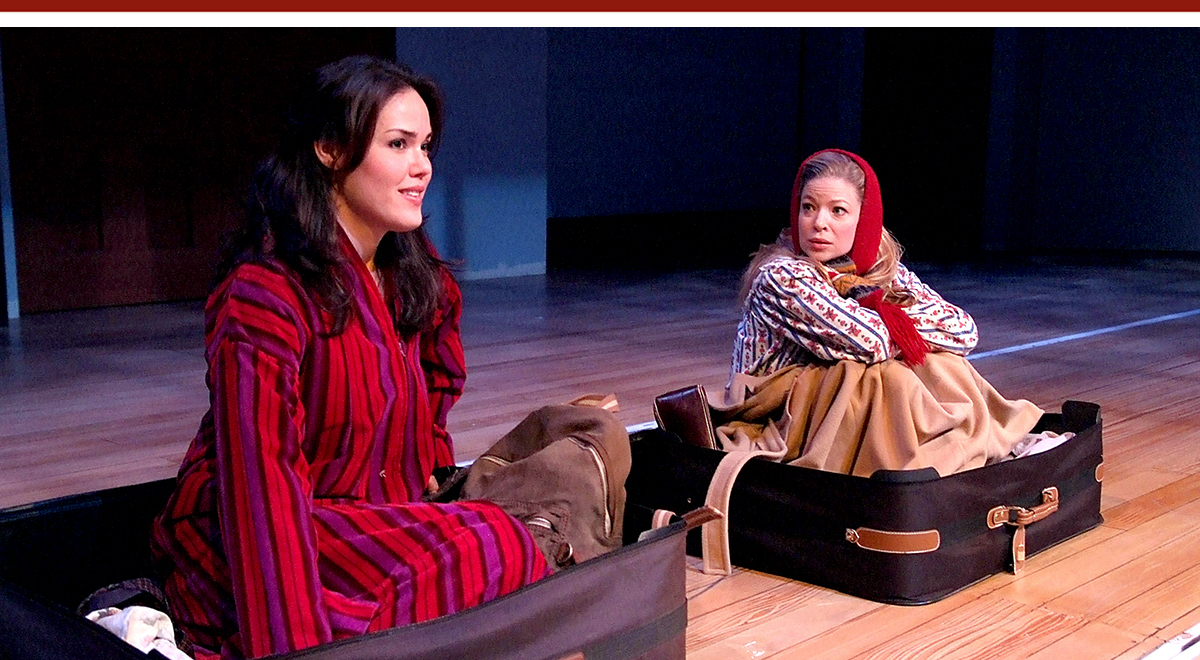
So poor that they literally sleep in suitcases their first night, Deena (Dorothea Harahan) has been told by Dad
that she has two years to become a Broadway star, while Maureen’s (Kim Shively) folks, who will
disapprove of a burlesque role, will be happy if she simply makes it as “a working actress.”
In 2000, power couple Jason (Gino Anthony Pesi) and Jessica (Laurie Naughton) are pursuing careers in
finance and advertising, respectively, with plans to marry their fortunes together.
And, in 1937, Davia (Deborah Puette) is a Daddy’s-girl so sheltered she dismisses Hitler’s land grabs as
mere “monkey business.” Indicative of her father’s overbearance is the fact that she is named for the old
man. Nevertheless she has attracted a fine, down-to-earth suitor in Stephen (Brian Rohan), a beat journalist
who finds her I-have-no-need-for-you airs irresistible. Stephen pledges to do everything he can to make her
happy and to get her out from under her father’s sway. It’s an earnest ambition that runs up against fates
as intractable as her ‘ancestral home’s’ foundation.
What happens to them and how they connect is, while hardly the province of great art, a wholly satisfying
two hours of theater. The actors all have a grasp of their characters, delivering them with great sensitivity
and insight. Special kudos to Harahan, whose Deena etches the most severe arc, and to Rohan for being so
damn likeable. It’s great to see Harahan, who local theatergoers will recognize from her many classic roles
at A Noise Within (including the current ‘Henry IV, Pt. 1,’ which she apparently has left), showing off her
contemporary chops.
Butterfield’s last visit here was ‘The Sleeper,’ a more ambitious look at prejudice in a contemporary world
where America has drawn axes of evil in the sand, was not structurally as sound as ‘Brownstone.’ But
both reveal a playwright looking to contribute something significant. That motivation is reflected in many of
her ‘Brownstone’ residents. Congratulations to her for a casting a fine eye on the acting, and to Casting
Director Wally Ziegler, for coordinating the auditions, which, as we learn from the Deena and Maureen
scenes, can be perilous.
Deborah Puette
Brian Rohan
PHOTO ED KRIEGER


Culture Clash in AmeriCCa
by Richard Montoya, Ric Salinas and Herbert Siguenza, directed by David Emmes
South Coast Repertory • March 16-April 6, 2008 (Argyros; Opened 3/21, rev’d 3/22e; ext to 4/13)
WITH Richard Montoya, Ric Salinas and Herbert Siguenza PRODUCTION Angela Balogh Calin,
set/costumes; Lonnie Rafael Alcaraz, lights; BC Keller, sound; Conwell Worthington III, stage management
For more than a decade, Culture Clash (the trio of Richard Montoya, Ric Salinas and
Herbert Siguenza) has been creating serio-comic portraits of U.S. population areas by
interviewing citizens and then performing the edited transcriptions. Beginning with
‘Radio Mambo,’ the Miami survey that is still the group’s best effort, they have been
adding to their repertory, either with site-specific shows like ‘Bordertown’ (San
Diego/Tijuana), or with an expanding national portrait collected in ‘Culture Clash in
AmeriCCa,’ currently at Orange County’s South Coast Repertory. Sporting a handful of
fresh local faces added for this venue, the show quickly extended a week to April 13.
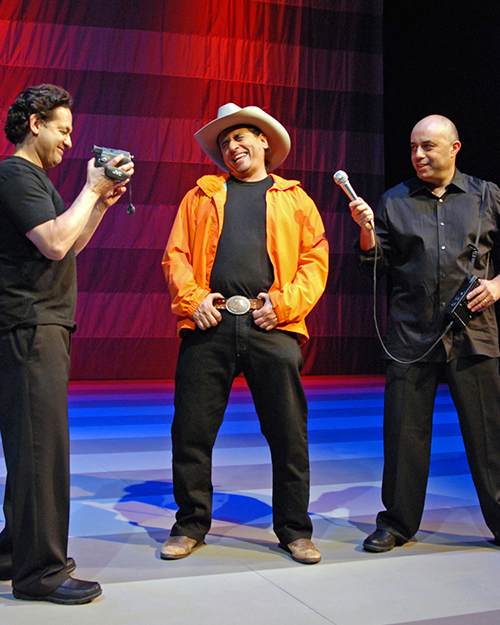
The resulting edition of ‘Culture Clash in Americca,’ in SCR’s Julianne Argyros Stage is a two-hour, two-act
greatest hits collection with such recognizable neighbors as the befuddled day laborer, a sun-setting Mike
Carona, and a goofy Vietnamese-American Car Clubber.
As we reported in 2006 after seeing the world premiere of the trio’s ‘Water & Power’ at the Taper, the Clash
has emerged as a bona fide regional – if not national – treasure. Still flying a proud, if faded, standard of
political theater, they showed in that show greater writing and acting range. Their talent for clowning,
however, can undercut the potential sharpness of a ‘Zorro in Hell,’ which last year at the Montalban
(unreviewed), seemed like backsliding. That show has a still-potent message about cultural imperialism here
in the (albeit fabricated) West. Mexican characters and storylines are money in the bank for studios, while
Mexican actors are banished to the food banks. But the point and rapier wit were dulled by too-often
unfunny schtick.
However, whether one is card-carrying Clash party faithful or first-timer, “Culture Clash in AmeriCCa” offers
their “sketch-theater” at its finest. Familiar loonies like ‘Radio Mambo’s’ Todd and Francis, the mildly racist
Norwegian-Cuban couple who are now post-Katrina trough-feeders, are joined by less familiar folks like a
merry Berkeley transsexual, a proud Nuyorican, and a white-bread Lesbian pair from suburban San Diego.
Credit director David Emmes for getting out of the way of what works and encouraging what the boys
needed to work on. One only wishes they had taken the time to screw their skills to the scripting place and
added the editorial über-structure that would lend the power of ‘W&P.’ These scenes seem to cry for a
cohesive package, perhaps with Montoya's empathetic day laborer as tour guide, that offers a more directed
look at the shifting tones of our immigrant nation.
Quibbles aside, it's always a thrill to be in a Culture Clash audience. They are such kinetic performers that
anything that happens in the theater during a how can provoke a spontaneous aside. Whether or not they
break character for such improv, however, we feel the gears constantly whirring in each artist. Montoya's
many moments go beyond comedy and reveal his deepening acting skills. Salinas, who could be winning
loving cups on 'Dancing With the Stars,' combines his keen comic-timing with musical timing for a dancer's
primer on how to distinguish Latin cultural differences. And, finally, the great Siguenza, the group’s acting
chameleon who supports the trio like the bottom acrobat in a human pyramid, offers his predictable range of
disappearing acts, in everything form surfers to tribal African. If Culture Clash served up no more than
Herbs, it would still be worth the meal ticket.
There are few -- if any -- events as reassuring to the potential for bi-cultural theater as a Culture Clash
performance. It's less noticeable here than in L.A., where extended single-ticket runs overflow with the
pride of a Middle Class Hispanic audience taking ownership. Still, Culture Clash has the ability to satisfy both
cultures. And, as time goes on and they continue to deepen their craft and messaging, Culture Clash
becomes much more than a good night out. They prove that a divided house will stand. And through April
13 in Orange County, that's for a standing ovation.
Ric Salinas
Richard Montoya
Herbert SIguenza
PHOTO HENRY DiROCCO