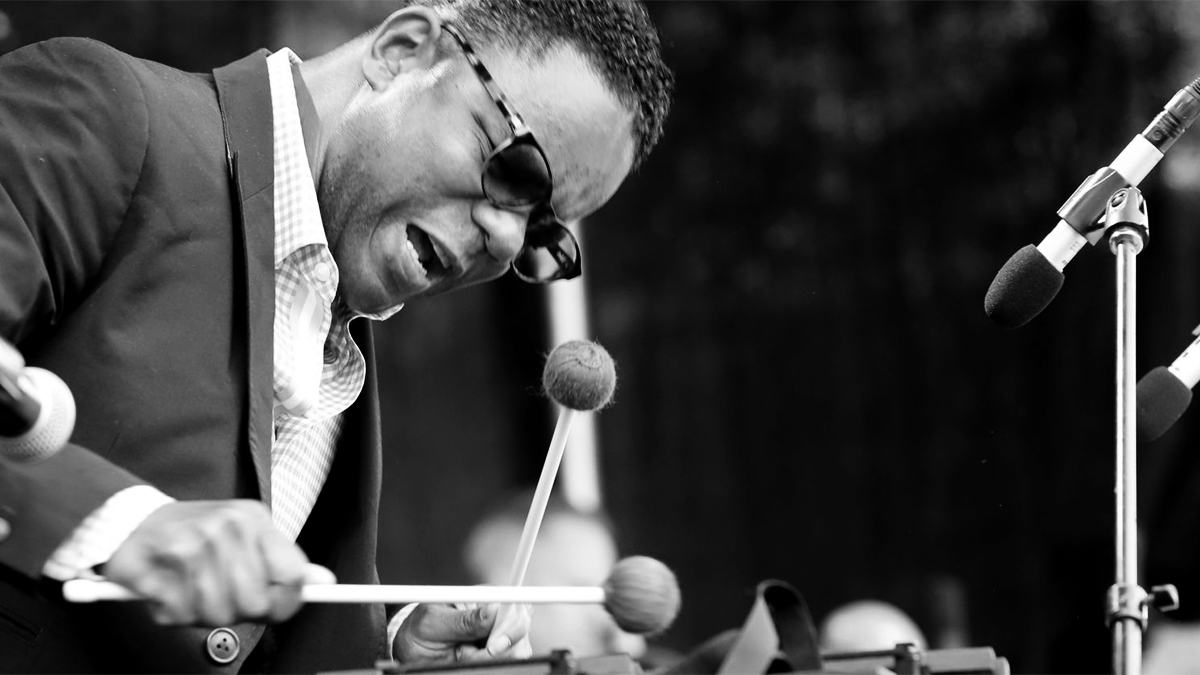
Stefon Harris
Global vibes – Navigating jazz from San Francisco to Havana, and points in between
We first spoke with vibraphonist Stefon Harris in 2009, by cell phone, as he drove through New York on an errand, careful not to be gone too long from his wife, who was home about six months pregnant with their first child. We spoke again in 2011. This time he was stationary, the baby was healthy, and he was engaging in many projects, including his third year contributing to the SFJAZZ Collective.
Harris is as precise in his conversation as he is in his playing. The clarity of the vibraphonist, whose wood-on-metal hammering doesn't allow bending or lipping notes up or down, was reflected in his comments, which over the two interviews provided great insights for articles on a Blue Note Records anniversary tour (which he was not part of), his band Blackout's 2009 appearance at the Segerstrom Center for the Arts (then called the Orange County Performing Arts Center), a story on that Center's 25th Anniversary, the SFJazz Collective appearance there in March 2012, and 90 Miles, a collaboration with Cuban musicians, trumpeter Christian Scott and saxophonist David Sanchez (who would soon be joining the Collective).
The two interviews have been integrating into the following conversation.
THEATERTIMES: You played 20 instruments before you were a teenager. How did you gravitate to the vibes given that it seems to be one of the more logistically challenging instruments? That’s got to be harder than a piano to find in practice rooms or lug around to school.
STEFON HARRIS: I think that’s the euphemism of the year, man. [laugh] I think it’s a testament to the power of mentorship. I met a gentleman by the name of Richard Albagli who was a percussionist, and he became my private teacher when I was in the 8th grade. And his passion and love of music was so strong that I just chose the instrument that he played, really. To me the instruments really aren’t that important. Ultimately it’s about the story that’s being told. So, if I weren’t a vibraphonist, I’d be a pianist or bass player. I would be expressing myself in some way. Maybe a writer. Who knows? [laughs]
THEATERTIMES: There’s also the technical appreciation . . .
HARRIS: Obviously, after all these years of playing I appreciate it in more than just a technical manner. But I think it’s a series of random events that brought me to be playing the vibraphone at this point.
THEATERTIMES: Do you practice any other instruments these days?
HARRIS: Yeah. The majority of my practice is done at the piano, actually. Most of my study of harmony and writing music is done at the piano. And, I practice vibes just for technical means.
Although there is all this freedom onstage and creativity that flows from a great jazz ensemble, the actual practicing part of this is monotonous! [laughs] There’s not a lot of creativity in my practice regimen now. It’s all about absorbing fundamentals and being prepared for the moment.
THEATERTIMES: What’s the rule of thumb on number of sticks a vibraphonist usually uses?
HARRIS: I play with one mallet, two mallets, three mallets and four. The most you can hold is two in each hand. It’s totally dictated by the need of the music.
THEATERTIMES: So you can strike a four-note chord . . .
HARRIS: Yes.
THEATERTIMES: And you have a sustain pedal so you can add into that chord . . .
HARRIS: Yes you can.
THEATERTIMES: Not that you should have to teach me what the vibes are all about . . . I’m sorry to do this to you, but it just came out . . .
[Laughter]
THEATERTIMES: I know that you had on your first album all original stuff plus one tune by Bobby Hutcherson. . . Since he’s a Californian and I think you joined SFJAZZ to take up what might be called his chair, what has he meant to you and how are you two similar or different?
HARRIS: Well, again, it’s another great testament to the power of heroes. I think Bobby Hutcherson is someone who on the vibraphone itself, technically, brought it to a completely different level. But his influence is much greater than the instrument. I think his sense of melody and sense of timing and wit and his gift harmonically is really, really special, and has very little to do with the vibraphone. So that’s one of the reasons that he’s someone that I gravitated to. That he didn’t play any "vibraphone-like" stuff. And also, his sound . . . if I am similar to him I hope that it’s in spirit. I hope that I have watched an artist like him and learned to have that sense of freedom and that sense of exploration and curiosity that he has about music, and apparently about life as well.
But, yeah, I consider myself a musician first, so if you really get into a lot of my influences, they’re not vibraphonists. I’m a huge Miles Davis fan. I have all of his stuff obviously, but in terms of the type of bandleader that I want to be, that I aspire to be is totally influenced by Miles Davis. . . .
Coltrane is another hero of mine. I think that he is probably one of the most articulate, emotionally articulate musicians of the century. So when I’m looking for the specifics that I want to use to tell my story, I go to whoever’s expert at that. If it’s about emotional expression, I go to Coltrane.
THEATERTIMES: Along those lines, who, alive or dead, would you like to play with – because it would be a great learning experience or just fun? Sounds like Coltrane and Davis would be fun.
HARRIS: Well, sure, of course. But honestly I’m not the most nostalgic type of person. The people I would name are probably people who are alive right now. My peers, like Kenny Garrett, I’m a big fan of Kenny Garrett. I haven’t played with him. I’ve had the opportunity to play with a lot of my peers. Well, Herbie. I haven’t had a chance to play with Herbie Hancock. I would love to play with Herbie Hancock. And, ah, Wayne Shorter, I haven’t had the chance to play with. So, I tend to gravitate to living musicians I want to play with right now.
But, you know, one person who I didn’t get a chance to actually play music with who has passed away is Shirley Horn. Absolutely love Shirley Horn. Shirley Horn is a major influence on me in terms of learning how to phrase. I listen to that CD Shirley Horn with Strings: Here’s to Life. I wore that out! And I would just listen to it again and again. And listen to the space and the timing. I really learned a lot about music being used as a tool to tell a story from Shirley Horn. . . . .
THEATERTIMES: So let’s talk about some of these living musicians you play with. I think you’re bringing out your regular band . . .
HARRIS: That’s right, the group Blackout.
THEATERTIMES: So this isn’t a pick-up situation, these are guys you really know and work with. What characterizes your relationship with these players?
HARRIS: Well certainly chemistry, first and foremost. There’s nothing like the test of time and given time and chemistry together and the opportunity to develop, it’s absolutely amazing. We have a very strong sense of intuition with one another where we can almost hear where someone is going before they even go there. And when you have that kind of chemistry a lot of magic happens because it’s very unpredictable. When you get a sense of where something is going to land, maybe you can jump in that space first and catch them. [laughs] So you actually end up in the space together. So it does not have the sense of five people getting on the stage together who don’t really know each other. [Watch TED Conference video above right for demonstration.]
THEATERTIMES: There’s not that tentativeness of waiting to see what someone likes to do first . . .
HARRIS: No. There’s definitely a lot of risk that happens when we play and I think that’s because we’re learned to really trust each other. Like we take chances that are totally unpredictable, and sometimes they work, sometimes they don’t. But we trust each other enough to know that somewhere on the other side someone is going to pick up the ball and we’re going to be all right and we’re going to keep moving forward as a team.
THEATERTIMES: And the music gets that exciting edge when just that kind of thing is going on anyway.
HARRIS: That’s right. And we’re all basically of the same generation, not that you can’t work with musicians of different generations, but I think we all have a similar story to tell and we can relate directly to one another in a way that I think is special and really happens when you have people who are like brothers with one another.
And so you have Marc Cary on key and piano, who is from Washington DC, has a lot of go-go influence, R&B influence in his playing. Of course he’s played with Betty Carter, Abby Lincoln, a lot of great straight-ahead jazz musicians as well, but he brings all of that other stuff that I really appreciate.
Terreon Gully, on drums is someone who, as I understand, learned to play at church. My mother’s a Pentecostal minister so I grew up in a church as well. So there’s a certain sound to gospel music, a certain feeling and emotional commitment that comes from Gospel music that we’re able to reference and relate to one another. So [if] we go there at any given moment on the bandstand, everybody is together.
Then you have someone like Casey Benjamin on alto saxophone and vocorder. He’s very influenced by Prince, Stevie Wonder . . . I’m a huge Stevie Wonder fan. So there are times where we may randomly go into a part of a Stevie Wonder tune and we all know it. Of course we’re all united by jazz, that’s a given. But our influences really are much more indicative of our era or our time, not only Stevie, but we’ve gone into quotes from Missy Elliott tunes and it can be anything at any given moment. And that makes it really unique, special, unpredictable for us and we know therefore that it’s unpredictable for the audience. So it becomes this amazing journey that we all get on together.
THEATERTIMES: What makes a venue work for you?
HARRIS: The biggest thing you’re looking for a space to provide is the feeling of connectivity with the audience. So many times very, very large spaces are more challenging because there’s a lot of distance between you and the audience. So the types of venues that I’m drawn to are the ones in the middle. They’re large enough to accommodate a lot of people, yet you can see the people, the people can see you. That’s one of the things I remember about appearing in Orange County is that it has that sort of hybrid feel of playing in a club and a large performing arts center.
Ultimately this is a music that thrives live. And the reason it thrives in a setting like that is because it is very unpredictable. And that "connecting with an audience" is essential because we literally feed off the energy of the audience. Depending on the energy we’re getting when we walk out on stage, we may play a ballad or we may play something fast, or something in the middle. We really don’t know.
THEATERTIMES: I was just listening to Curtis Mayfield today. Is that someone you’ve ever tried to work a song out of? He’s got quite a lot.
HARRIS: What a voice. I need to check him out. I’ve obviously heard a lot of Curtis Mayfield but I haven’t recorded any of his music. I need to first document a Stevie song. Stevie is my hero. One of the greatest musicians ever, and certainly one of my most influential people. He’s got a boatful of them.
Briefly jumping ahead to our 2011 conversation, when Harris was in between his third and fourth years with SFJAZZ Collective. Both years featured the music of Stevie Wonder.
THEATERTIMES: So, you're now in in SFJAZZ in time for "the Wonder Years."
HARRIS: I like that, "the Wonder Years." Actually I played on two earlier ones. I was in for the Wayne Shorter year and I was on the Horace Silver year, too.
THEATERTIMES: This 2011-12 extension of Wonder is the first time SFJAZZ has given the artist-of-focus a second year
HARRIS: We have such a great book of music that everybody in the group agreed that we want it to continue touring for a little bit longer.
THEATERTIMES: So, to remind readers of the SFJAZZ process: there are still eight songs by the composer and an equal number by the individual members?
HARRIS: Yes. That’s the basic structure, which I think is really, really critical to keeping the ensemble vibrant. If it became just some type of repertory ensemble, I don’t think the musicians would be as inspired. Because of the way it’s structured we’re actually allowed to really be influenced by the music of the chosen composer. Because we’re studying their music, intensely: writing our arrangements and then turning around and writing our originals. You can’t help but be influenced by the people you’ve been spending a lot of time studying.
So it’s a near-perfect structure in my opinion. And that’s really interesting. In theory, the SFJAZZ Collective is an ensemble that plays ALL new music. Because every arrangement that we’re doing is certainly not in the traditional sense. Everyone is bringing his or her own flavor to it, in addition to the original. So it’s an ensemble that is very much alive and about the sound of today.
THEATERTIMES: Back in 2008, however, we discussed how you get energized by a blend of the past and present, but there is particular relativity in the music of today.
HARRIS: When you have that kind of energy and you’re referencing things of our lifetime I think the audience can actually relate to that much more. There’s nothing wrong with ghost bands and things of that nature, but I honestly can’t play a lot of the older music with the same level of sincerity that I demand of myself. Many times it becomes a song that I like that I have the technical ability to play, obviously, but I don’t have an emotional connection to that piece of music. It’s just an intellectual exercise. And I put as much emotion into it as I can. But on the record Evolution, we recorded a Sting song called Until, which is from the movie King Leopold, and I had a physical experience where I was at the movie with my wife watching it, so I remember the characters, I remember the costumes, I remember the day in the theater. And when I play it, it feels that way to me. Not that I can’t play a standard. There are some standards that pull something from inside of me: that are timeless. There are certain love songs, where it doesn’t matter when they were written. It’s about something that is universal and that is never going to change.
THEATERTIMES: That’s right.
HARRIS: But there are songs that are written now that I think are of unbelievably great quality.
THEATERTIMES: On that issue of generational change . . . you and your wife are having a baby soon . . . ?
HARRIS: Yeah. It’s going to be my first. So we’ll see what kind of influence that has on things.
THEATERTIMES: Well it’ll have some on your sleep, that’s one thing.
HARRIS: That’s for sure, right? One thing that’s changed already is I’m working my butt off at home, just practicing as hard as I ever have in my lifetime to get as much work in as I can now.
THEATERTIMES: Well, you could be lucky. it sounds like you’ve got a pretty good spirit, so hopefully you’ll get that back in a calm sleeper [laugh].
HARRIS: [Laughing.] Well we’re looking forward to it.
THEATERTIMES: When is it due?
HARRIS: March 2009
THEATERTIMES: Oh, wow, so just a few weeks before the show. We’ll if you’re dozing on the stand we’ll know why.
HARRIS: Oh no. [Laughs.] In fact it’s another one of those interesting challenges as a musician. I’ve decided that I’ve cleared my calendar. I’ve cut back on a lotof work so that I can be around to be a father. It’s a great experience and for many musicians it’s a tough choice. Because you’re balancing income and . . . we’ll it’s a challenge. But for me I really have made it a priority so I’m only taking the gigs that I feel are special and are going to mean something unique to me.
And, back to 2011 for a brief discussion of "90 Miles," a CD released that year that was recorded in Havana with trumpeter Christian Scott, saxophonist David Sanchez, and top Cuban musicians: pianists Rember Duharte and Harold López-Nussa, bassists Osmar Salazar and Yandy Martinez González, and percussionists Eduardo Barroetabeña, Ruy Adrián López-Nussa, Edgar Martínez Ochoa DeZabalegui, and Jean Roberto San Miguel.
There's so much I have in my imagination right now, so much I dream of accomplishing in terms of music. It's as clear as day what it is I need to work on for the next 20 years to get where my ambition lies. I see it more clearly than I ever have in my life and I'm working harder with more passion than I have so the music is absolutely amazing to me.
THEATERTIMES: And what are some of those configurations that you see? Blackout and what else?
HARRIS: It's funny. I don't really think in terms of configurations. I think more in terms of people, when you meet someone that you feel connected with, they could play anything, and if it's incredible and I feel a connection to them we'll put something together based on that sense of connectivity. So, texturally I'm wide open to whatever comes my way. It's more about expanding my ear and my ability to hear what's going on around me and interpret music on a more profound level.
THEATERTIMES: And is the "90 Miles" project a step into music where more is opening up to you?
HARRIS: Absolutely. I went to Cuba to make that record with no expectations at all, and the spirit of those Cuban musicians was such an inspiration. They played with so much joy. It's kind of a simple thing to say, but it's very rare actually that someone plays with that kind of open spirit and real appreciation for the moment. And, so that was an incredible reminder for me of what the music is really all about. Taking opportunities like that are critical for my growth as a musician, but just also as a human being.
And we conclude with a bit of the first interview from 2008.
THEATERTIMES: Since you came up with the album title "Grand Unification Theory," you seem the man to ask where jazz is today?
HARRIS: [laughs] Ha. That’s an apropos title for that question actually. It seems to me that the music is always a reflection of what’s going on in the world. And the world is getting smaller and smaller, with the Internet and just the globalization of these large companies. I think we’re finding that in the music we’re able to incorporate many, many different cultures and it’s a really open art form where you’re allowed to have your own perspective. In fact, you’re required to have your own perspective in order to make a contribution to the legacy of this music.
So I actually think the music is in a really interesting state, where it’s really become a type of world music, if you will. So I’m very optimistic about where we stand, and I’m optimistic about the potential to continue to reflect the possible social structure of the United States artistic. How inclusive this art is, and how encompassing it is. It really is a prototype for how our political system could work.
THEATERTIMES: Well it’s been a real pleasure to talk to you.
HARRIS: You too Cris, nice to meet you.