

Staying on top
After our 'Top Girls' interview, a return for 'Rapture, Blister, Burn'
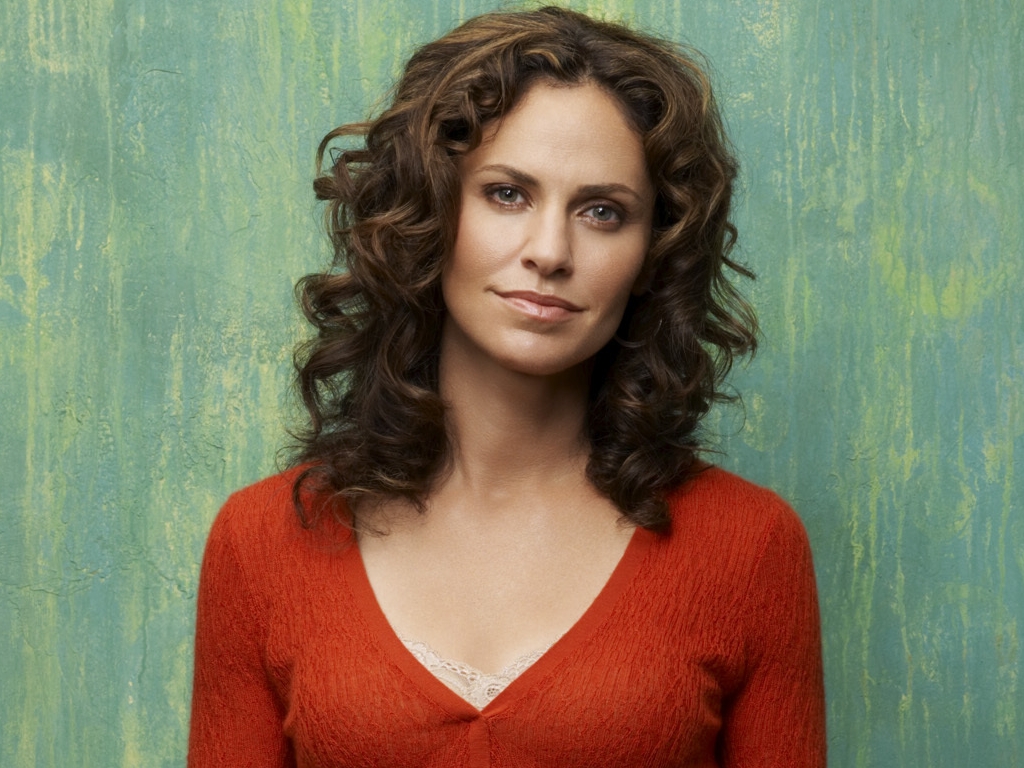
Amy Brenneman adds both luster and depth to the female characters she portrays, whether on stage, television, or in film. As she has gained acclaim and influence through a succession of hit TV shows, from "NYPD Blue," to "Judging Amy," and "Private Practice" she has been able to be selective about her projects. By design or empathy, her work has increasingly been in collaboration with women writers, and helped raise their acclaim and influence.
Currently, in August 2013, she is in the Geffen Playhouse's West Coast premiere of Gina Gionfriddo's Rapture, Blister, Burn (through September 22), in the central role of Cathy, which she created in the play's 2012 off-Broadway premiere at Playwrights Horizons. Brenneman first spoke to Theatertimes in June 2008 on the day before her 44th birthday and a week before the rebroadcast of the LA TheatreWorks taping of Caryl Churchill’s Top Girls, in which she performed the central role of Marlene.
What follows is a "15 Minutes with . . . " drawn from our two conversations, in which she chats about both plays, as well as the women who wrote them and her recent television programs – "Judging Amy" writer-producer Barbara Hall and "Private Practice's" Shondra Rhimes.
THEATERTIMES I feel the biggest achievement of Rapture, Blister, Burn is that Gina completely engaged the audience during what, in the first act, is largely a graduate school colloquium on challenges to women's self-actualization.
BRENNEMAN I totally agree that it's all about the writing, especially in the first act. My journey with it was that I was emotionally connecting all over the place in the first act, which makes me laugh now because now I'm more in Cathy's skin, the [rational] educator, provocateur, person of ideas. The first act is all about the ideas and the second act is how human beings behave. And what's funny is the discrepancy obviously.
Coming from television, this was just a lovely palette cleanser to remember how much fun it is to have words in your mouth, In television, unless you're Aaron Sorkin or a couple other people, a three-line speech is considered overwritten – and not incorrectly. Film is a much more visual medium, where it's all about what you're thinking and how you're behaving, less about the language.
THEATERTIMES Since [reviewing it] I've read that one of Gina's interests in the content was how Internet porn proliferation, which is more a male preoccupataion, is harming relationships and by extension culture and society. That's big, but I think she has even more going on here.
BRENNEMAN Yeah, I agree. I think all of that research, or a lot of it, went into Avery and her point of view of what it's like at her age. But I think it became much bigger and with the inclusion of parts of Gina's own story, as a woman in her 40s she decided to become a single mom, and Gina herself is very, very close to her mother, so the story just got bigger and bigger and bigger. Now she's got these great mouthpieces for all these different points of view.
Right – Brenneman as Cathy with Virginia Kull as Avery in Rapture, Blister, Burn – Photo: Michael Lamont
THEATERTIMES That's something else Gina handled very well: distinguishing the generations without any clichés, but keeping the women clear individuals who nevertheless represent both the continuity and the changes that have occurred.
BRENNEMAN Well, you know, it's funny. I've been doing interviews, and I've done a couple of the morning talk shows and I just contextualize it because you want to have an elevator speech. And I told my husband, I'm not satisfied with any elevator speech because I really shy away from the word feminism for all the reasons she explores in the play. I feel like we need a new word. Just like I think we need to throw out the word Christian. I think it doesn't mean anything anymore. And feminism is sort of the same way.
I think the bottom line is Gina loves all these characters and you feel it. She just has great affection for all of them. They all have wisdom. Even after a year and a half of hearing this play I hear new things. And everyone, all five of the characters, have a moment where I think: You know what, she – or he – is right about that. They really have a bead on this point. So I think that because she so doesn't want to pick a fight, but actually explore, that she blows up the polemics, and does it in a very playful way.
I mean I also think that, for all the reasons that I could articulate right now – I have a 12-year-old and an 8-year-old – that the older generation and the younger generation have freedom of behavior and freedom of thought that frankly people in their 40s can't have because you're modeling for children. You're not as free. So I think we start out super free and then we commit to things and maybe a behavior, and then hopefully things work out and we become free again.
THEATERTIMES Do you feel there's a female consciousness within Rapture , in the writing – whether it's choice of words, or subjects, characterizations or any of that?
BRENNEMAN I do . . . in the best way. I think the reason people respond to this play, that men and women respond to it, that different generations respond to it, is because Gina is not afraid to spoof it all, and she has this incredible balance of being able to make fun of stuff and love it at the same time. And if that's female . . . I do tend to think that is a little bit more female: to hold disparate ideas simultaneously, and breathe through it, you know. I think neurobiologists would sort of agree with that, that the female mind tends to hold onto dichotomy with no easy answers. That kind of thing. I don't think of female consciousness in terms of sentiment. One of the things I just always loved is that, as much as Cathy sort of falls apart once her heart gets involved, she's still not dying to become a biological mom. I think that's a story we've heard a lot and she's different in that way – it's one of things she wants, but it's not paramount, you know, and Gina would say the same thing.
So, yeah, I think that like [writer-producer] Barbara Hall popped my cherry on "Judging Amy," that was when I first felt like, Oh My God I've been spending most of my time either trying to figure out what Shakespeare wanted to say, like you're working with a writer who's no longer with us, or like in Steven Bochco-land trying to explain the female experience to a male writer, which I was happy to do. But that joy when Barbara started writing for me, with so many things unsaid and so many more mutually understood, we were able to start our collaboration at a much better level. That was interesting and that's something I've been blessed to continue in dealing with people like Shondra and Gina.
You may know this story, but before I ever laid eyes on this play there was a version where Cathy and Don and Gwen were in their 30s. Tim Sanford at Playwrights Horizons was so wise and said they have to be in their 40s because 40s signals mortality. It's the end of fertility. Especially these days, the 30s are like the 20s where you can do anything. There's the biological stuff and I think that's the whole trigger of the play. The whole trigger is Alice's heart attack and it becomes a running joke because obviously she's so healthy, but for whatever reason it's like my mother will die and I have no siblings and I'm utterly alone and that's the existential trigger.
But I really loved the play: I had lived it because I never really worked away from my kids because I've been really lucky and have been able to be here in L.A. So [for the New York production in 2012], I had to figure out how that would work with my husband. It's like the play says, you can't both go first. It was a very active engagement with the scenes of the play.
The other thing was, I didn't know Becky Shaw [Gionfriddo's earlier, Pulitzer-nominated play, REVIEW] and I didn't know Gina, and I wanted to make sure that the playwright didn't want the feminist to be punished. This stuff is so tricky. So I got on the phone with her and I liked her immediately and I felt a lot better. I never asked for script changes, but the end did change in very subtle ways.
In the original, there was language about finding Cathy a guy. Mom says I'll give you two years and Avery says oh we can find a guy in two years. So the end game was still finding a man for her. So that was something that we toned out. And then she wrote my little speech about realizing I was loved by my mother. There's now that wistfulness about it. Cathy feeling, Okay, who's going to love me [if Alice dies]. But I always find it really beautiful that, this thing that I've been wanting, the experience of being loved, I have been loved. And the audience, because Alice is a great character and they love Beth Dixon [who plays Alice], they feel that love. So, it's a very cool moment at the end: Whatever happens, I have the wind beneath my wings in a way that I was not even aware of consciously. And, yes, that will be sad when it goes but how extraordinary that it happened at all. I love that moment: Alice comes in with her martini and I just feel like Cathy is looking at her with such new awareness. Alice is doing the same stuff that she always does, and yet now it's so full. So full.
And then the last speech that Beth delivers. You think you're going one way and then, right at the end . . . It's classic Gina.
Another of the writers we discussed in 2008 was playwright Julie Marie Myatt, whose Someday had just premiered at Cornerstone Theater, a unique company that Brenneman co-founded with Harvard classmate Bill Rauch. Had she seen the production?
BRENNEMAN I did and was very blown away. I was actually part of one of the story circles for it. Sometimes Cornerstone adapts a show and sometimes they create an original piece. And I have lots of feelings and have experienced a lot about this kind of thing and so for the first time I was a participant at a story circle, and Julie came to my house with a bunch of my friends and it was really cool. It was probably the only way that I hadn’t participated in a Cornerstone show, to be a resource in this way. I actually felt very connected to that show.
THEATERTIMES I think Julie's one of the best writers out there. She taps into the mystery, whether it's Someday, or My Wandering Boy [REVIEW], orWelcome Home, Jenny Sutter [REVIEW], or the more recent The Happy Ones [REVIEW], she always gets at an unspoken world that lies between the lines.
BRENNEMAN I was almost in Wandering Boy. It was a very sentimental moment where I thought, ‘Oh, Bill, you’re going to Ashland,’ and I wasn’t working, although I had some things on the back burner. But, you know, to make the schlep . . . .
THEATERTIMES Well, Beth Ruscio did a great job with that part. So Bill and Julie were well served. And, speaking of well-served, and sequeing back to Top Girls, you served Ms. Churchill well in the LATW recording. Another strong female writer with a wholly different take on things. Was it a challenge transferring it to radio and going without the visual element?
BRENNEMAN It’s funny, I don’t really think about the radio aspect. For me it was just a very safe way to explore really great literature.
THEATERTIMES In reviewing the 2008 Broadway revival, Ben Brantley pointed out that Top Girls has this incredible first scene with all the colorful women from across centuries coming together for a contemporary dinner party, and then you go into the comparatively drab modern stuff. But it seems that radio, where costumes and characters and structure are somewhat sublimated to the words and language, might help mitigate that issue. Certainly Churchill was aware of what she was doing. There is a lot going on in those latter acts. Do you remember it well enough to recall if it seemed to work well in that way?
BRENNEMAN Yeah. I knew that I liked Churchill’s work, but when I sat down to first read it, and got into that first scene I thought, my God what is going on? [laughs] And then going into the rest of the play, on the surface it’s just so different stylistically and everything else. But, you know, the more that we did it, the topic of conversation that is set up in the first scene really carries you through. And, I benefited because Marlene is the same gal in the second act, where the other actresses become contemporary characters after the dinner scene.
I would say there definitely are times during our process where we wished that we had the costumes and we wished that we had the visuals, because there are visual gags if you will. There’re obviously visual cues of the ethnicity and the time periods of these characters. So, in some ways it was mitigated and in some ways we had a bigger challenge to communicate all of it.
When I did [Arthur Miller's] After The Fall, Susan [Lowenberg, LATW's producer] called me up to ask and I just said "Yes." I didn’t know the play. It’s almost always a really wonderful experience because in the best sense, the expectation for exploration and excellence is really high, and they’re not going to let you crash and burn.
Also, I think the audience knows that we’ve only gathered together for five days. They obviously see us with our scripts in hand. And rather than that taking away from that experience, that’s what the people who come really enjoy: to feel a part of the creative process. It's just such a wonderful way to just dive deep for a couple weeks.
THEATERTIMES Well it's been great talking to you – again. Maybe we'll do it again in another five years!
BRENNEMAN All right! Thank you. Thanks for talking to me.
THEATERTIMES Thank you! Have a great week and rest of the run. Bye.
BRENNEMAN Bye now.