
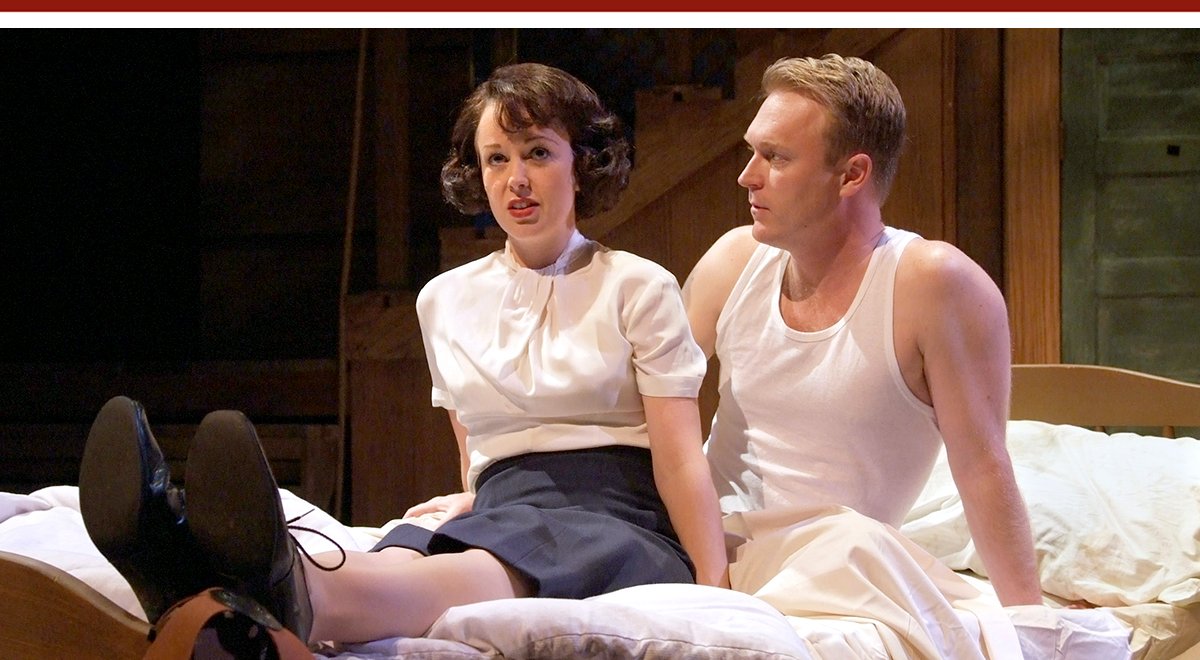

Adam Kulbersh, Joan Rivers and Emily Kosloski / Michael Lamont
Facing the facts
Putting the goods up front has always worked for country-pop icon Dolly Parton. And, true to form, 9 to 5: the musical wastes no time in filling the Ahmanson Theatre with the nudging eighth-note thump of the 1980 film's title tune. Unlike the characters who sang it, the song rocketed to the top, taking the #1 spot on Billboard's pop and country charts and earning the singer-songwriter an Oscar nomination and two Grammy Awards. But thoughts that this musical version (through October 19) is resting on past laurels without anything new to back it up can be dismissed. Rich in talent and ideas, this 9 to 5 parallels the Parton lyric "don't judge me by the cover, 'cause I'm a real good book."
That opening song is the only "cover" in the show, directed with firm control and great originality by Joe Mantello. Nineteen new songs weave through a real good book by Patricia Resnick, who scripted the film. They include "Backwoods Barbie," a Parton mini-biography (with the lyric quoted above) that is the title track of Parton's February 2008 CD.
The story is set in a microcosm of the American workplace at the dawn of the 1980s. Typewriters clack away as dinosaur copiers chew documents. An aloof executive, Franklin Hart, Jr. (Marc Kudisch) terrorizes his employees, cheats on his wife Missy (Lisa Howard), and hits on Doralee (Megan Hilty), a hard- working staffer who happens to enjoy looking like a showgirl. While she forsakes easy advancement by rejecting Hart's advances, he spreads rumors to the contrary through his devoted office manager, Roz (Kathy Fitzgerald). That isolates her from the other women, including the leader of the workers, Violet (Allison Janney). Violet, three years a widow and with a teenage son to raise, regularly sees the promotions she has earned go to men she has trained.
The show begins as Judy (Stephanie J. Block) arrives in an outfit Polyanna would have worn (William Ivey Long created the beautiful period ensembles). Making it clear that unfair practices extend from boardroom back to bedroom, the script introduces a divorcing Judy, cut loose by a husband seeking younger, looser women. She, Violet and Doralee will eventually split their differences and become friends as they share Cannibis-fueled fantasies of smoking the boss. Unintentionally, one of the plans gets played out and they spend Act II trying to avoid getting caught for kidnapping.
Like the movie, the musical slips its message about workplace inequalities and indignities suffered by women into a universal message. The song, in fact, is a non-discriminatory blast at exploitation of workers of both sexes. Thanks to Kudisch's wonderful characterization, Hart is hateful, but with just the right cartoon shading. Maybe it's too many performances of Pirates of Penzance on Broadway, but his style, especially in his introductory "Here for You," suggests the glinty-toothed smarm of Disney's Captain Hook. That the sycophantic Roz looks like Smee and ìViolet'sî fantasy is played out in Snow White dress and Minnie Mouse hair bow, are further invitations to Disney world.
Musically, Parton works her crossover magic with country, Nashville and pop styles. She is well-served by Stephen Oremus' crisp direction of one of the finest pit bands in memory, richly delivering the range of styles from lush ballads to a funky instrumental break that would make Quincy Jones proud.
The cast is excellent down to the last dancer, and though Janney may not be a Broadway singer, she acquits herself just fine. Mantello's decision to trade off for a lead grounded in acting (and with "West Wing" celebrity) is welcome. Like all the leads - including Fitzgerald - she makes the most of the showcase solos Parton has created. In addition to her "Barbie" number, Hilty gets a domestic pop duet with her husband (Charlie Pollack) that could justify Parton reuniting with the Gambler to chart those ìIslands in the Streamî waters. Block's self-determination epiphany, "Get Out and Stay Out," is the kind of great stand-and-deliver Broadway moment that builds to an audience-tingling climax. As the show really gets its legs, the audience may well find its and give her a mid-act standing O.
While the women's fantasy numbers - including one for Roz – are what Broadway audiences pay to see, they come at the expense of neglected story development. However, with a Scott Pask set that seems to reconfigure as quickly and magically as a kaleidescope - thanks in part to a massive diamond vision screen for an upstage wall - it's a gripe that hardly seems worth making. (One typically ingenious backdrop is a forced-perspective, black-and-white world right out of a Stanley Kramer film.)
But for all her charming music, Parton owes her success to Mantello and choreographer Andy Blankenbuehler, who pass control of the action back and forth in a fluid exchange. Blankenbueler inserts plenty of story-specific gestures into his moves while seamlessly incorporating phones and other office machines into the movement. Montello beautifully manages the overlapping time frames: providing a sense of the mini-arc of a nine-to-five workday (beginning with the percussive swatting of morning alarm clocks); the longer arc of Judy's beginning career; and the play's kidnapping plot (including a ìwhere-they-are-nowî epilogue that sums up entire lifespans).
While the show's office equipment may be a thing of the past, office gossip and sexual politics are not. Parton and Resnick surely don't want to suggest that they are or ignore a chance to say they still need addressing. So, they take advantage of a scene in which, under Violet's temporary management, the company has undergone some minor progressive changes. It's a quick salute to acknowledge we're on the right track. It may be only a momentary tie down to the real world, but it's one more good reason to leave 9 to 5 feeling good.
top of page

Kirsten Potter and Brendan Ford in Red Herring / Ed Krieger
If the Shue fits
In Be Like Water, receiving its world premiere at East West Players (through October 12), playwright Dan Kwong, whose primary credits are as a performance artist, reveals an ability to adapt the huge issues (racism, mother-daughter stalemates, application of ancient wisdom) to living-room scale. He balances these disparate dimensions so that the expansiveness, danger and instruction of the unknowable elements of his story are just as active in the day-to-day trials of these familiar family characters.
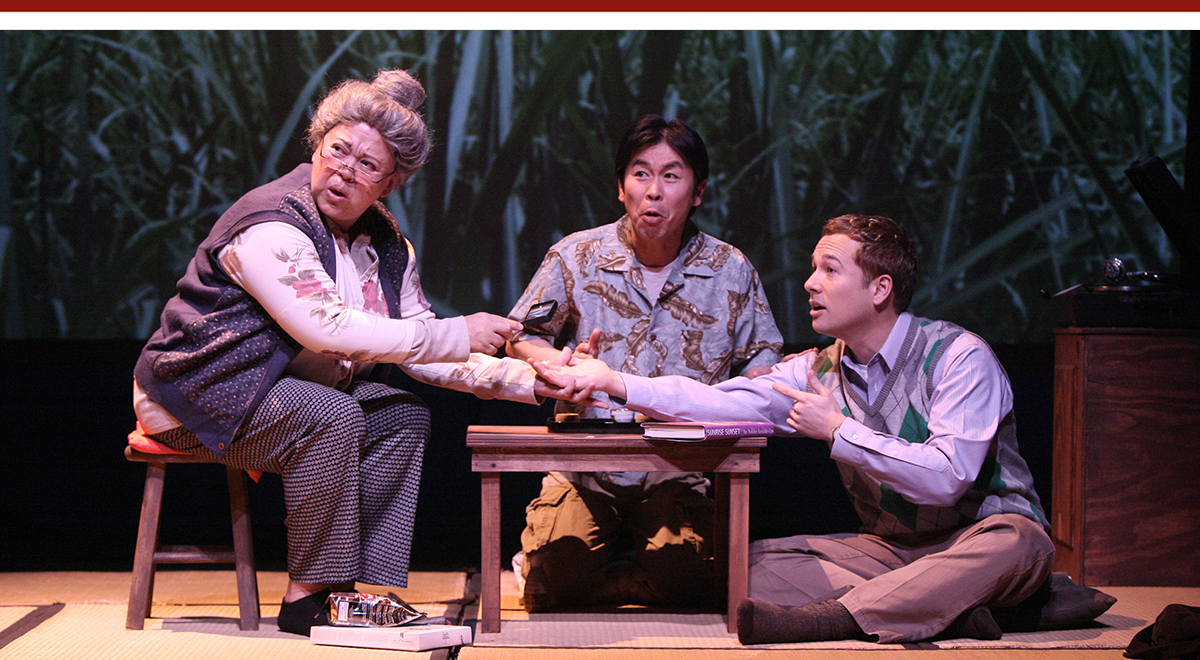
Director Chris Tashima has accepted Kwong's challenge to find four teenagers who can carry most of the show's weight. The toughest roles are the play's lead, Tracy, played by Saya Tomioka, and her friend played by Shawn Huang. For the most part they hold her own. Tomioka is good as the pivotal Tracy. She hasn't figured out how to modulate her big fights with her mom into something more than screaming. And all the kids seem blissfully unaware that the pervasive attitude of sarcasm (as in, "hel-LO") developed since the '70s. It's a contemporary cliche that would be wise to lose. But these are clearly dedicated performers and nuance will come. Fortunately, she is sharing the stage with one of the most wonderful characterizations seen this year.
As the Ghost of Bruce Lee, Cesar Cipriano turns what could be a poster-thick movie star portrait into a tribute to the actor and all the Asian American teens who saw in him a powerful, uplifting on screen reflection. Though Lee's movies never merited more than a B, the star was by default the A-list Chinese actor in America. James Hong, Jack Soo and Pat Morita weren't about to challenge Stallone, Norris and Reynolds in the testosterone department. The emergence of Lee, even in his tragically short life (mirrored by the short life of his son Brandon, who like Dad died just before his biggest film was released), gave young men - like Kwong, one assumes - reason to stride out of a theater with head high.
Cipriano looks like Lee, moves like Lee (at least enough to convince the uninitiated), and is clearly a trained dancer - which adds precision to Kwong and Tashima's big theatrical moment. Also, he delivers his aphorisms with a mix of the ancient sage and the deadpan comic, leaving just enough crack between the two to laugh at himself.
Tracy is an only-child daughter of a Chinese-American father (Michael Sun Lee) and Japanese-American mother (Pam Hayashida). Kwong even manages to encapsulate the Sino-Japanese issues of World War II into this relationship, with references to the occupation playing out in the couple's obvious willingness to overlook the brutalities.) Tracy is a tomboy. It's 1978, and disco is setting the style, and style is seeming very shallow. (Dave Iwataki creates a time-travel sound survey.) Tracy's best friend, a diminutive classmate saddled with the outsized name of Bruce Lee (Huang), is not a fan of the film star, but instead a fan of the dance craze. (Speaking of anachronisms, Lil Lee carries a personal stereo, like a Walkman, which wasn't even introduced in Japan until 1979; Tracy switches off her TV with a remote, which were hardly the stuff of poor kid bedrooms back then.)
Together, Tracy and Bruce keep each other from being friendless. Representing Ms. Perfect is Tina (Ariel Rivera), also of Japanese-American descent. She's a model citizen in the eyes of Tracy's mom because she is always dressed like a lady, and participates in school projects.
Part of the non-ladylike behavior that drives Tracy's mom nuts is her study of - and proficiency at - Kung Fu fighting, something her father tacitly encourages. It has made her a schoolyard force to be reckoned with. The play's lone white kid, Jeremy (Jonathan Decker), embodies racism. He lays on the epithets with such abandon that it won't be surprising if a folding chair comes flying out of the audience at him during a performance. Understandably, when Tracy can no longer take the taunts, she lets him have it.
In something between a hallucination and a visitation, Lee's Ghost appears to Tracy to offer guidance. He is a Sifu, a teacher. In accordance with the old Taoist lesson to "be like water," Lee has attained this afterlife travel pass through understanding of the great teachings. How he arrives is another subtle comic device that the team take advantage of, aided by Alexander Gao's projections, in an example of how East West continues to expand its limited stage. (Though projecting the television show Tracy briefly watches seems like a missed opportunity.) Lee explains to Tracy why water,:which seeks the level and flows around immovable objects, is to be emulated.
The nicest moment in the show, which Kwong earns through the steady, honest build of his plot and characters, is a coming together of the sacred and the profane of Kung Fu and disco. Here the Ghost of Bruce Lee and the young, somewhat nerdy Bruce Lee gradually merge fight moves into dance moves and vice versa. It's an original moment that touches this show with magic. Kudos to Diana Lee Inosanto and Ron Balicki, who contributed the martial arts choreography, and Blythe Matsui, credited with the dance moves.
Much of the musical memories, however, come to cover scenery shifts by the busy actors that are adding time to the show and should be refined by Tasumi and set designer Akeime Mitterlehner. Given the great projection screen to help establish location, some simpler piece that doesn't require so much resetting should have been employed. If there's one tip the set design needed, it's the play's title. By being more fluid, the play would also benefit from a Western cliche: less is more.
top of page

Denise Moses, Joel Polis, Chris L. McKenna, Emily Eiden and Steve Vinovich / Kreiger
Logan's Run
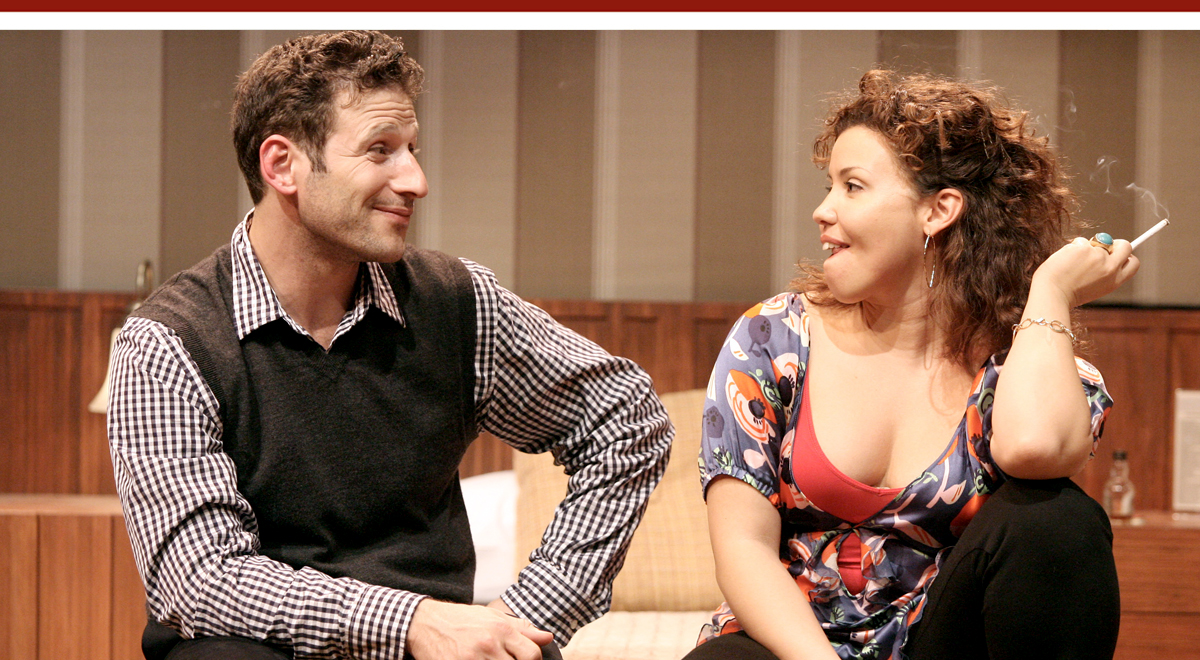
The character of self-absorbed TV actor Curt Logan may have been miscast for the play within Tom Dudzick's backstage comedy Don't Talk to the Actors, but Steve Vinovich is spot-on to play him. The Laguna Playhouse West Coast premiere (through October 12), is a one-dimensional vehicle that works well in the hands of Rick Sparks' six-member cast. But Vinovich gets a role that is pitched straight for his wheelhouse. As a result, he knocks it - and the production - into next week.
Jerry (Chris L. McKenna), a Buffalo bank teller moonlighting as a playwright, is snatched from community theater celebrity by a chance meeting with a Broadway producer. Don't Talk begins as he and his fiancée Arlene (Emily Eiden) arrive in the dingy New York rehearsal room to which his play, a portrait of his parents entitled The Piano Tuner, has attracted a director from Chicago (Joel Polis), Broadway's "most sought-after" stage manager (Denise Moses), and the two actors: Beatrice Pomeroy (Eileen T'Kaye) and Logan.
Dudzick, who based this script on experiences with his own breakout play, Greetings, initially teases with big issues of chance versus determinism in a neatly rendered distinction between luck and miracles. But, ultimately, it's just groundwork to help excuse the dropping at curtain of a heavy-handed deus ex machina. The happy ending falls with a leaden desperation more at home in the fantasy films of the Depression-era.
By that time however, we've had our fun and are grateful for another chance to see Vinovich give another empty vessel the carefully crafted disguise of sincerity. Like comedy's great male lugheads, Vinovich creates an selfish buffoon we can't help loving. In the middle of serious discussion, what seems to be a deeply held conviction will lose his interest as easily as his LBJ grins slides from his face.
As the awestruck girl in the big city - doubly burdened by a childhood infatuation with Logan - Eiden shows off more than she could in her small part of Taking Steps at SCR last June. She moves effortlessly from unyielding girlfriend insisting Jerry be realistic to moon-eyed pool of jelly when Logan walks in the room. Polis, a journeyman with great instincts, becomes the show's anchor, and with McKenna, one of its two straight men. They admirably do their jobs and let the others - including Moses' depiction of another lunatic stage manager, and T'Kaye's thankless role as the less-than-funny co-star Pomeroy - get the laughs.
And there are laughs, mostly actor driven and certainly plenty for those with a working knowledge of theater. Dudzick can thank Sparks and company - including designers Bruce Goodrich, Julie Keen, Paulie Jenkins, and David Edwards - for making it real, fun and real fun.
top of page
Rosalind Chao, Marc Feuerstein / Michael Lamont
The rake's wake
By 1982 it had been 30 years since a handful of plays had placed Arthur Miller atop the list of American dramatists and 20 years since divorce from a handful named Marilyn Monroe had ended five years atop America's all-time female sex icon. On one hand Miller was looking to explore new forms of drama. On the other, he was haunted by the now-mythic form of an ex-wife who, 18 months after their marriage ended, had ended her life.
Those preoccupations form the ill-fitted hemispheres of Some Kind of Love Story, a one-act making its West Coast bow 26 years after Miller staged its premiere in New Haven. Michael Arabian directs the Hayworth Theatre production, which continues through August 31.
Miller has acknowledged his conscious motivation behind writing this play and its companion one-act, Elegy for a Lady. "[They] are of a different form than I've ever tried before," he told Matthew Charles Roudan in 1983. "Some Kind of Love Story concerns the question of how we believe truth, how one is forced by circumstance to believe what you are only sure is not too easily demonstrated as false."
Unfortunately, that explanation only confuses the issue. Not only is it clearly a verbatim transcript, which can make the best interviewee sound like Cheech or Chong, it sounds like a writer still fumbling after a phantom form. Not surprisingly, Arabian and his two-member cast - Beege Barkette as Angela and Jack Kehler as Tom _ all seem to have been dumped without a map into the show's apartment bedroom set (a surprisingly impersonal example of Prop Storage Chic by the usually resourceful John Iacovelli).
Miller's experimenting has done little more than pull the rug out from under his actors and audience.
It's the middle of a spring night in 1962, not coincidentally a few months before Monroe's suicide. A distraught Angela, unmade-bed sexy despite a new shiner from a man who has just left, is now awaiting the arrival of Tom, a 24-year NYPD veteran who became her lover while investigating a crime that she had witnessed. Tom still believes the case closed after an innocent man was convicted. He also thinks that Angela is hiding some fact that can free the wrongly imprisoned man. Unfortunately it, like her feelings for Tom and any hope for coherence in this story, are buried under her many layers of mental instability. Between her exorcising multiple personality demons and exercising her sex-for-money machinations, what she says is always suspect. (Even if Tom got something, it's unlikely her word would stand up in court, given her mental illness and history of bedding -- so she claims -- many key figures in the case.)
Still, hope of righting this injustice is Tom's stated reason for again leaving his wife's bed and risking a house call to Angela's. We begin to get the groundwork for a fascinating story about compulsive behavior, addiction to the wrong people, truth, lies and fantasy. Unfortunately, Kehler's cop is a theatrical flatfoot. If this play can work at all (and it apparently didnít in Millerís staging either), we need someone who can transmit this man's multi-leveled frustration, passion and anger. What Kehler offers is discomfort, weariness and some sense of moral indignation. He does offer anger. But the two or three times we see Tom's outrage, it explodes out of his placid demeanor like a monster bursting up out of a loch. It feels stagy and further hinders our engagement.
It must be reported here that press night was twice delayed a week, a not inconsequential bit of evidence in determining what has been committed here. That clue may or may not connect to Kehlerís half-dozen word stumbles _ roughly double this reviewer's (generous) allowance for a performance (even by a Non- Equity actor). For her part, Barkette also is asked to create a character with so much submerged and unexplained baggage that she is drowning in opportunities for overplaying. To her credit, she does not, except for scenes in which Miller and Arabian make her jump through multiple personality hoops. They don't really land, but she can be forgiven considering the general confusion of the enterprise.
Miller provided the opening tip to the personal dimension of this play by setting it just months before his ex- wife's death. Arabian closes the case with the second Angela costume he orders from designer Traci McWain. We won't spoil the moment by describing it. Let's just say it begs for a stiff breeze. But so does the cobwebby plotting of Miller's spider-and-fly tale. Whle an unusual amount of stage fog fills the house when audience members arrive inside the intimate Studio, it dissipates during the 75-minute show. Plenty of plot-fog, however, will be carried home by the audience.
A film noir version of the story was created by Miller in his screenplay Everybody Wins, starring Nick Nolte and Debra Winger. Those obsessed with solving the mystery of this odd one-act by the 1947 Pulitzer Prize-winner may want to investigate that work for clues to what happened here.
top of page
auren Kennedy, Sarah Stiles, Anneliese van der Pol / Craig Schwartz
Dressing Makes the Meal
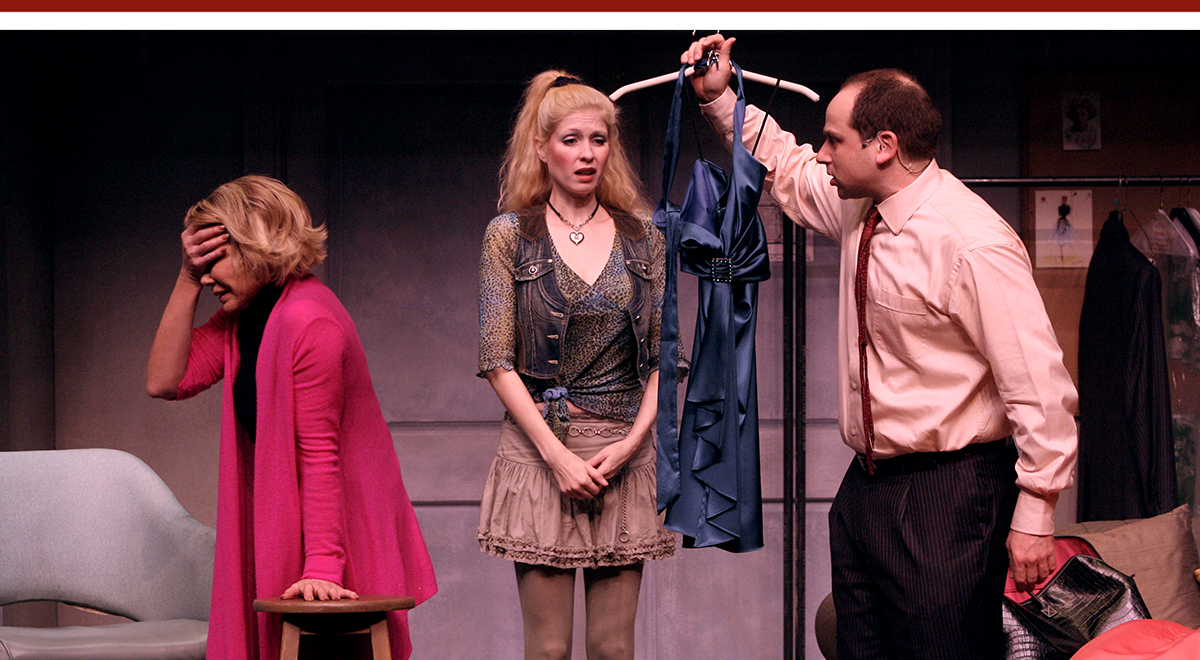
The faces in the mirrors of Vanities, a new musical at the Pasadena Playhouse (through September 28) are as captivating to the audience watching them as to the characters wearing them. In fact, in Judith Ivey's staging of this update by Heifner of his 30-year-old play, Lauren Kennedy, Sarah Stiles and Anneliese van der Pol are so engaging that we might all be forgiven for joining them in ignoring what is being reflected around them.
Heifner has moved from playwright to librettist for this expansion of a play that, despite critical snubbing in its January 1976 premiere, became one of Off-Broadwayís longest-running shows. With the collaboration of composer/lyricist David Kirshenbaum ("Summer of í42í), it has grown by 12 songs and 16 years.
We meet the three best friends as high school cheerleaders in Fall 1963, the football season of their senior year, as college sorority sisters four years later, and during a rocky get together unofficially marking their 10-year high school reunion. A 1990 meeting has been added as epilogue for a clearer and happier ending than had been left with the playís original conclusion in the 1974 scene.
The musical premiered under Iveyís direction at TheatreWorks in Palo Alto and is scheduled to begin previews on Broadway in February 2009. As with the increasingly sturdy California crop of Broadway- bound musicals, this one is ready for its close-up. Anna Louizos' set is rich and inventive. Joseph G. Aulisiís costumes remain appropriate as they change through the periods and John Marquetteís hair and wig designs vary just enough to remind us that these are, at their roots, conservative women. (Although, let the record show that Joni Mitchell's "Clouds," depicted on Maryís wall, came out in 1969, the year after that setís last scene.)
The women are stars and the performances are chameleonic without being obvious. They age before our eyes thanks to subtle acting and costuming. They create recognizable people with a layering of social enigma. While all three characters are from Texas, only Stiles slathers on the Southern accent. At times it sounds like it could be used in canning fruit and you just wish sheíd can it. She can also, occasionally, go shrill in her singing. But these are minor complaints on three performances that elevate the show.
As eye-catching as the women are, however, they can't keep us from eventually sensing that there's an "elephant in the room" that is not being addressed. It's the question of how Heifner thinks these three women represent the impact, value, place or appeal of social and self consciousness in the '60s. Raising the question of consciousness-raising may seem heavy-handed in a play that appears to ask us to be no more critical of its subjects than we would leafing through a friend's photo album. But Heifner and Kirshenbaum have clearly stuck things in the background of their snapshots.
For one thing, the original play's time frame is in sync with the cultural '60s as opposed to the chronological '60s: from the assassination of President Kennedy to the resignation of President Nixon. More importantly, the first three songs depicting the girls' high school self-involvement do provoke our curiosity about how these three will navigate the coming liberation movements. But just when it looks like the play is going to avoid the larger issues and keep it personal to them, that elephant is brought to the center of the room with the song "I Don't Wanna Hear About It."
This is a direct rebuke of social matters, coming as it does following the cancellation of a Friday football game the night of the assassination in nearby Dallas. They then lump in their desire to resist the protest songs of contemporary "troubadours," which is a clear reference to Dylan et al. This clearly establishes the front end of an arc in which they will get more or less aware of the world around them. But it is a bridge to nowhere. As opposed to a character like Forrest Gump, who went through a similar time period, was in on everything and wanted to be impacted despite his disabilities, these three invest their intelligence in their own lives, which are too often defined in relation or reaction to someone else (usually men).
Ivey has given this Vanities an appreciable and appreciated sense of restraint, which includes appropriately minimal choreography that is always welcome and always close to character. The music is reminiscent of earlier styles - one might imagine Manilow singing a number, the Fifth Dimension another, and in the pivotal "I Don't Want to Hear About It," which briefly skirts with the big "consciousness" question, the band could easily veer out of its opening eight bars into Jackie Wilson's Higher and Higher.
In the end, Heifner's play is about friendship and not a statement about social responsibility and the value of involvement in things bigger than ourselves. It wants to be, but seems to have run out of will. Fairly soon, the elephant wanders out of the room. Perhaps, the women's lack of involvement in the world around them is Heifner's way of explaining a contemporary social mystery. It provides a profile of the people needed to elect one of the characters' fellow Texans to two four-year terms as President. Now it makes sense that the albatross elephant we've had in our living rooms for the past eight years got there because folks whose social awareness stopped with high school socials, mistook popularity for progress and made someone best suited for enlivening a Grand Old Frat Party into a world leader.